

There is something quietly powerful about a name whispered for the first time over a newborn child. In Indian culture, that moment carries centuries of meaning, devotion, and identity. Hindi names are not simply labels. They are prayers, promises, and portraits of the soul wrapped in a few syllables. Whether drawn from the ancient Sanskrit texts, the flowing verses of the Ramayana, or the timeless poetry of Mirabai, every Hindi name carries a universe within it.
Hindi names have always served as bridges between the mortal and the divine. A child named Arjun walks through life carrying the legacy of the greatest warrior-archer in the Mahabharata. A girl named Kavya is already a poem before she speaks her first word. This is the magic that makes Hindi names so deeply beloved, not just among Indian families, but among parents around the world who are drawn to their musical quality, spiritual weight, and sheer beauty.
For writers, worldbuilders, and storytellers, Hindi names offer an extraordinary source of inspiration. Just as bold fantasy adventurers might seek out fierce minotaur names for their epic campaigns, a creator building an ancient civilization rooted in wisdom and myth will find that Hindi names deliver an authenticity that few naming traditions can match. They carry sound patterns that feel both ancient and alive, warm yet commanding.
This collection brings together over 200 Hindi names, organized by theme and meaning, to help parents, writers, and dreamers find the perfect name that speaks to the heart.
Famous Hindi Names From Literature and Mythology
Before diving into the lists, it is worth pausing to appreciate what great names have already given the world. These legendary figures show us exactly why Hindi names carry such extraordinary power.
Arjuna is perhaps the most iconic name in all of Indian literature. The third Pandava in the Mahabharata, Arjuna embodies discipline, courage, and the eternal struggle between duty and desire. His name, derived from the Sanskrit word meaning “bright” or “shining,” perfectly mirrors his role as a figure of radiant heroism.
Draupadi stands as one of the most complex and powerful female figures in Hindu mythology. Her name, meaning “daughter of Drupada,” grew beyond its literal origins to symbolize resilience, grace under fire, and unyielding dignity. She is proof that a name can become larger than its original meaning.
Rama, the divine prince of Ayodhya and hero of the Ramayana, carries a name so sacred that merely speaking it is considered an act of worship in many traditions. Meaning “pleasing” or “charming,” Rama has inspired millions of names across centuries and cultures.
Meera, the poet-saint who composed passionate devotional hymns to Lord Krishna, gave the world a name that became synonymous with spiritual love and creative fire. Short, luminous, and unforgettable, Meera remains one of the most beloved Hindi names for girls to this day.
Traditional Hindi Boy Names
These timeless names have roots stretching back thousands of years into Sanskrit literature, Vedic texts, and the great epics. They carry a noble gravity that never fades.
- Aarav
- Aditya
- Akash
- Alok
- Amit
- Anand
- Arjun
- Ashok
- Bharat
- Chetan
- Deepak
- Dhruv
- Gaurav
- Girish
- Govind
- Harish
- Hemant
- Ishan
- Jagdish
- Kailash
- Kartik
- Lalit
- Mahesh
- Manish
- Mohan
- Naresh
- Nikhil
- Omkar
- Pankaj
- Pranav
- Rajesh
- Rakesh
- Ramesh
- Rohit
- Sachin
- Sanjay
- Shiv
- Suresh
- Tarun
- Umesh
- Varun
- Vikram
- Vinod
- Vivek
- Yogesh
Traditional Hindi Girl Names
These names are drawn from rivers, flowers, goddesses, and the poetry of ancient India. Each one carries a grace that is both soft and enduring.
- Aarti
- Anita
- Anjali
- Anushka
- Archana
- Babita
- Bhavna
- Chaya
- Deepa
- Disha
- Geeta
- Heena
- Ila
- Jyoti
- Kamla
- Kavita
- Kiran
- Komal
- Lata
- Leela
- Madhuri
- Malti
- Meena
- Mira
- Neelam
- Neha
- Nisha
- Poonam
- Priya
- Radha
- Rekha
- Rita
- Ritu
- Sarita
- Savita
- Seema
- Sharda
- Sheetal
- Shobha
- Sita
- Sunita
- Sushma
- Usha
- Vandana
- Veena
Cool and Unique Hindi Names
Modern Indian parents and storytellers are increasingly drawn to Hindi names that feel fresh, distinctive, and layered with meaning without being too common. These names blend ancient roots with a contemporary spirit. If you enjoy exploring equally distinctive naming traditions, a browse through elegant French names can offer fascinating comparisons in how cultures pour identity into language.
- Aahan
- Aahna
- Aakav
- Aarush
- Abhiraj
- Advaith
- Ahana
- Ahir
- Ainesh
- Aivaan
- Ajanma
- Akira
- Ameyaa
- Anvay
- Araan
- Aradhya
- Ardra
- Arnesh
- Atharva
- Avaan
- Avni
- Ayaan
- Bhavik
- Brihat
- Chahna
- Chiraag
- Daivat
- Darpan
- Devraj
- Dhairya
- Divit
- Ekaa
- Ekaant
- Elan
- Esha
- Gyan
- Hridaan
- Inaya
- Ishaan
- Ivaan
Warrior and Strong Hindi Names
In the great epics, warriors carried names that rang like steel. These Hindi names project strength, valor, and the kind of fierce determination that legends are made of.
- Abhimanyu
- Agni
- Bajrang
- Balaraj
- Bhima
- Chandragupta
- Dhananjay
- Durgesh
- Fieroz
- Gajendra
- Hansraj
- Indrajit
- Jaidev
- Jaiveer
- Karan
- Kratu
- Kshatriya
- Mahaveer
- Nand
- Pratap
- Prithviraj
- Raghuveer
- Rudra
- Sahdev
- Samarth
- Shaurya
- Sher
- Surya
- Tej
- Ugresen
- Veer
- Vijay
- Vikramaditya
- Yudhishthir
Royal and Noble Hindi Names
For characters born to rule, or children whose parents dream of a life of greatness, these names carry the unmistakable weight of royalty and refined nobility.
- Aishwarya
- Ananya
- Aparajita
- Chandrika
- Devika
- Divyaraj
- Indira
- Ishwari
- Jayanthi
- Kalyani
- Kumari
- Maharani
- Mrinalini
- Nandini
- Padmavathi
- Rajkumari
- Rani
- Saraswati
- Shakuntala
- Vasudha
- Yashoda
For male royals:
- Chakravarti
- Dilip
- Harshvardhan
- Mahendra
- Nripendra
- Rajendra
- Samrat
- Siddhartha
- Viraj
- Yuvraj
Hindi Naming Traditions and Cultural Meaning
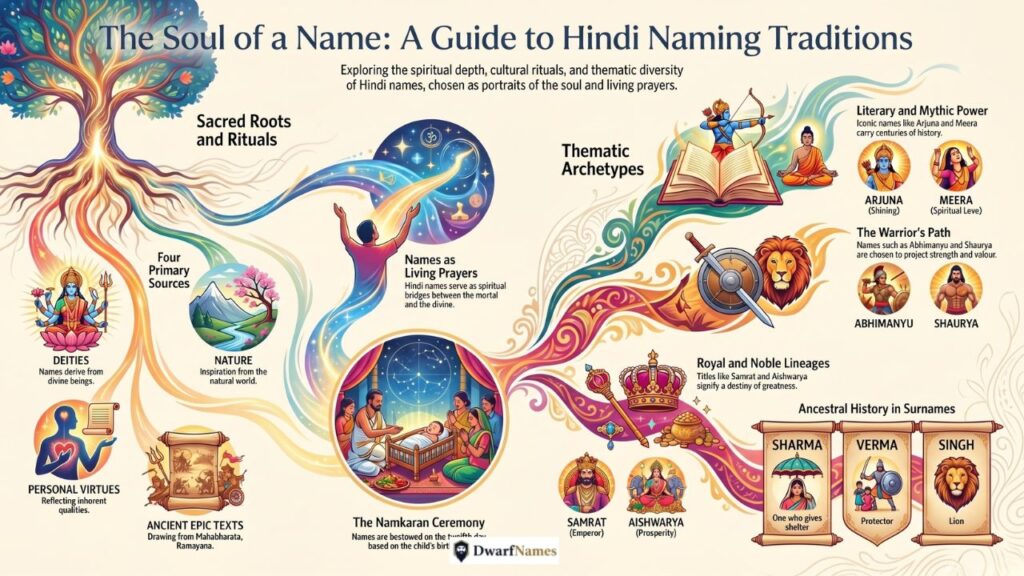
In Hindi culture, the act of naming a child is a sacred ritual known as the Namkaran ceremony, typically performed on the eleventh or twelfth day after birth. The name is chosen based on the child’s birth star (nakshatra) as determined by a Jyotishi, or Vedic astrologer. The first letter of the name is prescribed by the nakshatra, ensuring that the name vibrates in harmony with the cosmos the child was born into.
Names in Hindi tradition are rarely arbitrary. They are drawn from four primary sources: names of deities (Devnaam), names from nature (Prakriti), names of virtues (Gunn), and names from the great epics and Puranas (Pauranik). A child named Surya carries the sun itself in their name. A girl named Ganga is blessed with the sacred purity of India’s holiest river.
Family names, or surnames, also carry deep meaning in Hindi culture. They often denote caste origin, ancestral occupation, or home region. Names like Sharma (one who gives shelter), Verma (protector), and Singh (lion) are more than identifiers. They are ancestral stories compressed into a single word.
In storytelling and worldbuilding contexts, understanding these traditions allows creators to build naming systems that feel authentic and internally consistent. A village of farmers might carry nature-based names. A royal dynasty might pass down Vedic deity names. A warrior clan might take names meaning valor, fire, or iron.
Bonus: Hindi Surname and Clan Name Ideas
Whether you are building a fantasy world inspired by ancient Indian civilization or simply looking for compound names with a mythic resonance, these surname and clan name ideas draw from the rich tradition of Hindi compound naming.
- Agnivanshi (born of fire)
- Akashputra (son of the sky)
- Amritvahini (carrier of nectar)
- Aparajitavansh (lineage of the undefeated)
- Arjunputra (son of Arjuna)
- Chandravamsha (moon dynasty)
- Deenanath (lord of the humble)
- Devabhakta (devoted to the divine)
- Dharmaraksha (protector of dharma)
- Digvijay (conqueror of all directions)
- Durgaputra (son of Durga)
- Gangavanshi (children of the Ganga)
- Giridhari (one who holds the mountain)
- Indraputra (son of Indra)
- Jagatpati (lord of the world)
- Jyotirvamsha (dynasty of light)
- Kailashputra (son of Kailash)
- Lokapalaka (guardian of the people)
- Mahakaal (beyond time)
- Mahishasura (great warrior lord)
- Nandkishore (youth of joy)
- Navratna (nine jewels)
- Omvamsha (dynasty of Om)
- Panchaanana (five-faced one)
- Rajvanshi (of royal blood)
- Rudravamsha (lineage of Rudra)
- Sahasranaam (thousand names)
- Satyapalaka (upholder of truth)
- Shivputra (son of Shiva)
- Suryavanshi (solar dynasty)
- Swargaputra (child of heaven)
- Tejasvanshi (dynasty of brilliance)
- Trishulvahini (bearer of the trident)
- Vayuputra (son of the wind)
- Vedapalaka (guardian of the Vedas)
- Vijayavanshi (lineage of victory)
- Vishnuputra (son of Vishnu)
- Vrishakethu (banner of the bull)
- Yashovardhan (one who increases glory)
- Yuddhapalaka (guardian of war)
Conclusion
A Hindi name is never just a word. It is a root reaching down into the deep soil of one of humanity’s oldest living civilizations. Whether you are a parent searching for the perfect blessing to give your child, a novelist building a world where ancient wisdom still breathes, or a gamer creating a character whose name should resonate across every room they enter, this collection of Hindi names offers you 200 doorways into something extraordinary.
Names shape how we see ourselves and how others see us. They carry ancestral memory and future aspiration in equal measure. The Sanskrit traditions that gave the world names like Dhruv (the immovable pole star) and Saraswati (the flowing goddess of knowledge) understood this better than almost any other culture.
For writers crafting school settings and communities where names define belonging, the way characters in a story are named can transform the entire atmosphere, much like choosing the right school names sets the tone for an entire fictional institution. Every name you choose sends a message about who these people are and where they come from.
Choose a name that sings. Choose one that carries meaning. Choose one that, when spoken aloud, sounds like a small prayer offered to the universe. That is what Hindi names do best.
Frequently Asked Questions
What does the Namkaran ceremony mean in Hindi naming traditions?
Namkaran is the sacred Hindu naming ceremony held after birth, where a Vedic astrologer helps choose a name aligned with the child’s birth star.
Are Hindi names suitable for children outside India?
Absolutely. Hindi names are increasingly popular worldwide for their beautiful sounds, deep spiritual meanings, and distinctive cross-cultural appeal.
What is the most popular Hindi name for boys in recent years?
Aarav has consistently ranked among the most popular Hindi boy names, meaning “peaceful” or “melodious,” loved for its modern yet rooted feel.
Can Hindi names be used in fantasy worldbuilding?
Yes, Hindi names are perfect for fantasy settings rooted in ancient civilizations, offering authentic-sounding names with rich mythological and spiritual resonance.
What makes Hindi girl names special compared to other naming traditions?
Hindi girl names often carry meanings connected to nature, goddesses, and virtues, giving them a lyrical, timeless quality that feels both spiritual and poetic.
How do Hindi surnames reflect family history?
Hindi surnames often indicate ancestral profession, caste origin, or home region, turning a family name into a compressed story of generational identity.
Are there Hindi names that work for both boys and girls?
Yes, names like Kiran (ray of light), Arya (noble), and Jyoti (flame) are traditionally used across genders in different regions of India.