
The ancient kami of Japan do not sleep. They breathe in the mist rising from sacred mountains, whisper through bamboo groves, and stir beneath the surface of still black ponds. Long before the modern world carved borders into maps, Japanese mythology had already built something far more intricate — a cosmos teeming with thousands of divine beings, each one carrying a name that meant something. Not just a label. A destiny.
For writers, gamers, and worldbuilders, Japanese god names represent one of the richest veins of naming inspiration in all of world mythology. These are not arbitrary syllables. Every name in the Kojiki and Nihon Shoki — Japan’s oldest divine chronicles — describes a force, an essence, a spiritual truth. Amaterasu does not merely mean “sun goddess.” She is the light that rules the heavens. Susanoo is not simply a storm deity. He is the howling chaos that breaks against divine order. In Japanese divine naming tradition, the name is the being.
Whether you are building a fantasy pantheon, crafting a tabletop RPG campaign, writing mythological fiction, or simply searching for that perfect character name that carries weight and mystery, this guide offers over 350 Japanese god names drawn from mythology, ancient chronicles, folklore, and fantasy interpretation. We have organized them by theme, gender, function, and archetype with lore notes and worldbuilding tips woven throughout.
If you love mythology-inspired naming, you might also enjoy exploring Norse god names for a contrasting but equally epic tradition of divine naming across ancient cultures.
Famous Japanese Deities From Mythology & Fantasy
Before diving into the full name lists, it is worth meeting the divine figures who have already shaped storytelling, gaming, and popular culture. These names prove that Japanese god names carry extraordinary narrative power.
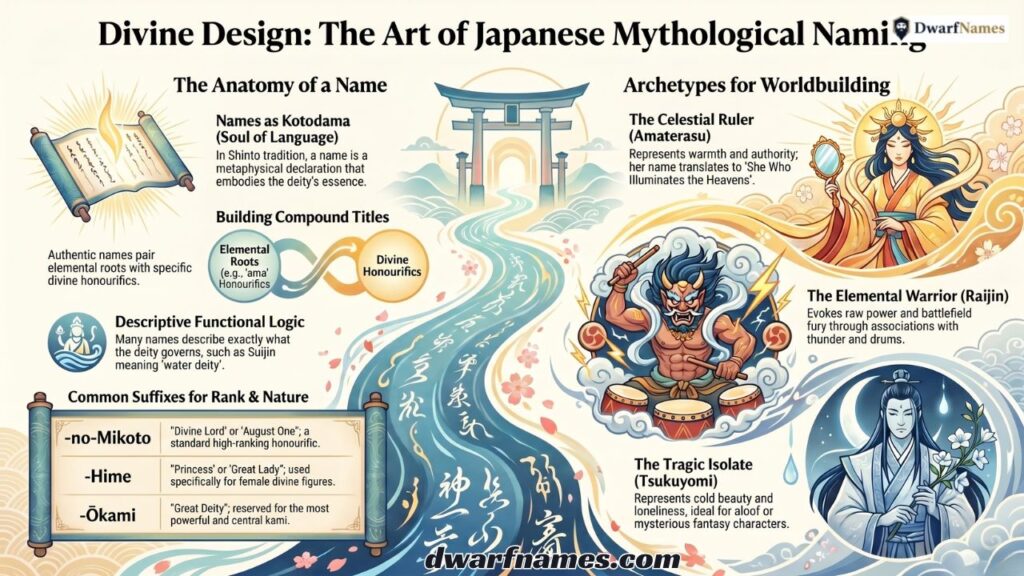
Amaterasu — Goddess of the sun and ruler of Takamagahara (the Plain of Heaven), Amaterasu is perhaps the most recognizable deity in all of Japanese mythology. Her name translates roughly to “She Who Illuminates the Heavens.” In fiction, she appears as the radiant wolf deity in Ōkami — one of gaming’s most beloved god-figures. Her name suggests warmth, authority, and unyielding celestial presence.
Izanagi — The “Male Who Invites,” Izanagi is a creator god who stirred the primordial ocean with a jeweled spear to birth the islands of Japan. His journey into Yomi, the underworld, to retrieve his dead wife is one of mythology’s most haunting tales of grief and divine loss. For storytellers, Izanagi represents the creator-father archetype in its most ancient form.
Raijin — The god of thunder, lightning, and storms, Raijin is depicted as a fearsome, wild-eyed deity beating drums to produce thunder. His name combines rai (thunder/lightning) and jin (god/spirit). In RPGs and fantasy settings, Raijin-inspired names evoke raw elemental power and battlefield fury.
Tsukuyomi — The Moon God, Tsukuyomi’s name means “Moon Reader” or “Moon Counter.” He is one of the three noble children of Izanagi, alongside Amaterasu and Susanoo. After slaying a food goddess for her offensive manner of cooking, Amaterasu refused to ever look upon him again — which is why the sun and moon never share the same sky. Tsukuyomi is a name drenched in cold silver beauty and tragic isolation, perfect for aloof, powerful fantasy characters.
These archetypes echo across many naming traditions — just as blood elf names often carry an ancient, otherworldly elegance, Japanese divine names balance beauty with fearsome power.
Male Japanese God Names
The male kami of Japanese mythology range from creators to destroyers, from gentle river spirits to thunder-hurling war deities. These names carry masculine force — thunderous, ancient, and vast.
- Izanagi
- Susanoo
- Tsukuyomi
- Raijin
- Fujin
- Takemikazuchi
- Ōkuninushi
- Kotoshironushi
- Takeminakata
- Ōyamatsumi
- Kagatsuchi
- Kukunochi
- Watatsumi
- Ryūjin
- Ebisu
- Daikoku
- Bishamonten
- Inari (male aspect)
- Saruta-Hiko
- Amenominakanushi
- Takamimusubi
- Kamimusubi
- Umashiashikabihikoji
- Amenotokotachi
- Kunitokotachi
- Toyokumono
- Uhijini
- Suhijini
- Tsunuguhi
- Ikuguhi
- Ōtonoji
- Ōtomabe
- Omotaru
- Hayatarou
- Kagutsuchi
- Toyo-Ukehime (male in some texts)
- Ōmononushi
- Kotarou
- Nigihayahi
- Yamatsumi
- Yamato-Takeru
- Ajisukitakahikone
- Futsunushi
- Amenokoyane
- Futodama
- Ame-no-Mahitotsu
- Ōhirume
- Ōmononushi-no-Mikoto
- Izanagi-no-Mikoto
- Ōnamuchi
Female Japanese Goddess Names
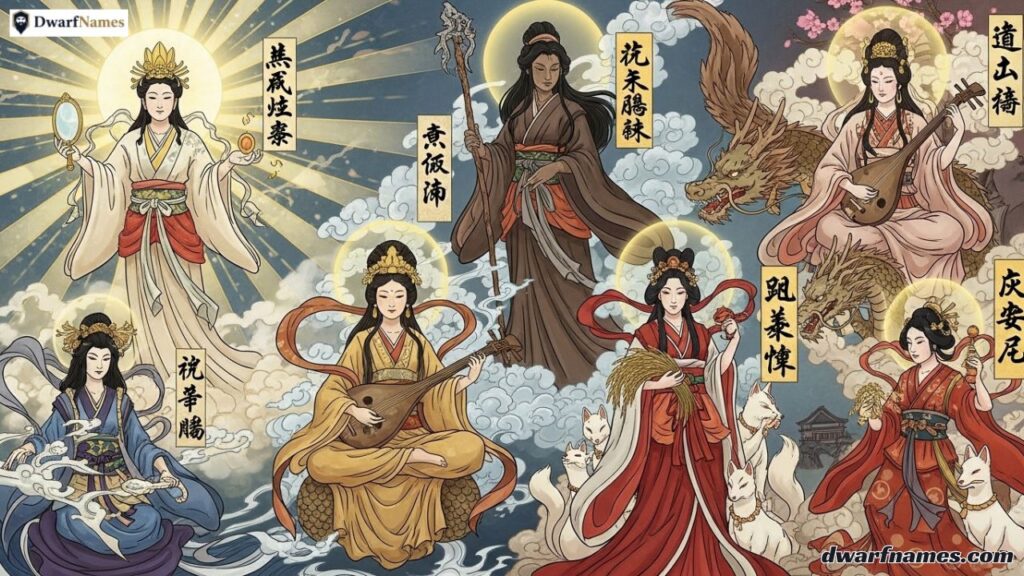
The goddesses of Japan are forces of creation, beauty, vengeance, mystery, and transformation. Their names often end in -hime (princess/lady) or -me (woman/goddess), but the power they carry is anything but gentle.
- Amaterasu
- Izanami
- Benzaiten
- Konohanasakuya-Hime
- Tamayori-Hime
- Ame-no-Uzume
- Kishijoten
- Wakahirume
- Toyotama-Hime
- Ukanomitama
- Shitateruhime
- Tagorihime
- Tagitsuhime
- Ichikishimahime
- Kukurihime
- Ōgetsu-Hime
- Kamimusubi
- Waka-Hirume-no-Mikoto
- Himegami
- Yamato-Hime
- Tsuruhime
- Saho-Hime
- Nunakawa-Hime
- Nakatsu-Hime
- Hime-Gami
- Inada-Hime
- Kushinadahime
- Asama-no-Ōkami
- Kagamitsukuri-Kami
- Nüwa (borrowed influence)
- Shirayukihime
- Tamahime
- Haniyasuhime
- Tsukisayu-Hime
- Yakami-Hime
- Ōtohime
- Ōmiya-Hime
- Wakumusubi
- Ashikazumi-Hime
- Tamatori-Hime
- Shinatsuhime
- Sagamehime
- Ōryu-Hime
- Shiokama-Hime
- Ōmononushi-Hime
- Funadama
- Torihime
- Mizuhame
- Kamikazehime
- Yamatohime
Cool and Unique Japanese God Names
Some names from Japanese mythology stand apart for their sheer sonic power or their deeply unusual mythological origin. These are the names that stop readers cold — names that feel ancient and invented all at once. They are ideal for fantasy character naming or for designing your own divine beings.
- Magatsuhi-no-Kami
- Nahobi-no-Kami
- Ohonahodori
- Amenotokotachi
- Takamimusubi
- Umashiashikabihikoji
- Tenjin
- Ryūjin
- Shōjō
- Tengu
- Raijū
- Oni-Kami
- Kuraokami
- Takaokami
- Mizuchi
- Nue-Kami
- Kirin-Kami
- Zashiki-Warashi
- Yokai-no-Ōkami
- Shiranui
- Tatari-Mokke
- Namazu-Kami
- Kōjin
- Kenro-Ji-Jin
- Suijin
- Takuhatachijihime
- Yamagami
- Kakuriyo-no-Kami
- Kunitsukami
- Amatsukami
- Tsurugi-no-Kami
- Tsuchimikado
- Shikigami
- Karura-Kami
- Fūjin-Raijin
- Suseri-Hime
- Hiruko
- Kotoamatsukami
- Mikafutsu
- Kaguya-Hime (divinized)
Warrior and Powerful Japanese God Names
For warriors, battle gods, and divine champions — these names carry the weight of divine conflict, lightning strikes, and sacred blades. Fantasy warriors, paladins, and warlords would bear these names into legend.
- Takemikazuchi
- Futsunushi
- Bishamonten
- Raijin
- Yamato-Takeru
- Marebito
- Ōkuninushi-no-Mikoto
- Hayatarou
- Tsukuyomi
- Nigihayahi
- Amenohiboko
- Jinmu
- Kashima-no-Kami
- Futaranoyama
- Ōnamuchi
- Tatarigami
- Kagutsuchi
- Takeminakata
- Ajisukitakahikone
- Ame-no-Wakahiko
- Kenro
- Arahabaki
- Funamusubi
- Haraedono
- Susanoo-no-Mikoto
- Futodama
- Amenokoyane
- Iwainushi
- Tatsu-Kami
- Ōtori-Kami
Royal and Noble Japanese God Names
Nobility in Japanese divine tradition often manifests as celestial hierarchy — gods and goddesses who govern vast territories of sky, sea, or underworld. These names carry the gravity of divine courts and heavenly palaces.
- Amaterasu-Ōmikami
- Izanagi-no-Mikoto
- Amenominakanushi
- Kunitokotachi
- Takamimusubi-no-Kami
- Ōkuninushi-no-Mikoto
- Ryūjin-no-Mikoto
- Tsukuyomi-no-Mikoto
- Ōyamatsumi-no-Kami
- Toyotama-Hime-no-Mikoto
- Konohanasakuya-Hime
- Ōtohime-no-Mikoto
- Watatsumi-no-Ōkami
- Takamimusubi
- Musubi-no-Kami
- Kamimusubi-no-Kami
- Kagamitsukuri
- Tamayori-Hime-no-Mikoto
- Ōmononushi-no-Mikoto
- Himemiko
- Saruta-Hiko-no-Ōkami
- Funamusubi-no-Kami
- Ōhirunome-no-Kami
- Ame-no-Koyane-no-Mikoto
- Futodama-no-Mikoto
- Tajikarao-no-Kami
- Ame-no-Uzume-no-Mikoto
- Ōnamuji-no-Kami
- Tenjin-Chigi
- Inari-Ōkami
Traditional and Classic Japanese God Names
These are the names that have endured through centuries of oral tradition, ritual prayer, and written chronicle. They form the backbone of Shinto cosmology and are the foundational vocabulary of Japanese divine mythology.
- Amaterasu
- Izanagi
- Izanami
- Susanoo
- Tsukuyomi
- Raijin
- Fujin
- Inari
- Ryūjin
- Ebisu
- Daikoku
- Benzaiten
- Bishamonten
- Hotei
- Fukurokuju
- Jurojin
- Ōkuninushi
- Kotoshironushi
- Kagatsuchi
- Ōyamatsumi
- Amenominakanushi
- Takamimusubi
- Kamimusubi
- Saruta-Hiko
- Ame-no-Uzume
- Futodama
- Amenokoyane
- Tajikarao
- Watatsumi
- Kukunochi
Lore: Japanese Divine Naming Traditions
In the ancient chronicles of Japan — the Kojiki (Record of Ancient Matters, 712 CE) and the Nihon Shoki (Chronicles of Japan, 720 CE) — divine names are not ornaments. They are descriptions, prayers, and metaphysical declarations all at once.
The Structure of Kami Names
Most kami names in classical Japanese follow a compound structure, pairing elemental or conceptual roots with divine suffixes. The most common are:
- -no-Mikoto — an honorific meaning “divine lord” or “august one”
- -no-Kami — simply “the god/spirit of”
- -Hime — used for female divine figures, meaning “princess” or “great lady”
- -Ōkami — meaning “great deity,” used for the most powerful kami
- -no-Ō — meaning “great king” or “divine sovereign”
So a name like Amaterasu-Ōmikami translates fully as “The Great Heavenly Shining Deity,” compounding the concepts of heaven (ama), shining light (terasu), and greatness (ōmikami) into a single title of cosmic authority.
Functional and Elemental Names
Many kami names describe exactly what that deity governs. Kagatsuchi (fire deity) contains kagu (fire/shining) and tsuchi (earth/matter). Fujin pairs fū (wind) with jin (god). Suijin means “water deity.” This functional naming tradition means that worldbuilders can construct entirely new Japanese-style divine names by combining elemental or conceptual roots — creating beings that feel authentic to the tradition without simply copying existing mythology.
Names as Spiritual Seals
In Shinto tradition, speaking or writing a kami’s name is not a casual act. Names carry kotodama — the spirit or soul of language. A name uttered in prayer or ritual becomes a form of invocation. This belief makes Japanese divine names feel especially weighty in storytelling contexts. When your fictional character invokes a deity’s name, they are reaching into something sacred and ancient.
This philosophy of names-as-power resonates strongly in fantasy worldbuilding. If you enjoy building morally complex, linguistically rich cultures, you might also find inspiration in DnD half-elf names — beings caught between worlds often carry names that bridge two linguistic traditions.
Japanese Divine Clan and Lineage Names
In Japanese myth, lineages matter enormously. Gods beget gods, and those divine bloodlines are tracked carefully across both the Kojiki and Nihon Shoki. Below are compound names suited to divine clans, celestial houses, and sacred bloodlines in your fantasy worldbuilding — perfect for naming noble houses, divine orders, or ancient kami bloodlines.
- Amatsu-Kaze (Heavenly Wind Clan)
- Tsurugizaki (Sword-Peak Lineage)
- Ryūkotsu (Dragon Bone House)
- Kamiyanagi (Divine Willow)
- Hikariumi (Shining Sea)
- Tsurugiha (Sword Blade Clan)
- Kuroyama (Black Mountain)
- Shirohane (White Feather)
- Kōunryū (Auspicious Cloud Dragon)
- Tenjō-Kin (Heavenly Gold)
- Yamikaze (Darkness Wind)
- Hōseki-Kami (Jewel Deity Clan)
- Inazuma-Za (Lightning Seat)
- Mizuumi (Lake Clan)
- Kasumi-Ha (Mist Blade)
- Akatsuki-Ryū (Dawn Dragon)
- Kurohane (Black Feather)
- Shirotsuru (White Crane)
- Kagami-Za (Mirror Seat)
- Taiyō-Ken (Solar Fist)
- Tsukikage (Moon Shadow)
- Harunami (Spring Wave)
- Fuyu-Kami (Winter Spirit)
- Natsushiro (Summer White)
- Akikazari (Autumn Ornament)
- Onmyō-Za (Yin-Yang Circle)
- Kaen-Ryū (Flame Dragon)
- Hyōga (Glacier Clan)
- Yakumo (Eight Clouds)
- Hibikizawa (Echoing Marsh)
- Tategami (Standing Mane)
- Kamikaze (Divine Wind)
- Oni-Za (Demon Seat)
- Raikō-Ha (Thunder Light Blade)
- Suisei (Water Star)
- Kinryu (Golden Dragon)
- Shiraga (White Hair Clan)
- Kūchū (Hollow Sky)
- Morikami (Forest Deity)
- Yamashiro (Mountain Castle)
- Nishiumi (Western Sea)
- Higashiyama (Eastern Mountain)
- Tsukishima (Moon Island)
- Kagerō (Heat Haze)
- Fūryū (Wind Dragon)
- Tōkyū (Distant Ball/Sphere)
- Nōshin (Concentrated Heart)
- Izumizawa (Spring Marsh)
- Kaminari-Za (Thunder Seat)
- Shiranami (White Wave)
Conclusion: Why These Names Matter
A name is the first act of creation. Before a god can reign over thunder, before a goddess can hold dominion over the flowering cherry, before an ancient spirit can haunt a mountain pass they must first have a name.
Japanese mythology understood this more profoundly than almost any other tradition. The kami of Japan were not distant, marble-cold figures on carved pedestals. They were intimate, present, dangerous, and glorious woven into rice fields and storm clouds and ocean trenches alike. And their names reflected that intimacy. Every divine name in the Kojiki vibrates with meaning.
For your stories, your games, your worlds these names are gifts. Take Tsukuyomi for a cold, beautiful deity who governs isolated knowledge. Use Raijin for a war god whose blessing comes in bursts of terrible power. Build a clan called Akatsuki-Ryū the Dawn Dragon House and watch how a single name transforms a settlement into a legend.
If you hunger for more mythological naming inspiration, the tradition of Norse god names offers a fascinating contrast thunderous where Japanese names are poetic, blunt where kami names are compound and layered. Exploring both traditions together opens a vast creative landscape.
You might also explore Hawaiian names for another Pacific mythological tradition rich with divine naming power, or Italian names if your pantheon blends Eastern and Western classical traditions. For those building morally complex warrior cultures, DnD half-orc names offer a different kind of power — raw, forged, and primal.
The kami are waiting. Name them, and they will come alive.
Frequently Asked Questions
What are Japanese god names called in mythology?
In Japanese mythology, divine beings are called kami. Their names are recorded in the Kojiki and Nihon Shoki, Japan’s oldest sacred chronicles.
What is the most powerful Japanese god name?
Amaterasu-Ōmikami, the Great Heavenly Shining Deity, is widely considered Japan’s supreme deity, governing the sun, heaven, and divine order.
Can I use Japanese god names for fantasy characters?
Yes, Japanese god names are widely used in fantasy fiction, RPGs, and worldbuilding for their powerful sound, mythological depth, and rich cultural symbolism.
What does the suffix “-no-Mikoto” mean in Japanese god names?
The honorific suffix -no-Mikoto means “divine lord” or “august one,” and is used to indicate a deity of high celestial status in Shinto tradition.
Are there female Japanese god names for warrior characters?
Yes, goddesses like Amaterasu, Benzaiten, and Konohanasakuya-Hime carry strong, warrior-adjacent divine authority perfect for powerful female fantasy characters.
What Japanese god name means storm or wind?
Susanoo is the god of storms, while Fujin governs wind. Both names are ideal for storm-wielding warriors or elemental fantasy deities.
How do I create original Japanese-style god names?
Combine elemental roots (kaze for wind, hi for fire, mizu for water) with divine suffixes like -kami, -hime, or -no-Mikoto to create authentic-sounding original divine names.