
Every great world begins with a name whispered in the dark — a name that carries the weight of storms, the warmth of harvest fires, or the cold silence of the void. Whether you’re crafting the mythology of a new continent, building a pantheon for your tabletop campaign, or simply searching for a name that resonates with divine power, the names you choose for your gods and goddesses will echo through every story you tell.
Divine names are not mere labels. They are proclamations. When mortals kneel before an altar and cry out a name, that name carries culture, fear, reverence, and wonder all at once. The god of war is not just a warrior — he is the thunder of iron boots, the copper taste of blood, the last breath before silence. His name must carry all of that. A goddess of the moon is not simply a woman standing in light — she is the pull of tides, the keeper of secrets, the silver thread between life and death. Her name must shimmer with mystery.
For writers, game masters, and worldbuilders alike, naming the divine is one of the most powerful acts of creation. A well-crafted god name instantly communicates personality, domain, and cultural flavor. It tells your reader or player something essential before a single myth has been shared. Just as medieval names shaped the texture of historical fantasy settings, divine names shape the spiritual architecture of entire worlds.
This guide gives you over 350 carefully crafted god and goddess name ideas, organized by domain, tone, and gender — with lore sections, naming traditions, and cultural worldbuilding to help you bring your pantheon to life.
Famous Gods and Goddesses From Literature and Games
Before we dive into the name lists, it helps to look at how master storytellers have named their deities. The greatest fictional pantheons draw their power not just from mythology, but from the music and meaning of language itself.
Melkor (Tolkien’s The Silmarillion) — The first and greatest of the Valar to fall into darkness. His name has a hard, broken quality — that initial “Mel” (meaning “might” in Elvish) corrupted by the sharp “kor.” It tells you instantly this was once something great that shattered. Names that begin beautifully and end with harshness are perfect for fallen gods.
Meridia (The Elder Scrolls) — A Daedric Prince of life and light. Her name flows with soft vowels, carrying a kind of celestial brightness. Yet there’s an edge to it — “Meri” could mean the sea, “dia” echoes the divine across many real-world tongues. It feels ancient without being unpronounceable.
Vecna (Dungeons & Dragons) — The Undying King, the Whispered One, the god of secrets and undeath. Short, sharp, and final. Two syllables that feel like a door slamming in a crypt. This is how you name a god of darkness — economically and with menace.
Selûne (Forgotten Realms) — Goddess of the moon. The accent marks alone suggest something from another tongue, another world. It’s gentle, circular in sound, and impossible to say without your voice softening. Perfect for a deity of night and silver light.
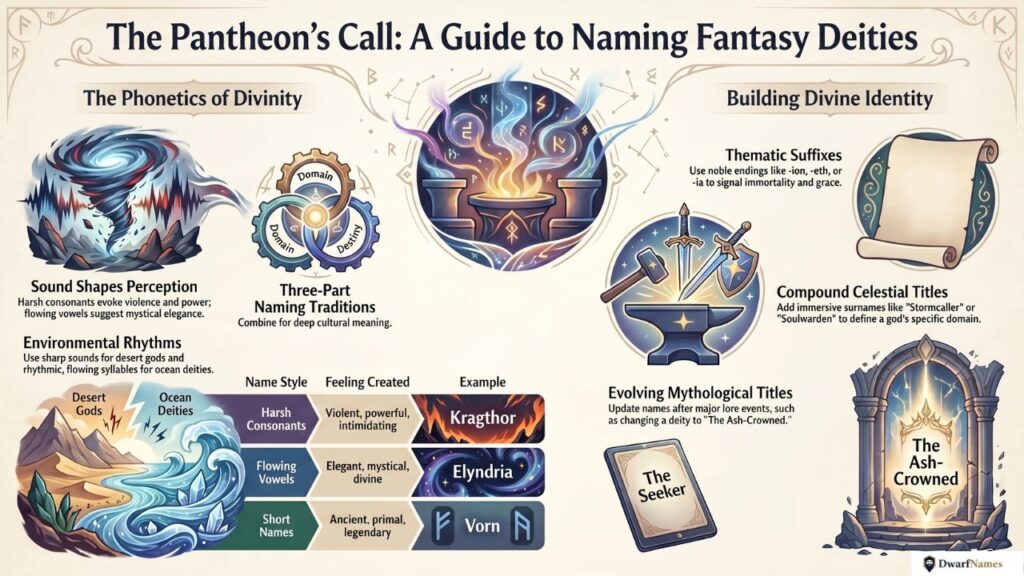
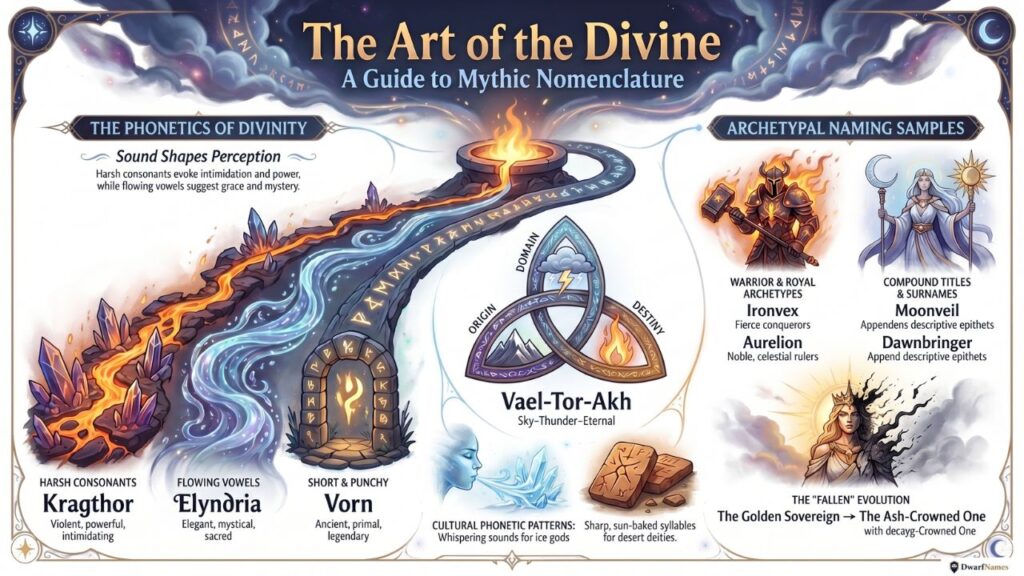
These examples reveal something crucial: the sound of a name is part of its meaning. Harsh consonants for war gods. Flowing vowels for nature and light. Sibilant sounds for tricksters and shadow. Broken syllables for the fallen. Keep this in mind as you browse the lists below.
Male God Names
These names carry the weight of divine masculinity — strength, authority, wisdom, and occasionally terrible wrath. Use these for gods of war, thunder, the forge, the sun, fate, death, or the deep earth.
- Aldravon
- Tharuus
- Keldaris
- Vorath
- Omnuvar
- Solthanis
- Brennakos
- Duravel
- Hextarion
- Malgravus
- Solcyndor
- Zarothus
- Veradyn
- Praesomal
- Khaldrus
- Urvanthas
- Brennuvar
- Thalgrim
- Ondruvis
- Caladorn
- Xerathis
- Pythorax
- Valadris
- Gorunthas
- Aeldarion
- Mordavyn
- Stravellus
- Quelanthor
- Dravethus
- Aldramor
- Solkaryn
- Ithravon
- Caldremus
- Voranthis
- Aexorath
- Nyxavorn
- Thaldrimus
- Kaevonthor
- Ruventhas
- Obraxis
- Draventus
- Halvorus
- Zenokrath
- Perandus
- Sorvathis
- Ulvadon
- Morthinus
- Caelvarin
- Zolvanthas
- Rhaedonus
Female Goddess Names
Goddesses rule domains as vast and varied as the cosmos — from birth and harvest to storm and death. These names carry grace, power, and mystery in equal measure. Whether you need a goddess of dawn, winter, wisdom, the sea, or forbidden magic, this list offers a wide range of tones.
- Aelindra
- Vaeloria
- Thessivane
- Nyradel
- Solmira
- Caelindris
- Zyrantha
- Vothara
- Elarindel
- Mirathwen
- Valasoris
- Thessawyn
- Lunivara
- Dravethi
- Aendorel
- Sarithwyn
- Orvindra
- Nyssolene
- Calydriss
- Velundra
- Elarith
- Tharesswyn
- Solivara
- Myrandis
- Quelindra
- Vandoress
- Lyrathwen
- Zinovara
- Caldriveth
- Aexorith
- Sylvaress
- Morvindra
- Thelysane
- Ulvindra
- Nerelaveth
- Ayrindis
- Draelyndra
- Thessiveth
- Valyndris
- Sovrindra
- Eloritha
- Myrandeth
- Caelydris
- Nyxolveth
- Vandoriel
- Sarindra
- Luvindrath
- Zhevara
- Quelithra
- Thyrandis
Cool and Unique God Names
Sometimes you need a name that doesn’t sound quite like anything your players or readers have heard before — something that stops them cold and demands attention. These names lean into the strange, the grand, and the otherworldly. They’d suit a god from beyond the known pantheon, an ancient deity predating memory, or a divine being whose true nature defies easy categorization.
- Ix’valar
- Zorathyss
- Umvakael
- Thyxoran
- Vekrathul
- Aezuron
- Nyxovael
- Crassivar
- Omvareth
- Drulithax
- Skaelovar
- Uvarthyss
- Zyxavorn
- Qaeltharyn
- Molvakris
- Ezruvorn
- Thuvalkari
- Vexomrath
- Nolvarith
- Axoruvyn
- Thyxulvar
- Omrekith
- Szavulorn
- Kryxoveth
- Durulvath
- Vyraxaen
- Thessorvyn
- Morkuvael
- Aexulvorn
- Drysoveth
- Zyxovaris
- Queluvorn
- Vaxulthis
- Omraveth
- Nyxorulv
Warrior and War God Names
Gods of war demand names that feel like blades — short, hard, final. These are names shouted before charges, carved into shields, and whispered as last rites. They should feel powerful even on first reading. Just as DnD players might browse DnD Tabaxi names when seeking fierce, predatory characters, a war god’s name should carry that same primal edge.
- Kravuthar
- Maldrix
- Thorgavel
- Vorask
- Durganthos
- Braekuvar
- Slathrim
- Vorthrax
- Kazmodrus
- Grimvoral
- Drakthorin
- Ulvarath
- Mordakris
- Skarnuvath
- Vaekruul
- Thralgorim
- Brutavorn
- Ravkothis
- Drazurak
- Helkruvar
- Grolvaxis
- Borathrim
- Malakvorn
- Straxivar
- Thundravok
- Vargoluth
- Krolmuvath
- Drazenthor
- Grimolvar
- Brakathor
- Skulvanthas
- Zorthraxis
- Malvadrus
- Vrakothun
- Dragnuvar
Goddess of War and Vengeance Names
Female war deities are among the most compelling in fantasy mythology — they carry the cold wrath of justice and the burning fury of battle in equal measure. These names blend strength with a sharp, crystalline quality.
- Vythara
- Kraelindris
- Morvaness
- Skuldra
- Brathindis
- Vaelkira
- Dravindra
- Thralyndis
- Grumaress
- Skarniveth
- Caldrivane
- Vythindra
- Morravaness
- Ulvindrath
- Kraethoveth
- Brutharess
- Drazivane
- Skarnivara
- Voldrindis
- Thulvaress
- Mordakis
- Vaekindra
- Skulvaness
- Kraethinveth
- Golvindra
Gods of Nature and the Elements
Nature deities are among the oldest in any fantasy pantheon. They govern storm, river, forest, fire, and frost — the forces that shaped the world before mortals drew their first breath. These names blend organic sounds with something ancient and wild.
- Sylvaranthos
- Verdulvain
- Torreval
- Stormavorn
- Ashenvael
- Thornivaris
- Mossuldren
- Glacivorn
- Fenvaris
- Embraveln
- Galeonthor
- Tidevorn
- Cindravalis
- Shaleventhos
- Bogmiravel
- Barkuldren
- Rootavorn
- Dawnveldris
- Duskmirval
- Stonecalvyn
- Tidravorn
- Galeindris
- Thornvalis
- Frostivael
- Briarventhos
- Ashuldren
- Sedgimvorn
- Verdanthas
- Cindravel
- Mooravyn
Royal and Noble God Names
Not every deity is a force of nature or a weapon of war. Some rule with law, wisdom, and divine authority — gods of kings, justice, civilization, and celestial order. These names carry grandeur, suggesting thrones above the clouds and edicts written in starlight.
- Imperathon
- Solvectris
- Celestavorn
- Augustivael
- Regalindrus
- Domivaris
- Arconthalis
- Sovrentus
- Majestivorn
- Auranthos
- Celestundris
- Domivorn
- Regnithalis
- Aureventhos
- Solmajestis
- Archiventhos
- Gloravdris
- Imperundras
- Celestravyn
- Aurelventhos
- Solvajestis
- Regnavorn
- Majesindris
- Arkovalis
- Divinethalis
- Glorivaxis
- Imperundrel
- Sorvanthos
- Regnavael
- Celestavalis
Gods of Death, Shadow, and the Underworld
Dark deities occupy a special place in fantasy worldbuilding. They are not always evil — often they are simply inevitable. Gods of death, shadow, entropy, and the afterlife carry names that feel hollow, cold, and final. Readers of vampire names will recognize the same atmospheric darkness that makes these names so compelling.
- Morthaevyn
- Null’varath
- Duskolveth
- Shadravorn
- Voidalindris
- Gravulthis
- Ashenvaris
- Mortivael
- Dimvulorn
- Erebavorn
- Cryptivael
- Hollowvaris
- Duskmorthen
- Voidulthar
- Ashvulorn
- Gravindris
- Mortexis
- Dimavaris
- Erebuldren
- Cryptovael
- Hollinthis
- Shroudavorn
- Relicvaris
- Dustvulveth
- Asholindren
- Voidmorthen
- Grimvulorn
- Gravulthar
- Crypolindris
- Morthaevael
Trickster and Chaos God Names
Every great pantheon needs its wildcard. The trickster deity — whether benevolent jester or malevolent deceiver — is essential to mythological balance. These names are slippery, playful, and unsettling all at once.
- Luravel
- Wickenthor
- Jestivorn
- Trixavael
- Knavuldren
- Foxivaris
- Mirthavorn
- Dupliveth
- Slyvindris
- Shiftvulvael
- Tangolindren
- Prankvalis
- Trickelvorn
- Luruvath
- Jestivael
- Wickovaris
- Foxulveth
- Mirthovael
- Riddickvorn
- Slythindris
- Knavulveth
- Snarlindris
- Mimolvorn
- Puckivael
- Leeruvath
Goddesses of Love, Beauty, and Fate
These deities wield perhaps the most dangerous power of all — the hearts of mortals, the threads of destiny, and the beauty that inspires both creation and catastrophe. Their names should feel beautiful, lyrical, and quietly powerful.
- Amorindel
- Venuriveth
- Faelvaris
- Heartindra
- Fortunivael
- Desirveth
- Gracindris
- Lustravorn
- Fatewynd
- Charmiveth
- Weavindra
- Lovavorn
- Blissiveth
- Eternindra
- Lustravael
- Fortuniveth
- Gracelvorn
- Desirvaris
- Heartivael
- Weavulveth
- Amorindris
- Venurivarn
- Faelindra
- Charmivael
- Blissuldren
Divine Naming Traditions: Worldbuilding Lore
The way a culture names its gods reveals everything about how they see the universe.
The Doctrine of the First Sound — In many ancient fantasy civilizations, it was believed that a god’s name was not invented by mortals, but heard — whispered in dreams, sensed in the vibration of stone and water. Priests called “Name-Listeners” would spend decades in silence until the true name of a deity came to them. This makes for compelling lore: gods who have multiple names across cultures, with priests endlessly arguing over which is “true.”
Compound Title-Names — Some pantheons don’t use personal names at all. Their gods are known only by domain titles: The One Who Burns Beneath, She Who Tends the First River, The Warden of Unfinished Paths. This works particularly well for eldritch or primordial deities who existed before language.
The Syllable of Power — In certain worldbuilding traditions, a god’s name contains one syllable that is never spoken aloud. Mortals know the “partial name” — the rest is considered too dangerous, too raw with divine energy. The true name, fully spoken, would unmake the speaker.
Gender-Fluid Naming — Many fantasy cultures assign divine names fluidly, with a god who presents as male in one era reborn as female in another. Their name simply shifts in suffix: Aldravon becomes Aldravindra, reflecting transformation rather than replacement.
Occupation-Derived Names — Just as DnD Gnome names often reflect a gnome’s inventive, curious nature, divine names in many fictional cultures derive from the god’s primary act of creation. The god who first struck flint is named something that echoes spark and stone. The goddess who wove the first net is named in syllables that sound like running water.
Traditional and Ancient God Names
These names draw on the deep, archaic quality of ancient mythological naming — they feel like they’ve always existed, carved into stone tablets before living memory.
- Panthoran
- Arcaveldris
- Pristavorn
- Eldravaris
- Anchivael
- Firstivorn
- Agenvaris
- Primaveldris
- Sacrivorn
- Lorindavael
- Eldumvaris
- Archavorn
- Holivaris
- Sacrathorn
- Primeldris
- Agenvorn
- Anchuldren
- Firstivael
- Lorindavorn
- Arcavalis
- Panthuldren
- Sacrivael
- Primaeldris
- Eldurvalis
- Anchorvael
- Sacrindris
- Firstovael
- Archimorvyn
- Lorindavaris
- Eldumvael
Pantheon Clan and Faction Names
Beyond individual deities, every rich pantheon has divine factions — celestial courts, elemental councils, and infernal dynasties. These compound names work as faction titles, divine houses, or even surnames for your gods.
- The Ashencrown
- Solarveil Court
- The Stormwarden Circle
- House of the Hollow Throne
- The Ironblessed
- Verdant Council
- The Deathwhisper Order
- Starlocket Conclave
- The Emberveil
- Court of the Shattered Moon
- The Tidewarden House
- Frostveil Sanctum
- The Bloodmantle
- Goldenspire Dynasty
- The Shadowbond Order
- Court of the Deep Root
- The Dawnforged
- House Moonsever
- The Ashwarden Covenant
- Celestial Ironbrace
- The Voidthorn Order
- House of the Burning Veil
- The Stonecrown Court
- Silvermarrow Conclave
- The Nightwoven Order
- House of the Unlit Flame
- The Stormblessed Dynasty
- Court of the Gravenveil
- The Runemarrow Circle
- House of the Firstborn Stars
- The Bloodwarden Sanctum
- Court of the Ebonstorm
- The Thornveil Assembly
- House of the Amber Throne
- The Gravecrown Covenant
- Starmarrow Dynasty
- The Ashbond Order
- Court of the Galeborn
- The Ironveil Conclave
- House of the Deepspire
- The Moonwarden Circle
- Court of the Forgiven Dead
- The Goldenveil Sanctum
- House of the Firstfire
- The Shadowcrown Assembly
- Court of the Ancient Tide
- The Emberbond Dynasty
- House of the Hollowed Star
- The Dawnveil Order
- Court of the Stonewarden
Conclusion: The Weight of a Divine Name
Names are not decoration. In the deepest sense of fantasy worldbuilding, a name is a spell. It summons a presence, implies a history, and creates an expectation. When a character in your story whispers a prayer to Vaeloria, She Who Turns the Tide, the reader already feels the sea in their chest, the cold spray, the sense of something vast and indifferent and beautiful listening.
The 350+ names in this guide are starting points — seeds, not finished trees. Take them, reshape them, break them and rebuild them into something that fits the specific spiritual landscape of your world. Change a vowel. Add a suffix that belongs to your invented language. Give a god a name that two cultures pronounce differently, each version revealing something new about how they understand the divine.
Whether you’re crafting a dark deity for your next campaign, building an entire mythology for your fantasy novel, or simply looking for the perfect name to give the thunder-god etched on your character’s shield — these names exist to serve your imagination.
The gods of your world are waiting to be named. The altar is yours.