
The torchlight flickers across parchment. A quill scratches a name into the vellum and in that single moment, a character is born. Not just a figure with a sword or a crown, but a soul with history, bloodline, and meaning pressed into every syllable. Medieval names carry the weight of stone castles, cathedral bells, jousting fields, and royal courts. They are forged from Latin prayers, Viking war cries, Norse sagas, and French poetry and they have never felt more alive than they do in fantasy storytelling today.
Whether you are writing a novel set in a kingdom shrouded in war, building a tabletop RPG campaign around a crumbling empire, or crafting a video game where every NPC deserves a title worth remembering the names you choose will define your world. The right name turns a nameless blacksmith into a legend. It transforms a generic queen into a figure of mythic consequence.
Medieval noble names, in particular, possess a gravity that modern names simply cannot match. They were chosen with deliberate meaning reflecting family lineage, religious devotion, territorial power, and ancestral pride. A knight was not simply named “William.” He was William of Ashford, or William the Ironhand, or William, third son of House Velmere. Names were identity, rank, and oath all at once.
This is your definitive compendium of 350 medieval names used by nobles, knights, and queens organized, lore-rich, and ready to be dropped into your world. From battle-hardened warrior names to the whispering elegance of courtly ladies, every name here has been chosen to feel authentic, resonant, and worthy of legend.
Famous Medieval Names From Literature and History’s Fantasy Stage
Before we descend into the full name vaults, let us honor the names that have already carved their place into the imaginations of millions. These are the names that shaped how we think about medieval fantasy identity.
Guinevere — Few names carry more layered tragedy than Guinevere, queen of Camelot in Arthurian legend. Her name, believed to derive from the Welsh Gwenhwyfar meaning “white phantom” or “fair one,” perfectly encapsulates her role: radiant, powerful, and haunted. She is proof that a queen’s name should carry both beauty and sorrow.
Roland — The great paladin of Charlemagne’s court in The Song of Roland, one of the oldest medieval epics. His name is bold and blunt a warrior’s name that ends on a hard consonant, like a sword striking a shield. Roland never retreats and never surrenders. The name says as much.
Isolde — From the tragic romance of Tristan and Isolde, this name belongs to an Irish princess whose love story echoes across centuries. It is soft, musical, and achingly beautiful a name for characters defined by passion, nobility, and fate. Isolde also demonstrates how medieval names for women could hold immense power beneath their elegance.
Edmund — Whether from Shakespeare’s King Lear or medieval historical records, Edmund is a name that pulses with ambition. It was borne by kings, martyred saints, and villainous bastards alike. Its versatility makes it one of the most enduring names in the medieval canon.
These names share something critical: they earn their symbolic weight through storytelling. When you name your character, you are not just labeling them — you are making a promise about who they are. Just as vampire names carry a dark immortal elegance, medieval noble names carry their own kind of ancient power.
Male Medieval Names for Nobles and Knights
The great halls of the kingdom echo with these names called out in tournaments, sworn in oaths of fealty, and carved on tomb effigies. These are names for lords, paladins, earls, and emperors.
Strong, commanding, and steeped in medieval atmosphere choose one and build a dynasty around it.
- Aldric
- Bertrand
- Caspian
- Dorian
- Edmund
- Fabian
- Godwin
- Harwin
- Iollan
- Jasper
- Kenelm
- Leofric
- Marek
- Niles
- Osbert
- Percival
- Quentin
- Rainier
- Sigbert
- Tobias
- Ulrich
- Valen
- Wulfric
- Xander
- Yorick
- Zephyrin
- Alaric
- Baldwin
- Cedric
- Dunstan
- Elric
- Ferrand
- Gawain
- Humphrey
- Ingvar
- Jocelin
- Kenrick
- Lachlan
- Morcar
- Nigel
- Oswin
- Piers
- Raynald
- Sigebert
- Tancred
- Urien
- Veran
- Warrick
- Ximenes
- Yvain
Female Medieval Names for Noblewomen and Queens
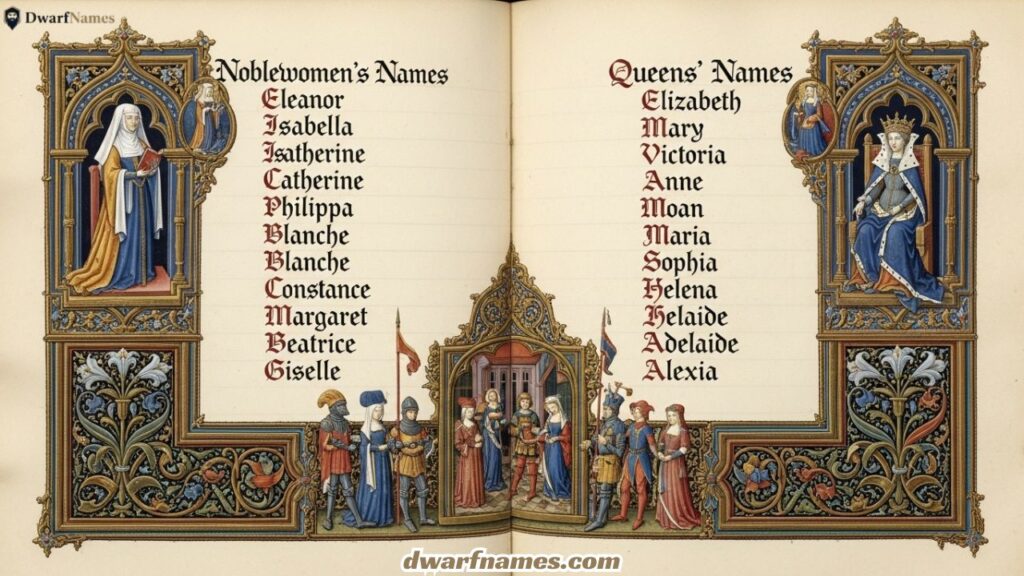
These names were whispered by ladies-in-waiting, announced at coronations, and painted in illuminated manuscripts. They carry the grace of vaulted chapels and the iron of political marriages. A queen’s name must command a room in silence — and every name on this list does exactly that.
- Alienor
- Blanche
- Cecily
- Dorothea
- Elspeth
- Felicitas
- Gwenllian
- Hilda
- Isadora
- Juliana
- Katarina
- Leonora
- Margot
- Nicolette
- Osanna
- Philippa
- Rosamund
- Sibyl
- Theodora
- Ursula
- Vivienne
- Winifred
- Yolande
- Zenobia
- Adelheid
- Berengaria
- Clothilde
- Devorgilla
- Eadgyth
- Floria
- Gunhild
- Hedwig
- Imogen
- Jolanda
- Kunigunde
- Libussa
- Matilda
- Nesta
- Orlanda
- Petronilla
- Rowena
- Sunniva
- Tiphaine
- Una
- Valdrada
- Wilhemina
- Xenia
- Ysabel
- Zoefia
Cool and Unique Medieval Names
Some names in the medieval world stood apart — chosen by eccentric lords, distant travelers, or families who wanted their heirs to be remembered. These are the names that feel both ancient and startlingly fresh on the page.
- Aldemar
- Briseis
- Colvyn
- Drace
- Eulalia
- Forant
- Gryffin
- Halvard
- Iolanthe
- Jarvik
- Kestrel
- Lysander
- Morrigan
- Naevius
- Orvyn
- Pellinore
- Quincey
- Ravenna
- Serion
- Theron
- Ulvane
- Vespera
- Wren
- Xanthia
- Ysolt
- Zoran
- Aurelian
- Brynn
- Caelith
- Dakarai
Warrior and Knight Names — Battle-Forged and Legendary
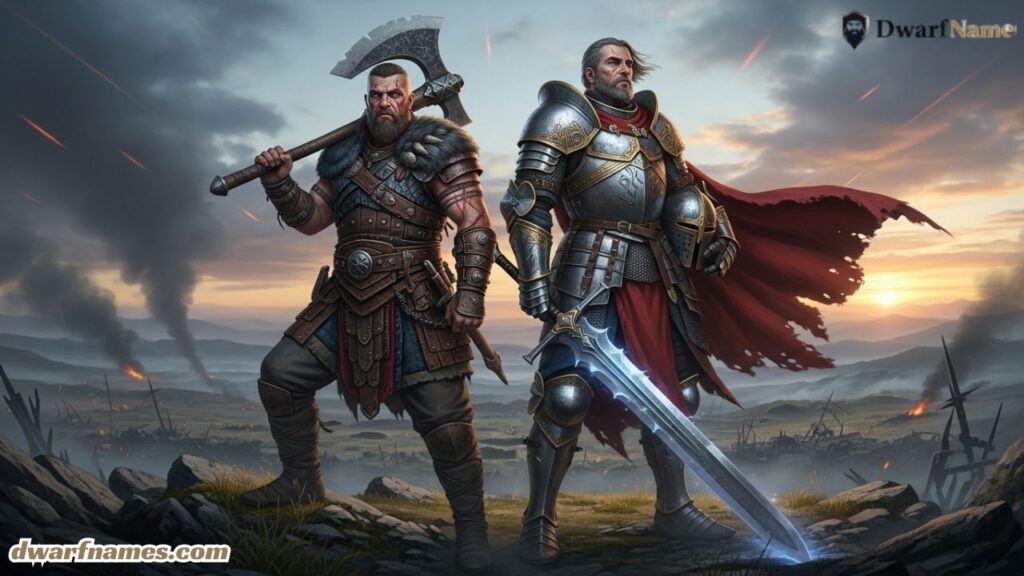
These names ring out across battlefields, are carved into sword hilts, and are spoken at knighting ceremonies before dawn. They are medieval names for warriors — hard-edged, powerful, and impossible to forget. A name like this needs no title. It is the title.
Much like how god names carry divine authority across fantasy pantheons, warrior names in medieval fantasy carry mortal legend — earned through blood and sworn in steel.
- Godric
- Thorfinn
- Aldwyn
- Brannor
- Carver
- Draegan
- Eithan
- Fenwick
- Grendal
- Halvrek
- Ironside
- Jarek
- Kolgrim
- Leothane
- Mordecai
- Northan
- Osric
- Peregrine
- Ragnar
- Steinar
- Torwald
- Ulfrik
- Vandal
- Westmore
- Xalvador
- Yorath
- Zoltan
- Adhemar
- Berold
- Clovis
- Draven
- Edric
- Faramond
- Gareth
- Hadwin
- Ingram
- Jarlath
- Karac
- Leodulf
- Malachar
- Norvin
Royal and Noble Names Fit for Kings and Queens
These are the names that appear in royal decrees, illuminated genealogies, and cathedral dedications. They are noble medieval names for characters who rule — whether with compassion, cruelty, or the elegant calculation of a chess grandmaster.
If you enjoy building royalty-heavy fictional hierarchies, you might also draw inspiration from ancient Egyptian names — another tradition steeped in divine rulership and dynastic power.
- Augustus
- Balthazar
- Constance
- Demetrius
- Eleanor
- Frederick
- Gertrude
- Heinrich
- Isabella
- Josaphat
- Katherine
- Leopold
- Magdalene
- Nikephoros
- Ottoline
- Ptolemy
- Radovan
- Sophia
- Thaddeus
- Valentina
- Wilhelm
- Xiomara
- Yseult
- Zacharias
- Anastasia
- Benedikt
- Celestine
- Dominique
- Eudoxia
- Florestan
- Gisela
- Hartmann
- Irene
- Jerome
- Konstantina
- Lothair
- Mechtild
- Nikolaus
- Orfeo
- Prudence
Traditional and Classic Medieval Names
These are the names that filled every village church, every castle registry, every tax roll in the medieval world. They are classic medieval names — proven, noble, and endlessly adaptable for fantasy settings. Sometimes, the most powerful choice is the most timeless one.
- Alfred
- Beatrice
- Conrad
- Diana
- Edward
- Florence
- Geoffrey
- Helena
- Ivan
- Joan
- Karl
- Laura
- Martin
- Nora
- Otto
- Patricia
- Ralph
- Sylvia
- Thomas
- Victoria
- Walter
- Agnes
- Bernard
- Clara
- Denis
- Edith
- Francis
- Grace
- Henry
- Ida
- James
- Lucy
- Margaret
- Nicholas
- Olivia
- Philip
- Richard
- Stephen
- Theresa
- Vincent
The Lore of Medieval Naming Traditions
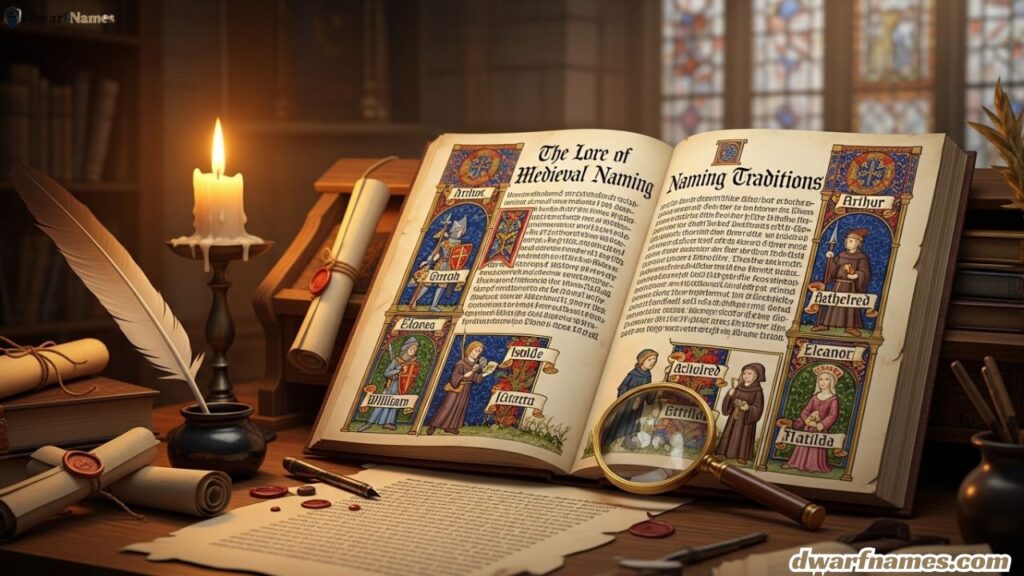
Understanding how medieval people named their children unlocks a deeper layer of worldbuilding authenticity. Names were not chosen casually — they were political instruments, spiritual declarations, and genealogical records all in one.
Dynastic Repetition was the cornerstone of noble naming. If a father was named Henri, his firstborn son might also be Henri — or might be named after the paternal grandfather to honor the lineage further back. This created chains of identity: Henri II, Henri the Young, Henri of the Marches. In your fantasy world, this convention can create instant depth. A character named Aldric IV signals a dynasty, a burden of expectation, and a legacy to either honor or shatter.
Baptismal Saints’ Names dominated Christian Europe. Children were named for the saint on whose feast day they were born, or for a patron saint chosen to guide and protect them. In fantasy worldbuilding, you can create similar traditions — naming children for celestial events, divine figures, or fallen champions of a past age. Explore how DnD Gnome names use whimsical internal logic to reflect their culture; the same principle applies here.
Epithets and Bynames replaced surnames for most of the medieval period. Instead of a fixed family name, a person earned or inherited a descriptor: the Bold, of Ashwood, Ironmantle, the Younger, Blackthorn. These bynames were fluid, could change with life circumstances, and were deeply tied to identity. A lord who lost his lands might lose his byname too.
Women’s Names and Power in the medieval noble class were often deliberately chosen to reflect dynastic alliances. When a duchess of one kingdom married a duke of another, her name might be changed or latinized to reflect her new allegiance. Names like Eleanor became Aliénor in French courts, Leonora in Italian ones. This linguistic drift is a wonderful detail to incorporate into multilingual or multinational fantasy kingdoms.
Medieval Clan and House Names — The Surnames of Legend
Every great knight needed a house to stand beneath, and every noble house needed a name that echoed through stone halls for generations. These are medieval surname and house name ideas — compound, evocative, and ready for your coats of arms.
These also function beautifully as clan names, mercenary company names, knightly order names, or dynasty titles.
- Ashveil
- Blackmantle
- Coldwater
- Duskhollow
- Emberthorn
- Frostgate
- Graymere
- Highwatch
- Ironvale
- Jadecliff
- Kestrelwood
- Lanternhurst
- Mossford
- Nighthollow
- Oakhaven
- Peregrine Crest
- Quarrystone
- Ravenwall
- Silverfen
- Thornwick
- Underhill
- Verdanmoor
- Wolfstride
- Xandermere
- Yellowstone
- Zephyrgate
- Aldenmoor
- Brightspire
- Coppergate
- Dunmorrow
- Edgewater
- Falconhurst
- Grimwood
- Harrowfen
- Ironcross
- Jadewater
- Kingsveil
- Longmarch
- Marshgate
- Nightvale
- Oldwick
- Proudmantle
- Queenshollow
- Rookwood
- Steelfen
- Thorngate
- Underveil
- Valdenmoor
- Winterspire
- Yarrowfen
Fantasy surnames like these function similarly to how DnD Tabaxi names use nature imagery and elemental descriptors — they anchor a character in their world, giving them roots and context.
Conclusion: Let the Name Carry the Crown
A name is not decoration. In medieval fantasy, a name is a declaration. It is the first thing a character claims and the last thing history remembers. Whether your knight rides under the banner of House Coldwater or your queen is crowned as Theodora the Unyielding — the name you choose shapes every scene they inhabit.
The 350 medieval names in this compendium are not just labels. They are starting points for dynasties, for tragedies, for romances and revolutions. They are the seeds of entire worlds.
So take what calls to you. Combine a first name with a house name. Give your villain an elegantly gentle name that unsettles. Give your quiet healer a warrior name that hints at a buried past. Let the names do the heavy lifting — because the right name, in the right story, is a kind of magic all its own.
Now go. Name your world. Make it worth remembering.
Frequently Asked Questions
What are the most popular medieval noble names for fantasy writing?
Names like Edmund, Eleanor, Aldric, and Matilda are perennial favorites. They feel historically grounded yet work beautifully in original fantasy settings.
How do I make medieval names sound authentic in my story?
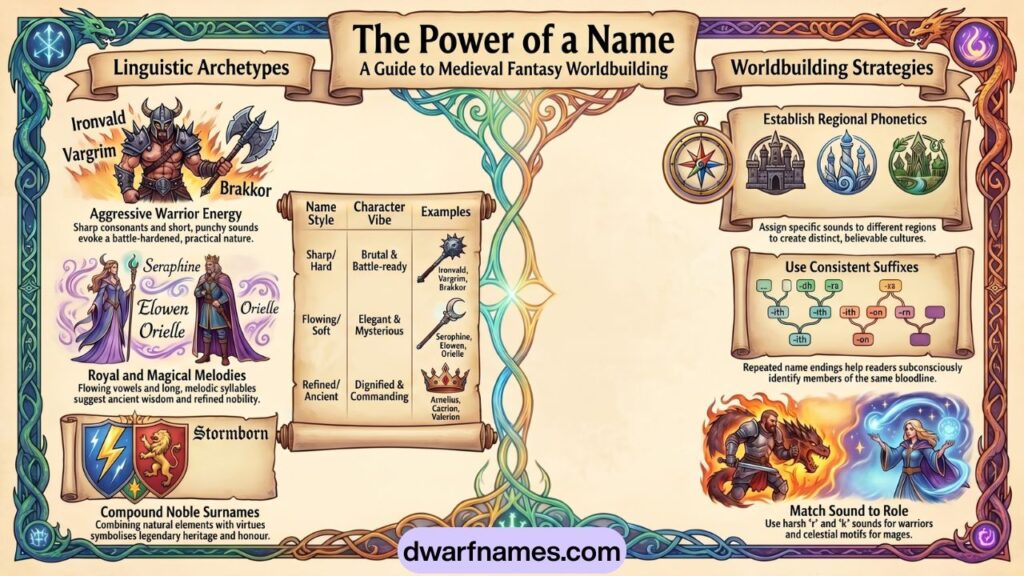
Use hard consonants for warriors, softer vowels for courtly figures, and Latin or French roots for clergy and nobility. Consistency within a culture matters most.
Can I use medieval names for DnD characters?
Absolutely. Medieval names work perfectly for human characters, paladins, clerics, and nobles in DnD campaigns, grounding them in a believable historical atmosphere.
What is the difference between a noble name and a commoner’s name in medieval fantasy?
Noble names were often longer, Latinized, or connected to saints. Commoners used shorter, plainer names. Using this distinction adds class texture to your worldbuilding.
Are medieval queen names different from regular female names?
Royal women often received dynastic names honoring ancestors or political alliances. Names like Philippa, Berengaria, and Constance were almost exclusively royal in practice.
How do medieval surnames and house names work in fantasy worldbuilding?
House names often referenced geography, heraldry, or a founding ancestor’s deed. Compound names like Blackmantle or Thornwick suggest history and legacy at a glance.
Where can I find more fantasy name inspiration beyond medieval names?
Explore adjacent traditions — ancient mythology, creature-based fantasy races, and cultural archetypes all offer rich naming systems to draw from for a layered world.