
Names are never mere labels. In the ancient tradition of Arabic culture, a name is a whisper of destiny, a prayer spoken at dawn, a story woven into the very breath of a child. Arabic names carry centuries of poetry, faith, conquest, and wisdom within their syllables. They rise and fall like sand dunes under moonlight, each one hiding something luminous beneath its surface.
For fantasy writers, game masters, and worldbuilders, Arabic names offer something truly rare: a deep well of authentic linguistic beauty that feels both exotic and timeless. Whether you are naming a desert sorcerer, a wandering scholar, a warrior queen of shifting sands, or a celestial spirit bound to ancient stars, Arabic baby names and their meanings deliver an unmatched depth of character. The language itself is built for resonance. Short names hit like stones. Long names flow like rivers across parchment.
In the world of tabletop roleplay and speculative fiction, naming traditions matter enormously. Just as DnD Orc names carry brutish power and Greek names echo marble temples and sea winds, Arabic names carry their own unmistakable weight. They speak of deserts that whisper secrets, of celestial maps traced by ancient hands, of palace gardens where poets once sat beneath jasmine-draped arches.
This guide gathers over 350 Arabic names with beautiful meanings, organized by character type, gender, and theme. Whether you are searching for cool Arabic names, unique Arabic name ideas, or fantasy Arabic names for your next campaign or novel, you will find your answer here.
Famous Arabic Names From Literature and History
Before diving into the lists, it helps to see how Arabic names already shape the most memorable characters in literature, mythology, and games.
Sinbad is perhaps the most famous Arabic fictional hero. His name, rooted in Persian-Arabic tradition, evokes adventure and wandering fate. He is the sailor who defies the impossible, and his name has become synonymous with wild, untameable journeys across impossible seas. The name alone conjures seven voyages worth of imagination.
Scheherazade from One Thousand and One Nights carries a name meaning “city-born” or “of noble lineage.” She is the ultimate storyteller, surviving through the power of narrative itself. For any writer building a lore-keeper character, this name signals brilliance, resilience, and narrative magic.
Aladdin, from the same tradition, carries the meaning “nobility of faith.” He begins as a street thief and becomes something far greater. His name maps his entire arc perfectly. Arabic names often do this: they carry the promise of who a character might become.
Iblis, the Arabic name for the great adversary in Islamic mythology, comes from a root meaning “despair” or “to be lost.” This is a masterclass in villain naming. The sound is sharp, the meaning is darkly precise, and the character is unforgettable. For a demonic antagonist in any fantasy world, few names carry this much weight.
Just as DnD Kobold names are built to feel small and cunning, and DnD Kenku names carry an eerie echoing quality, the best Arabic fantasy names are built to carry the soul of the character within them.
Male Arabic Names
These names carry strength, wisdom, and noble purpose. Perfect for heroes, scholars, chieftains, and wanderers of the endless desert.
- Zafir – victorious
- Khalid – eternal, immortal
- Tariq – he who knocks at the door, the morning star
- Nasim – gentle breeze
- Fadel – virtuous, excellent
- Ameer – prince, commander
- Bilal – moisture, freshness of water
- Daoud – beloved
- Faris – knight, horseman
- Ghaith – rain, relief
- Hakim – wise ruler, judge
- Imran – prosperity, long life
- Jabir – consoler, comforter
- Kareem – generous, noble
- Layth – lion
- Mazen – praised
- Nadir – rare, precious
- Omar – flourishing, long life
- Qasim – one who distributes
- Rafi – exalted, sublime
- Saad – happiness, luck
- Talib – seeker of knowledge
- Uzair – helper
- Wael – coming back for shelter
- Yasir – wealthy, prosperous
- Ziad – growth, increase
- Adnan – settler, one who stays
- Basim – smiling
- Diyar – homeland, abode
- Ezzat – dignity, glory
Female Arabic Names
From warriors of the sand to moonlit sorceresses, these female Arabic names with beautiful meanings are built for characters of depth and grace.
- Amira – princess, commander
- Basma – a smile
- Dalila – gentle guide
- Farah – joy, happiness
- Ghazalah – gazelle, graceful
- Hana – bliss, happiness
- Inaya – care, concern, protection
- Jamilah – beautiful
- Karima – generous, noble one
- Layla – night, dark beauty
- Malak – angel
- Nadia – caller, announcer of good news
- Omaira – long life
- Parisa – like a fairy
- Qamra – moonlight
- Rania – gazing with admiration
- Sahar – dawn, awakening
- Tahira – pure, virtuous
- Umayma – little mother
- Viviana (Arabized as Wafa) – loyalty, faithfulness
- Yara – small butterfly, friend
- Zahra – flower, radiant
- Afnan – tree branches, flourishing
- Bushra – good omen, good news
- Dina – judged, faith
- Enas – sociability, friendliness
- Firdaus – paradise garden
- Ghada – graceful young woman
- Hessa – destiny
- Iman – faith, belief
Cool and Unique Arabic Names
These names carry an edge. They sound unlike anything else and hold rare, striking meanings that set characters apart from the ordinary.
- Azraq – azure, brilliant blue
- Buraaq – lightning speed (the celestial steed of prophecy)
- Dhulfiqar – possessor of the spine, legendary blade name
- Enaam – gift, divine blessing
- Feroz – turquoise, victorious
- Ghassan – prime of youth
- Himam – high ambitions, great deeds
- Ibtihaj – joy, delight
- Jabbara – powerful, mender of broken things
- Kifah – struggle, striving
- Lujain – silver
- Miqdad – one who prepares the way
- Nafis – precious, refined
- Oqba – consequence, the horizon beyond
- Pirooz – triumphant
- Qadeer – capable, powerful
- Rawdah – garden of paradise
- Saffar – traveler, wanderer
- Tharwat – wealth, richness
- Ula – upper, highest
- Vaqar – dignity, stately bearing
- Wisal – union, communion of souls
- Xalis – pure, unadulterated
- Yaqout – ruby, precious stone
- Zaheen – intelligent, sharp-minded
- Azam – greatest
- Bara – innocent, free
- Chadha – pleasant aroma
- Dimashq – Damascus, ancient city of jasmine
Warrior and Strength Arabic Names
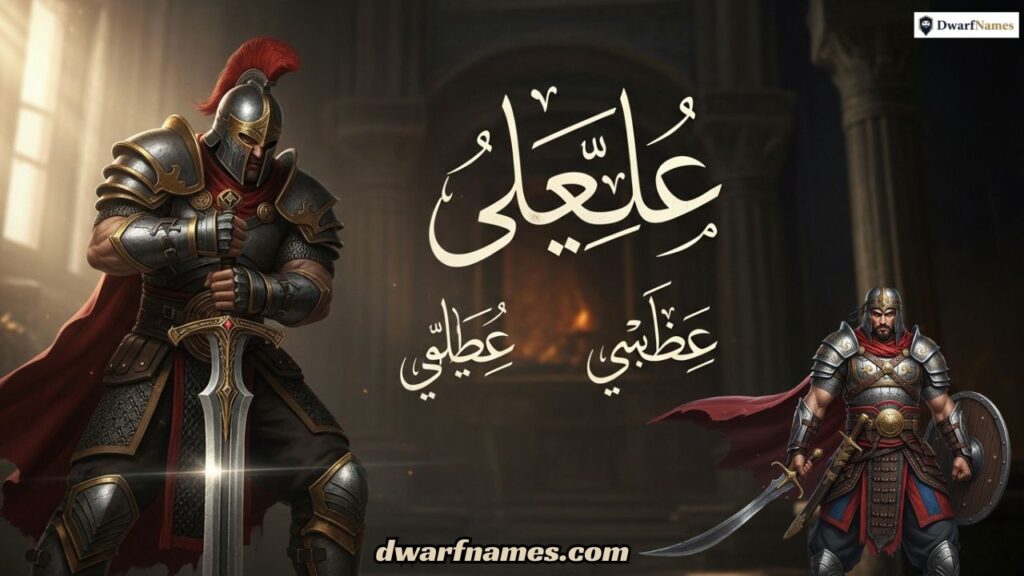
These are names forged for the battlefield, the arena, and the kind of character who carries legend on their shoulders. Much like DnD Warforged names carry the weight of iron and purpose, these Arabic warrior names carry the weight of sand, blood, and glory.
- Asad – lion
- Badr – full moon, brilliance in battle
- Dhafer – triumphant
- Fahl – brave, fierce
- Ghalib – conqueror, dominant
- Hamza – strong, steadfast lion
- Iyad – support, strength of arms
- Jafar – small river, stream of force
- Kahtan – ancient warrior king
- Mukhtar – chosen one
- Nizar – little, but fiercely proud
- Qahtan – ancient Arab war chief
- Raad – thunder
- Saber – patient, enduring warrior
- Thameen – precious, worth fighting for
- Ubaid – faithful servant of strength
- Walid – newborn warrior, one who arrives with purpose
- Zubair – strong, brave
- Antar – legendary Arabian warrior hero
- Bassam – brave smiler
- Dara – possessing wisdom and power
- Esam – safeguard
- Falah – success in battle
- Ghazwan – raider, expedition leader
- Harith – ploughman, one who cultivates by force of will
- Izzat – honor, invincibility
- Jasim – great bodied, powerful
- Khattab – great orator who commands armies
- Laith – fierce lion
- Mahdi – guided to greatness
Royal and Noble Arabic Names
These names carry silk and scepters. They belong to sultans and sultanas, to those born under golden domes with jasmine in the courtyard air. If you are building Greek names-style noble hierarchies but want a desert-kingdom flavor, these Arabic royal names are your foundation.
- Sultan – ruler, authority
- Sultana – queen, lady of power
- Malik – king
- Malika – queen
- Sharaf – honor, noble distinction
- Thuraya – the Pleiades, celestial royalty
- Ulya – highest rank
- Wajd – ecstasy of noble emotion
- Azza – mighty, precious
- Badi – marvelous, rare excellence
- Dawlat – state, dynasty
- Emeera – noblewoman, princess of the realm
- Fakhri – honorary, of proud lineage
- Ghurra – shining forehead, sign of nobility
- Hashim – generous crusher, ancestor of prophetic lineage
- Izz – glory, power
- Jalal – greatness, majesty
- Khadijah – first noble lady, premature child who grew into greatness
- Majd – glory, honor
- Nabil – noble, generous
- Qamar – moon, celestial ruler of night
- Reem – white gazelle, emblem of royal grace
- Safa – purity, serenity of the noble soul
- Tarfa – a type of tree that bends but never breaks
- Udaym – ancient, enduring nobility
- Wadha – bright, clear
- Yahya – God is gracious, name of prophets and kings
Traditional and Classic Arabic Names
These names have been spoken across deserts and cities for over a thousand years. They are the foundations of Arabic naming tradition, classic for a reason.
- Abdullah – servant of God
- Ibrahim – father of nations
- Ismail – God will hear
- Mariam – beloved, grace
- Musa – drawn from water
- Aisha – she who lives
- Ali – elevated, sublime
- Fatima – one who abstains, weaned
- Hassan – good, handsome
- Husain – good, beautiful
- Khadija – premature child, one of great early faith
- Ruqayyah – gentle, soft
- Zainab – fragrant plant, emblem of beauty
- Yusuf – God increases
- Sulayman – peaceful, man of peace
- Nuh – rest, quiet
- Hawa – life, the breath
- Asma – names, prestige, loftiness
- Jubayr – strong, powerful
- Maymun – blessed, fortunate
- Nawal – gift, benefit
- Rawda – garden, meadow
- Samira – entertaining companion
- Taha – mystical letters of the Quran, purity
- Umar – life, long life
- Wardah – rose
- Zayd – growth, abundance
- Hind – group of camels, ancient woman of legend
- Lubna – storax tree, ancient sweetness
- Muna – wish, desire
Arabic Naming Traditions: Worldbuilding Lore
In Arabic naming tradition, names are not merely identifiers. They are declarations.
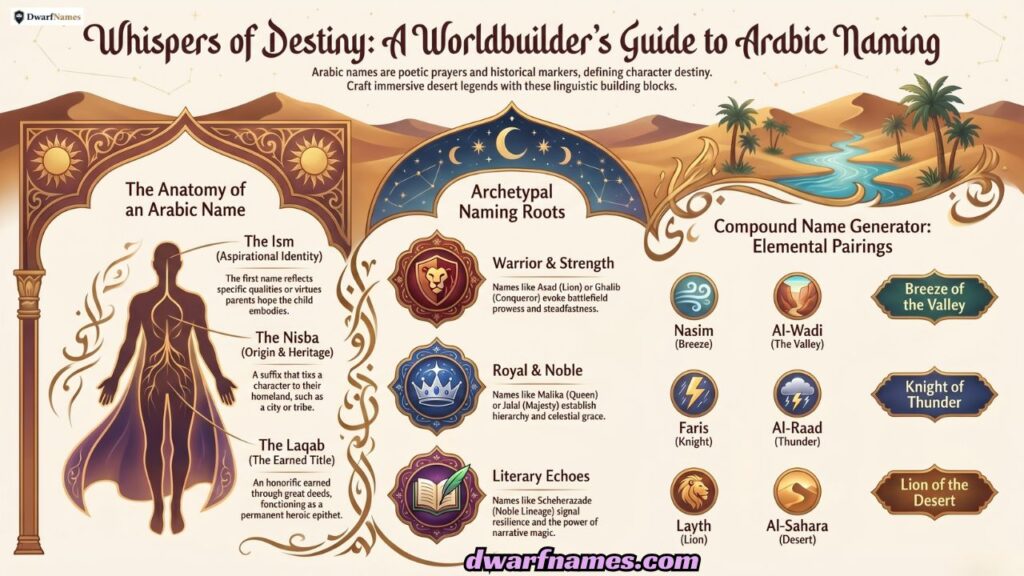
A child’s first name (ism) is chosen to reflect aspiration. Parents often name children after prophets, noble ancestors, or qualities they hope the child will embody. A boy named Khalid is being wished eternal life and glory. A girl named Farah is being gifted joy as her birthright.
The kunya system gives adults a secondary name based on their firstborn child. A father named Omar whose eldest is named Hassan becomes Abu Hassan, “father of Hassan.” A mother becomes Umm Hassan. This system creates deep relational identity. In a fantasy world, this could be how clan leaders earn their titles, not through conquest but through legacy.
The nisba is a suffix that ties a person to their origin: Al-Masri means “from Egypt,” Al-Dimashqi means “from Damascus.” For worldbuilders, this is a gift. Characters can carry their homeland in their name. A sorcerer from a hidden canyon becomes Rashid Al-Wadi, “Rashid of the valley.” A wandering scholar from a ruined fortress becomes Nizar Al-Qalaa, “Nizar of the citadel.”
The laqab is an honorific title earned through deeds. Al-Rashid means “the rightly guided.” Al-Mansur means “the victorious.” These earned titles function exactly the way fantasy epithets do: they are the names that history remembers.
Arabic Clan and Family Names (Surnames)
These compound names and clan surnames are built for dynasties, noble houses, and warrior lineages. Use them as last names, house names, or earned titles in your worldbuilding.
- Al-Rashid – the Rightly Guided
- Al-Mansur – the Victorious
- Al-Hakim – the Wise Ruler
- Banu Saad – Clan of Fortune
- Banu Hashim – Clan of the Crusher (prophetic lineage)
- Ibn Zafir – Son of Victory
- Bint Layla – Daughter of the Night
- Al-Nuri – of the Light
- Al-Badawi – the Desert Wanderer
- Al-Zahrani – of the Flowering One
- Al-Ghamdi – of the Mist
- Al-Qahtani – of the Ancient War Tribe
- Al-Harbi – of War
- Al-Shalabi – the Brilliant One
- Al-Tamimi – of the Proud Tribe
- Al-Amiri – of the Royal House
- Ibn Khalid – Son of the Immortal
- Al-Shammari – of the Fennel Grass Plains
- Al-Mutairi – the Free One
- Al-Subaie – of Seven Stars
- Al-Dosari – of the Ancient Fortress
- Al-Azhar – of the Blooming Light
- Al-Jabri – the Consoler
- Al-Anzi – of the She-Goat Tribe, ancient and proud
- Ibn Tariq – Son of the Morning Star
- Al-Malki – of the King
- Al-Mazrouei – of the Cultivated Land
- Al-Shamsi – of the Sun
- Al-Qamari – of the Moon
- Banu Laith – Clan of the Lions
- Al-Farouk – the Distinguisher Between Truth and Falsehood
- Al-Siddiq – the Truthful
- Al-Walidi – of the Newborn, ever fresh
- Ibn Basim – Son of the Smiling One
- Al-Karimi – of Generosity
- Al-Fakhri – of Honor
- Banu Reem – Clan of the White Gazelle
- Al-Sahari – of the Dawn
- Al-Wadi – of the Valley
- Al-Qalaa – of the Citadel
Bonus: Arabic Naming Generator Ideas
For writers and game masters who want to build their own Arabic-style fantasy names, here are structural patterns to generate endless possibilities.
Pair a root meaning with an elemental or natural suffix:
- Nasim + Al-Wadi = Breeze of the Valley
- Zahra + Al-Layl = Flower of the Night
- Faris + Al-Raad = Knight of Thunder
- Qamra + Al-Nuri = Moon of the Light
- Layth + Al-Sahara = Lion of the Desert
- Sahar + Al-Azhar = Dawn of the Blooming
- Tariq + Al-Jabal = Morning Star of the Mountain
- Malak + Al-Bahr = Angel of the Sea
- Hakim + Al-Riyah = Wise One of the Winds
- Iman + Al-Haqq = Faith of the Truth
Combine two strong root names for compound hero names:
- Zafir-Khalid = Eternal Victor
- Farah-Basma = Joy and Smile
- Asad-Faris = Lion Knight
- Malika-Zahra = Queen of Flowers
- Layth-Badr = Lion of the Full Moon
- Saad-Tariq = Lucky Morning Star
- Nadia-Iman = Caller of Faith
- Hakim-Nabil = Noble Wise One
- Ghaith-Nadir = Rare Rain
- Bushra-Hana = Good News of Bliss
Conclusion
Arabic names are ancient vessels. Each one carries a world inside it: the smell of desert rain, the weight of dynasty, the whisper of stars named by astronomers who mapped the sky a thousand years before anyone else dared look up and wonder.
Whether you are crafting a novel set in shifting dunes, building a desert empire in your tabletop campaign, or simply searching for a name for a new child that carries beauty and weight in equal measure, the treasury of Arabic names offers something no other naming tradition quite matches. These are names with souls.
Use them well. Let Zahra bloom in your pages. Let Layth roar through your battles. Let Scheherazade-inspired storytellers weave your world into something unforgettable. A great name is the first spell a character ever casts, and Arabic names cast powerfully.
Now go build worlds worth naming.
Frequently Asked Questions
What are the most beautiful Arabic names for baby girls?
Some of the most beautiful Arabic girl names include Zahra (flower), Layla (night), Farah (joy), Malak (angel), and Sahar (dawn). Each carries deep, poetic meaning.
What are strong Arabic names for baby boys?
Strong Arabic boy names include Asad (lion), Hamza (steadfast), Khalid (eternal), Faris (knight), and Tariq (morning star). All carry warrior and noble meaning.
Are Arabic baby names suitable for fantasy characters?
Absolutely. Arabic names carry lyrical sounds and rich meanings perfect for sorcerers, warriors, royals, and desert wanderers in any fantasy world or RPG setting.
What do Arabic family names like Al-Rashid mean?
Arabic family names often begin with Al (the) followed by a quality or origin. Al-Rashid means “the rightly guided,” while Al-Mansur means “the victorious” in Arabic tradition.
Can Arabic names be used in DnD or worldbuilding games?
Yes, Arabic names work beautifully in DnD and worldbuilding. They pair well with desert kingdoms, djinn mythology, and scholarly wizard archetypes across many fantasy settings.
What is the Arabic naming tradition called kunya?
The kunya is a secondary name based on parenthood. A father of Hassan becomes Abu Hassan. This tradition deepens character identity in stories, roleplay, and worldbuilding.
How do Arabic names reflect personality and destiny?
Arabic names are chosen to embody aspiration. A child named Nabil is wished nobility. A child named Farah is gifted joy. The name becomes a lifelong declaration of character.