
Between two worlds, half-elves walk a path no other creature fully understands. Born of elven grace and human ambition, they are neither entirely one thing nor another — and yet, in that in-between space, something extraordinary takes root. Half-elves are among the most beloved races in Dungeons & Dragons, celebrated for their adaptability, their charm, and their aching sense of belonging to no single people. Whether they were raised in elven forests, bustling human cities, or somewhere along a windswept road in between, their names carry the weight of both heritages.
Naming a half-elf character is one of the most creatively rich choices in any RPG campaign or fantasy novel. Their names can be soft and melodic like elven speech, grounded and strong like human tradition, or something entirely their own a hybrid identity forged from experience rather than bloodline. A name like Aelindra Thorne whispers of ancient forests and thorny roads walked alone. A name like Caelum Voss echoes both the sky and the steel of human fortresses.
For writers crafting fantasy fiction, worldbuilders designing new realms, or adventurers about to roll their first half-elf character, this list is your ultimate resource. We’ve compiled over 300 DnD half-elf names spanning every style, tone, and tradition from noble and regal to fierce and battle-hardened, mystical and melancholy to warm and earthy. Every name here has been crafted to feel authentic to the fantasy world and resonant on the page or at the table.
Names matter. They are the first piece of a character’s story. So let’s begin.
Famous Half-Elf Names From Literature and Games
Before diving into the lists, it helps to look at the half-elves who came before — the famous figures whose names have echoed through fantasy culture and influenced the way we imagine this remarkable race.
Tanis Half-Elven from the Dragonlance Chronicles is perhaps the most iconic half-elf in fantasy literature. His name says everything: “half-elven” isn’t a surname it’s a title earned through social reality. Tanis is torn between his elven upbringing and human desires, and this internal conflict makes him one of fantasy’s most emotionally textured heroes. His name feels grounded, approachable, and quietly burdened.
Jaina Proudmoore from the Warcraft universe while not formally labeled a half-elf has a name structure beloved by fantasy fans: short, sharp first name, followed by a proud, declarative surname. Her arc from idealistic mage to grief-hardened leader mirrors the half-elf experience of navigating between worlds.
Aribeth de Tylmarande from Neverwinter Nights is a half-elf paladin whose lilting, polysyllabic name evokes elven ancestry while her story betrayal, faith, and redemption screams human mortality. Her name structure (soft vowels, French-adjacent syllables, noble suffix) remains a gold standard for half-elf naming.
Zevran Arainai from Dragon Age: Origins is charming, dangerous, and impossible to ignore much like his name. The crisp “Z” opening, the flowing middle, and that proud surname make it feel cosmopolitan and roguish at once. Zevran’s name perfectly captures the half-elf as cultural outsider who turns their uniqueness into power.
These characters remind us that a great name doesn’t just label it foreshadows, reveals, and resonates.
Male Half-Elf Names
Half-elf men often bear names that blend the musicality of elvish speech with the directness of human naming customs. These names carry strength without being harsh, and elegance without being delicate. Many adventurers reach for these when building rangers, warlocks, diplomats, or wandering sorcerers.
- Aelric
- Thalion
- Caelum
- Rendal
- Sorvyn
- Eiran
- Drevon
- Faelith
- Quorin
- Aldris
- Sylvan
- Bryndor
- Aerdan
- Lirael
- Corvan
- Tivian
- Seldrel
- Vaedon
- Mirehn
- Tholvar
- Celadon
- Ryndal
- Ashari
- Elvoryn
- Duskael
- Norindel
- Vashyr
- Arindal
- Haelorn
- Quelidan
Female Half-Elf Names
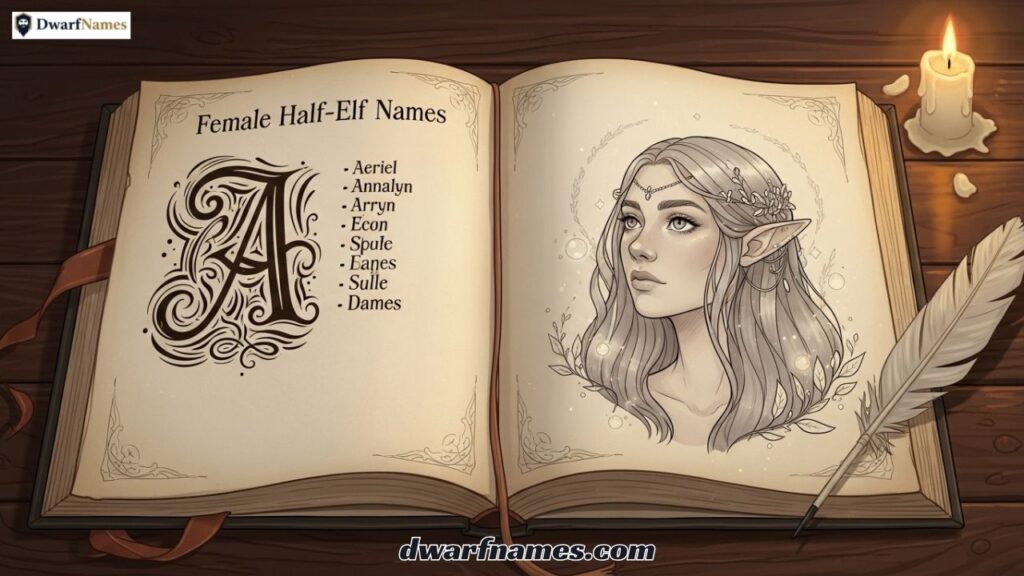
Half-elf women carry names that feel like songs half-remembered — fluid, graceful, yet touched with something mortal and fierce. These are names for healers who also carry blades, for bards who also carry grief, for rogues who left something beautiful behind.
- Sylara
- Aelindra
- Mireth
- Faelith
- Thalindra
- Seryndel
- Aeris
- Varith
- Caeliwyn
- Lirien
- Elowyn
- Selindra
- Dawniel
- Vashara
- Quelara
- Mireille
- Solvara
- Tinawyn
- Rindaleth
- Nyssara
- Caelindra
- Aerindel
- Luthiara
- Bryndis
- Elashara
- Vyndrel
- Ariswyn
- Delvara
- Faerindra
- Kesslyn
Cool and Unique Half-Elf Names
Sometimes you want something that stops people mid-sentence. These names have an edge, an unusual syllable structure, or a sound that makes them instantly memorable. They suit characters who refuse easy categorization — misfits, wanderers, anti-heroes, and visionaries. If you enjoy exploring other fantasy naming traditions, you might also find inspiration in Japanese names for their phonetic elegance.
- Zelvyn
- Kraelith
- Voxindel
- Azaryn
- Thyrvael
- Quindara
- Solthrex
- Meldris
- Nyxalith
- Vordael
- Criethon
- Zelawyn
- Thranvex
- Ossilara
- Auryndel
- Draxilith
- Vesparyn
- Cyndrel
- Olvaria
- Xaelthas
- Prynavel
- Haeloryn
- Zaeldis
- Tyrivael
- Mordecyn
Warrior and Badass Half-Elf Names
Not every half-elf wanders philosophically between worlds. Some plant their boots on the earth and dare the world to move them. These names are for fighters, battle-mages, gladiators, and warriors who have forged their identity in the heat of conflict. They carry consonants like weapons and vowels like war cries.
Much like the fierce DnD half-orc names that define brutal strength, the best half-elf warrior names combine power with a hint of the arcane.
- Valdris
- Kaelthorn
- Ryndrak
- Storvael
- Belthorn
- Gryndel
- Thyrekk
- Vaeldrak
- Mordrivyn
- Slyvorn
- Dravencael
- Kaerthal
- Ruthvael
- Thyrandrak
- Weldris
- Corvanthal
- Glaevyn
- Skarvael
- Drael
- Rendrak
- Calthorn
- Bravindel
- Thyrvex
- Mordaelyn
- Stalkravyn
Royal and Noble Half-Elf Names
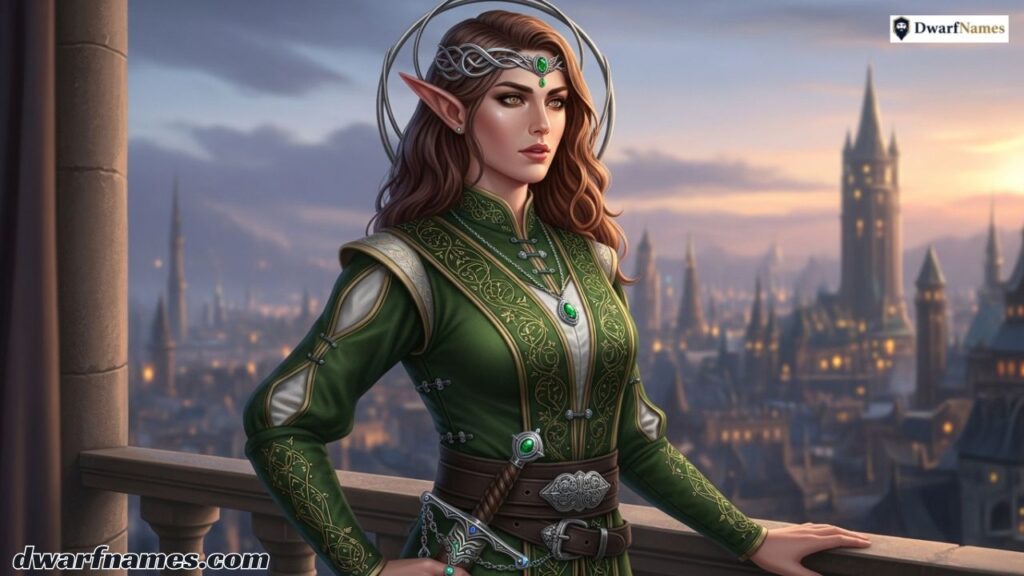
Half-elves who are born into power — or seize it — carry names that command silence in grand halls. These names suit lords, ladies, courtiers, diplomat-spies, and those who govern from the delicate edge between two political worlds. Think long syllables, smooth transitions, and names that sound like they belong on a family crest.
For even richer nobility name inspiration, consider blending these with traditions from Italian names, which carry an inherent sense of aristocratic elegance.
- Aelindor Vaerith
- Caelvaran Thalindra
- Sorvyn Ashmorel
- Elyndara Crestfall
- Valdris Mirevane
- Sylindra Ashenveil
- Aerindal Thornholt
- Quellindra Vayne
- Mirehn Silverveil
- Talindor Dawnmere
- Seryndel Crestmore
- Aelric Valerith
- Lirael Dawnhallow
- Faelindra Crestwood
- Elvindor Ashbourne
- Vaeris Thornmere
- Sylindor Galewing
- Celindra Moonseal
- Brandael Valemoor
- Arisyndra Thornweald
Traditional and Classic Half-Elf Names
Some names endure because they are simply right. These are the time-honored choices that feel immediately at home in any fantasy world, campaign setting, or novel. Classic half-elf names blend elvish phonetics with a timeless accessibility — the kind of name a reader accepts without question because it sounds exactly like it belongs.
- Aerin
- Liryn
- Thalos
- Sylvan
- Elara
- Rendal
- Corin
- Mirael
- Faelin
- Aerith
- Thalion
- Selara
- Daelin
- Quelar
- Varis
- Sylith
- Caelorn
- Mirindel
- Aelvaris
- Thalindra
- Corvael
- Eiryn
- Daelyn
- Lirindel
- Aelindra
Half-Elf Naming Traditions and Lore
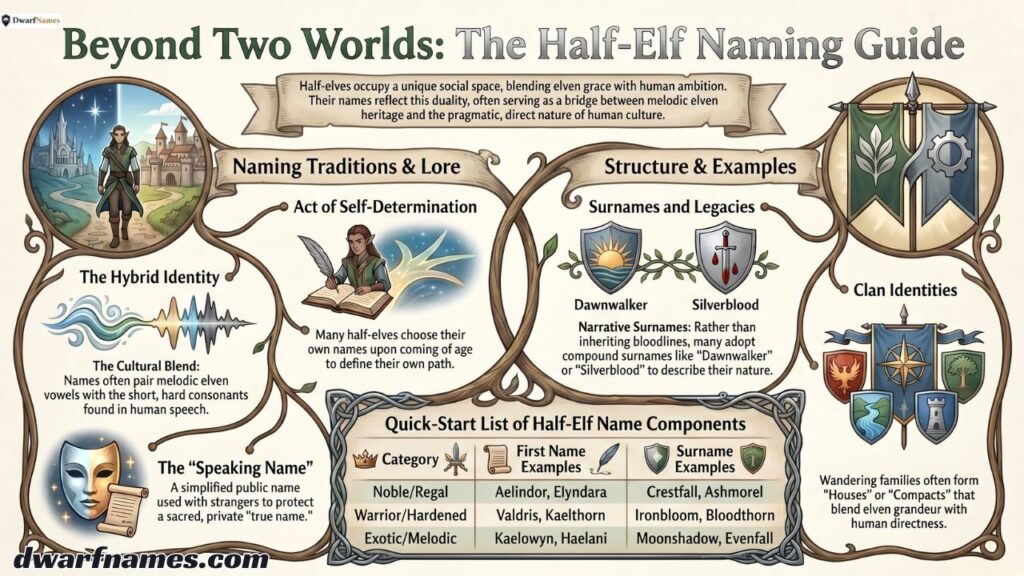
Half-elves occupy a fascinating space in naming lore. In most fantasy traditions, elves use long, melodic names passed down through ancestral bloodlines — names that carry the memory of forests, moonlight, and ages past. Humans, by contrast, favor shorter, harder names shaped by culture, religion, trade, or conquest.
When a half-elf is raised by their elven parent or within an elven community, they often receive an elven name in full — lilting, polysyllabic, and deeply meaningful in the elven tongue. When raised by humans, they might receive a human name entirely, sometimes with an elven diminutive used privately. Many half-elves, particularly those who grew up between cultures or were fostered far from both, choose their own name once they come of age — a deeply symbolic act of self-determination.
In some worldbuilding traditions, half-elves also adopt a “speaking name” — a simplified version of their true name that they offer to strangers, since their full elven name is considered too personal to share with those not yet trusted. This practice mirrors certain traditions found in Japanese god names, where a true name carries sacred power.
Surnames among half-elves are equally hybrid in nature. Some inherit an elven family name that sounds like poetry when spoken aloud. Others adopt human surnames from the town where they grew up or the guild they served. Many invent compound surnames for themselves — names like Dawnwalker, Silverblood, or Ashenveil — that describe their nature rather than their ancestry.
Half-Elf Surnames and Last Names
A half-elf’s surname is often where the real storytelling happens. These compound names, nature references, and invented titles tell the world who this person is beyond their bloodline. Norse naming traditions similarly use evocative compound names — you can explore that tradition through Norse god names for additional inspiration.
Here are over 50 half-elf surnames to pair with any first name above:
- Dawnwalker
- Ashenveil
- Silverblood
- Thornmere
- Moonshadow
- Galewing
- Embervale
- Crestfall
- Ironbloom
- Starlith
- Duskvane
- Misthollow
- Wildthorn
- Evenfall
- Windweave
- Goldmantle
- Ashbourne
- Crystaline
- Shadowmeld
- Rivenveil
- Softsteel
- Dawnmoore
- Embersong
- Silentvale
- Nightwhisper
- Mirefall
- Crestwood
- Starmantle
- Bloodthorn
- Fernweald
- Brightholm
- Darkbloom
- Swiftriver
- Stonewhisper
- Wolfveil
- Sundering
- Duskhollow
- Ironveil
- Thornweald
- Coldmere
- Valerith
- Ashmorel
- Dustmantle
- Embervane
- Silverweald
- Duskstride
- Mistborne
- Galestride
- Thornholt
- Twilightfall
- Moonweave
- Riverholm
- Ironleaf
- Starfall
- Windhollow
Half-Elf Clan Names
While half-elves rarely form clans in the traditional sense, many adventuring companies, mercenary bands, and wandering families of mixed heritage develop their own group identity. These clan names blend elven grandeur with human directness.
If you’re building a world where half-elves have formed their own communities apart from their parent races, giving that community a clan name adds tremendous depth. You might also look at blood elf names for clan structures with elven roots.
- The Ashenveil Compact
- Clan Dawnwalker
- The Twilight Kin
- House Ironbloom
- The Wandering Silver
- Clan Moonshadow
- The Rivenveil Brotherhood
- House Thornweald
- The Embersong Circle
- Clan Starmantle
- The Duskvane Company
- House Wildthorn
- The Between-Born
- Clan Crestfall
- The Halfblood Covenant
- House Galewing
- The Mistborn Wanderers
- Clan Evenfall
- The Twin-Heritage
- House Windweave
- The Shadowmeld Guild
- Clan Ironveil
- The Moonweave Fellowship
- House Starlith
- The Twilight Road
Hawaiian-Inspired and Exotic Half-Elf Names
For players and writers who want something genuinely distinct from the European-adjacent norm, drawing on more exotic phonetic traditions can produce breathtaking half-elf names. Hawaiian naming conventions, in particular, produce names with a flowing, open-vowel beauty that suits elvish heritage wonderfully. Explore Hawaiian names for that lyrical quality.
In the spirit of that tradition, here are half-elf names with an exotic, melodic quality:
- Kaelowyn
- Inalith
- Maelindra
- Lorivael
- Haelani
- Aelowyn
- Kaliveth
- Nalindra
- Taelorin
- Maelvar
- Korindel
- Halvael
- Iraelith
- Naelith
- Kaeliwyn
- Mirelowyn
- Aelakith
- Norivael
- Laelowyn
- Kaelveth
Conclusion: Your Name, Your Story
A half-elf’s name is never just a label. It is the compressed story of a life lived between two worlds — a bridge built of syllables across a divide that can never quite be closed. Whether your character chose their name in defiance, inherited it in love, or found it on a grave marker and decided it sounded like someone worth becoming, that name will follow them through every dungeon, every heartbreak, and every triumph.
The 300 DnD half-elf names in this collection span the full range of what half-elf identity can mean in your story: from the warrior who never looks back, to the noble who speaks three languages and trusts none of them, to the wanderer who names themselves after the road. Whatever your vision, there is a name here that fits.
Take your pick. Carry it well. Build something unforgettable.
Frequently Asked Questions
What makes a good DnD half-elf name?
A great half-elf name blends elven musicality with human directness, reflecting dual heritage. It should feel fantasy-authentic, memorable, and suit the character’s personality and backstory.
Can half-elves have fully human or fully elven names?
Yes. Half-elves raised by humans often carry purely human names, while those raised in elven communities bear traditional elven names. Many choose a unique hybrid name later in life.
How do half-elf surnames work in DnD lore?
Half-elves may inherit elven or human surnames, or invent their own compound name reflecting their nature, like Dawnwalker or Ashenveil, especially if they grew up without strong familial ties.
Are half-elf names gender-specific in DnD?
Not strictly. Many half-elf names are fluid or unisex. Players are encouraged to choose names based on sound and feel rather than strict gender conventions within the game’s lore.
What languages influence half-elf names in fantasy settings?
Half-elf names draw from invented elven tongues, Latin, Welsh, Gaelic, and Nordic roots. The blended phonetics create that distinctive fantasy sound balancing softness and strength.
Can I use half-elf names for other fantasy races?
Absolutely. These names work wonderfully for tieflings, humans with elven blood, fey-touched characters, and original fantasy races where a melodic-yet-grounded name is needed.
How do I choose the right half-elf name for my character?
Consider your character’s background, personality, and which parent culture raised them. A warrior raised in a human city needs a different name than a scholar raised in an elven library.