

In the vast tapestry of human language, few naming traditions carry the mystical weight of Japanese names. Each syllable is deliberate. Each character layered with meaning — drawn from nature, cosmic forces, ancient virtue, and the whisper of spirits long past. Whether you are crafting a novel set in a feudal fantasy realm, building a character for a tabletop RPG, or simply searching for a name that sounds as timeless as starlight, Japanese names offer a depth that few other naming traditions can match.
Japanese names are not merely labels. They are declarations. A warrior named Raijin carries the thunder in his very introduction. A healer called Haruka evokes the soft light of distant spring. In worldbuilding and fantasy writing, a well-chosen name does half the character work before a single line of dialogue is written. It signals culture, personality, and destiny all at once.
This is why storytellers, game masters, and creative writers across the globe return again and again to Japanese names when building their worlds. From anime heroes to samurai legends, from shrine maidens to celestial dragons — the names born of Japan’s rich linguistic heritage possess an almost supernatural resonance. If you have ever wondered why so many beloved fantasy characters carry Japanese-inspired names, the answer is elegantly simple: they feel like names that belong to myth.
In this guide, you will find over 300 Japanese names for boys and girls, organized by theme, tone, and fantasy archetype. Whether you want something fierce, something delicate, something ancient, or something that crackles with elemental power — the perfect name awaits within these lists.
Famous Japanese Names From Literature, Mythology & Games
Before we dive into the full lists, it is worth appreciating how legendary characters have shaped the way we perceive Japanese names in fantasy. These examples show how deeply a name can define a persona.
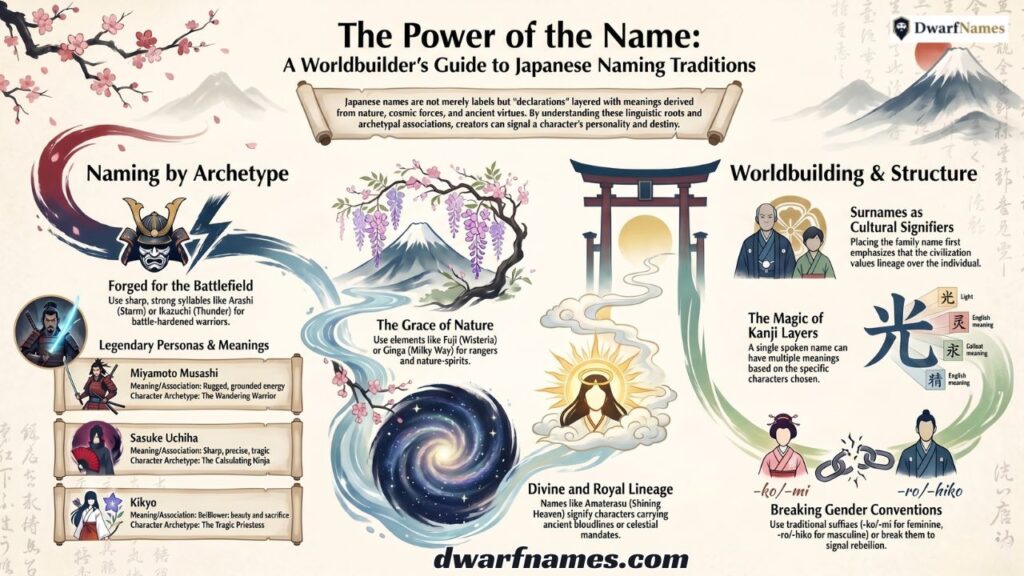
Miyamoto Musashi — Perhaps the most famous samurai name in history, later immortalized in Eiji Yoshikawa’s epic novel. The name Musashi carries a rugged, grounded energy. It is a name that belongs to someone who has walked through fire and emerged harder for it. In fiction and RPG settings, Musashi has become the archetype of the wandering warrior — skilled, solitary, and bound by an unspoken code.
Amaterasu — The goddess of the sun in Japanese Shinto mythology, her name means “shining heaven.” In the beloved video game Ōkami, she takes the form of a white wolf. Amaterasu is the quintessential example of a Japanese name that transcends character — it becomes a concept, a force of light and order. If you are looking for Japanese god names to inspire your divine characters, Amaterasu is the gold standard.
Sasuke Uchiha — From the world of Naruto, Sasuke is one of the most globally recognized Japanese names in modern fantasy. Derived from the historical ninja Sarutobi Sasuke, the name carries a sharp, precise quality — much like the character himself. Cool, calculating, and threaded with tragedy.
Kikyo — The tragic priestess from InuYasha, whose name means “bellflower.” Kikyo’s name is simultaneously soft and haunting — a name that speaks of beauty, sacrifice, and something unresolved lingering between worlds. It is a masterclass in how a feminine Japanese name can carry enormous emotional weight.
These characters prove that a great Japanese name is not just phonetically pleasing — it is an identity carved in sound.
Male Japanese Names: Traditional & Classic
These names draw from the deep roots of Japanese history — the age of shoguns, poets, monks, and wandering swordsmen. If your character is noble, ancient, or carries the weight of a long lineage, these traditional male names are a perfect fit.
- Akihiro
- Daisuke
- Fumihiro
- Genji
- Hachiro
- Isamu
- Jiro
- Kenji
- Masaru
- Noboru
- Osamu
- Raiden
- Saburo
- Tadashi
- Ukon
- Yukio
- Zenjiro
- Hiroshi
- Kazuo
- Makoto
- Naoki
- Satoru
- Taro
- Wataru
- Yoshio
Female Japanese Names: Traditional & Classic
Graceful, resonant, and timeless — these classic feminine Japanese names are rooted in centuries of poetic tradition. Many carry meanings tied to flowers, light, seasons, and virtue.
- Akiko
- Fumiko
- Harumi
- Izumi
- Junko
- Kazuko
- Machiko
- Noriko
- Reiko
- Sachiko
- Tamiko
- Umeko
- Yoshiko
- Yukiko
- Hanako
- Kimiko
- Masako
- Naoko
- Sadako
- Teruko
- Ayako
- Chizuko
- Emiko
- Hiroko
- Keiko
Cool & Unique Japanese Names for Boys
These names break away from convention. They sound modern yet mythic — the kind of names that belong to a rogue sorcerer, a wandering half-spirit, or an outsider hero discovering their power. If you enjoy exploring DnD half-elf names for characters who exist between worlds, these Japanese names will resonate with that same liminal energy.
- Aoiro
- Buraiha
- Chikara
- Daigo
- Eito
- Fujin
- Goro
- Hajime
- Ibuki
- Juro
- Kaito
- Lucio
- Minato
- Naoto
- Orochi
- Phantom
- Raijin
- Sora
- Takumi
- Urei
- Valgo
- Wakou
- Xenon
- Yamato
- Zenko
Cool & Unique Japanese Names for Girls
These feminine names carry a mystical edge — names that feel like they belong to a priestess who walks between realms, an archer of the celestial guard, or the silent keeper of ancient scrolls.
- Aika
- Byakuya
- Chiyo
- Daiki
- Enishi
- Fujiko
- Ginrei
- Hotaru
- Iori
- Jasmine
- Koharu
- Luna
- Mizuki
- Nagi
- Oboro
- Petra
- Rin
- Suiren
- Tsuki
- Umi
- Vega
- Waka
- Xenith
- Yuki
- Zara
Warrior & Badass Japanese Names for Boys
These names were forged for the battlefield. Strong consonants, sharp syllables, and meanings that evoke steel, storms, and unyielding resolve. For your samurai commanders, demon hunters, and battle-hardened veterans.
- Arashi (Storm)
- Bakudan (Explosive)
- Chikyu (Earth Force)
- Doragon (Dragon)
- Enma (King of Hell)
- Fudo (Immovable)
- Gouki (Strong Demon)
- Hayate (Gale Wind)
- Ikazuchi (Thunder)
- Jagen (Evil Eye)
- Kazan (Volcano)
- Musou (Peerless)
- Niten (Two Heavens)
- Oni (Demon)
- Raiden (Thunder God)
- Seiryu (Azure Dragon)
- Toranosuke (Tiger’s Son)
- Ujimasa (Righteous Clan)
- Vergil
- Warlord
- Xeros
- Yorozu (Ten Thousand)
- Zantetsu (Iron Cutter)
- Zubiri
- Kenzan (Sword Bloom)
Warrior & Badass Japanese Names for Girls
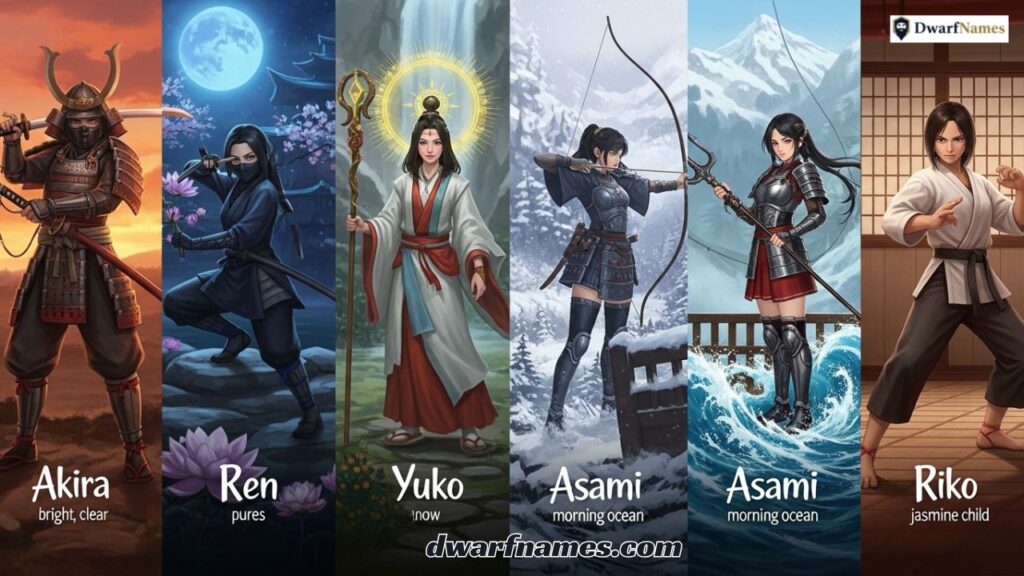
Fierce. Relentless. Unforgettable. These warrior names for women carry the energy of onna-bugeisha — the legendary female samurai who fought with equal ferocity and grace. These are names for characters who do not ask for mercy and do not offer it lightly. You might find similar spirit in lists of DnD half-orc names built for strength and survival.
- Arashi-ko
- Byakko (White Tiger)
- Chidori (Thousand Birds)
- Dokuja (Poison Snake)
- Engetsu (Flame Moon)
- Fujin-hime
- Goruden (Golden Warrior)
- Hibana (Spark)
- Ikari (Rage)
- Junpaku (Pure White)
- Kagero (Heat Haze)
- Mitsurugi (Three Blades)
- Nadeshiko (Wildflower Strike)
- Ogon (Gold Edge)
- Raikiri (Lightning Cutter)
- Seiran (Blue Storm)
- Tsubaki (Camellia Blade)
- Ukon-hime
- Vortex
- Washi (Eagle)
- Xenith-ko
- Yamabuki (Mountain Rose Warrior)
- Zanku (Residual Air Slash)
- Zetsumei (Certain Death)
- Hinata-no-Ken
Royal & Noble Japanese Names
These names are carved for emperors, empresses, high priests, and court lords. They carry elegance, authority, and the quiet weight of ancient bloodlines. If your characters rule over kingdoms or carry divine mandate, these names belong to them.
For Boys:
- Akihito
- Fumihito
- Hirohito
- Michimasa
- Naruhito
- Norihito
- Sadakazu
- Tokugawa
- Yoriyoshi
- Yoshitomo
- Munemasa
- Tadamichi
- Kinmochi
- Arikoto
- Hidetada
For Girls:
- Akiko-hime
- Fusako
- Haruko
- Kazunomiya
- Masako-hime
- Michiko
- Nagako
- Sadako-hime
- Teimei
- Yasuko
- Ryoko
- Kiko
- Fumiko-hime
- Ayanokoji
- Izanami
Mystical & Spiritual Japanese Names
Japanese mythology is a wellspring of extraordinary names — gods, spirits, and celestial beings whose names resonate like spells spoken aloud. These are names for characters touched by the divine: shrine maidens, spirit-walkers, oracle priests, and those born under celestial omens.
Just as Norse god names carry the thunder of Asgard, these Japanese spiritual names carry the sacred silence of ancient shrines and mountain spirits.
Boys:
- Benzaiten
- Fujin
- Gekko
- Hokusai
- Inari
- Jizo
- Kagutsuchi
- Musubi
- Ookuninushi
- Raijin
- Susanoo
- Takemikazuchi
- Ukemochi
- Vashti
- Wakahirume
Girls:
- Ame-no-Uzume
- Benzai-ten
- Chiyo-hime
- Fujin-no-kami
- Hotarubi
- Izanami
- Kaguyahime
- Mononoke
- Nue
- Oyasumi
- Ryujin-hime
- Shinigami-ko
- Tamayorihime
- Uki-fune
- Yaotome
Japanese Names Inspired by Nature
Nature is woven into the soul of Japanese naming tradition. Mountains, rivers, seasons, blossoms — these elements are not just backgrounds in Japanese culture; they are living forces that shape identity. These names are perfect for rangers, druids, nature spirits, or wanderers who feel more at home beneath an open sky than within castle walls. They carry a different kind of beauty than, say, Hawaiian names — more restrained, more mist-shrouded — but equally elemental.
Boys:
- Arashi (Storm)
- Byoki (River Stone)
- Cho (Butterfly)
- Enoki (Elm Tree)
- Fuji (Wisteria)
- Ginga (Milky Way)
- Hayabusa (Peregrine Falcon)
- Ibis
- Jin-no-hana (Flower of Camp)
- Kaiyo (Ocean)
- Minamo (Water Surface)
- Nami (Wave)
- Okami (Great God / Wolf)
- Ran (Orchid)
- Seiryu (Azure Dragon River)
Girls:
- Aoi (Hollyhock)
- Botan (Peony)
- Cho-ko (Butterfly Child)
- Fuyu (Winter)
- Haru (Spring)
- Ichika (One Flower)
- Jasmin-hana
- Kiku (Chrysanthemum)
- Momoko (Peach Child)
- Nadeshiko (Pink Flower)
- Sakura (Cherry Blossom)
- Tsubaki (Camellia)
- Ume (Plum Blossom)
- Yuri (Lily)
- Zakura (Cherry)
Sub-Lore: Japanese Naming Traditions in Fantasy Worldbuilding
Understanding how Japanese names are constructed gives your worldbuilding an additional layer of authenticity that readers and players will feel, even if they cannot name exactly why.
Structure: Traditional Japanese names consist of a family name (surname) followed by a given name. In fantasy contexts, you might flip this Western-style, or maintain the Japanese order as a cultural signifier that your character’s civilization values lineage over individuality.
Kanji Layers: Most Japanese names are written in kanji — characters with layered meanings. The name Haruto could be written to mean “sun flying” or “spring sky” depending on which characters are chosen. In your fantasy world, this layering of meaning can become literal magic — names inscribed with certain kanji grant abilities, while others carry curses.
Gender Markers: In traditional Japanese naming, feminine names often end in -ko (child), -mi (beauty), -ka (flower/fragrance), or -na. Masculine names often end in -ro, -to, -ki, or -hiko. Breaking these conventions in your fiction signals a character who defies social norms — a warrior woman who rejects softness, or a gentle male healer whose name carries feminine grace.
Names as Titles: In historical Japan, many names were effectively titles earned through deeds or rank. A foot soldier might be known by a simple given name, while a lord carried a name laden with ancestral weight and poetic meaning. In fantasy, this creates a rich system where characters might earn their true name — their birth name being a placeholder until their destiny becomes clear.
Japanese Clan Names & Family Surnames for Fantasy
These surnames and clan identifiers are perfect for creating lineages, guilds, noble houses, and ancient orders in your fantasy setting. Many are drawn from Japan’s feudal clan system, others invented in the spirit of that tradition.
- Ashikaga (Foot Tethered to Tomorrow)
- Byakuya-ryu (White Night Dragon Clan)
- Chosokabe (Long Grass Family)
- Daimyo-no-chi (Blood of the Great Lord)
- Enomoto (Beneath the Elm)
- Fuma (Wind Demon)
- Gokenin (Honored House Retainer)
- Hanzo (Half the Way)
- Imagawa (Present River)
- Jinno (Temple Field)
- Kusanagi (Grass Cutter)
- Maeda (Before the Rice Field)
- Nitta (New Rice Field)
- Oda (Small Rice Field)
- Ryuzoji (Dragon Elephant Temple)
- Shimazu (Island Crossing)
- Tachibana (Wild Orange Tree)
- Uesugi (Above Cedar)
- Valiant-no-ha (Leaf of Valor)
- Watanabe (Edge of the Crossing)
- Yamamoto (Base of the Mountain)
- Yashiro (Eight Cities)
- Zenshin (Whole Body Advance)
- Tokugawa-ko
- Muromachi-no-chi
If you enjoy deep-diving into naming traditions across fantasy cultures, exploring blood elf names or Italian names can provide interesting contrast — each tradition carries its own mythology of sound and meaning.
Bonus: Japanese Compound Warrior Names (Fantasy Titles & Epithets)
These are not given names but earned titles — the kind of names that echo through tavern tales and battlefield reports. They function brilliantly as nicknames, legend-names, or the names inscribed on ancient weapons.
- Akumabarai (Demon Sweeper)
- Bakuretsu-no-Ken (Explosive Sword)
- Chikara-Oni (Power Demon)
- Dokkaebi-Kiri (Goblin Cutter)
- Engetsu-Maru (Flame Moon Circle)
- Fuuha-no-Tachi (Bladed Wind of Ruin)
- Goryuken (Five Dragon Fist)
- Hiryuu-Shoten (Flying Dragon Ascent)
- Ikazuchi-Ryu (Thunder Dragon Style)
- Jigoku-Giri (Hell Slash)
- Kazan-Arashi (Volcano Storm)
- Kusarigama-no-Shi (Death of the Chain Sickle)
- Mugen-no-Ken (Infinite Sword)
- Niten-Ichi (Two Heavens as One)
- Okami-no-Tsume (Wolf Claw)
- Rasen-Shuriken (Spiraling Wind Blade)
- Seiryu-Sho (Azure Dragon Palm)
- Tengoku-Ryu (Heavenly Dragon Style)
- Umi-no-Oni (Sea Demon)
- Vajra-Ken (Diamond Fist)
- Wakou-Dachi (Wave Sword)
- Yaiba-no-Kaze (Blade Wind)
- Zangetsu (Slaying Moon)
- Zenshin-Totsugeki (Full Body Charge)
- Akatsuki-no-Yaiba (Crimson Dawn Blade)
Conclusion: The Power of a Name Well-Chosen
A name is the first gift a creator gives to a character, and the first promise made to a reader. When you choose a Japanese name — whether for a novel hero, an RPG party member, a clan in your homebrew world, or a child entering the world — you are reaching into a tradition that has been refining the art of meaningful naming for over a thousand years.
The names in this guide are more than sounds. They are doors. Each one opens into a world of potential — a warrior whose name means thunder who must learn to be still, a gentle healer whose name means blossom who must become a blade. The contradiction between name and deed, or the perfect harmony between the two, is where great stories live.
Use these names boldly. Combine them. Break their rules. Layer their meanings. Let a fierce warrior carry the name of a wildflower, and let a quiet scholar bear the name of a storm. That tension, that poetry — that is what makes storytelling timeless.
Your world is waiting. Now it has names.
Frequently Asked Questions
What are the most popular Japanese names for boys?
Classic Japanese boy names like Kenji, Hiroshi, and Takumi remain widely beloved for their strong, clear sounds and meaningful kanji representations in traditional culture.
What are some beautiful Japanese girl names with meanings?
Names like Sakura (cherry blossom), Yuki (snow or happiness), and Aoi (hollyhock) are beautiful Japanese girl names celebrated for their natural imagery and lyrical sounds.
Are Japanese names good for fantasy characters?
Absolutely. Japanese names carry layered meanings, mythological depth, and phonetic variety that make them exceptionally powerful choices for fantasy characters and worldbuilding projects.
How do Japanese naming traditions work in fantasy worldbuilding?
Japanese names traditionally combine family name first and given name second, with kanji characters adding layered meanings — a system rich for fantasy writers building cultures and lineage systems.
What Japanese names are best for warrior characters?
Names like Raiden (thunder god), Kenzan (sword bloom), and Musou (peerless) carry the fierce, martial energy that suits warrior characters perfectly in fantasy fiction and RPG games.
Can I mix Japanese names with other fantasy naming traditions?
Yes. Blending Japanese names with traditions like Norse or blood elf naming styles creates compelling hybrid cultures and characters that feel unique and deeply imagined in fantasy settings.
What Japanese names come from mythology and Shinto tradition?
Legendary names like Amaterasu, Susanoo, Izanami, and Raijin come directly from Shinto mythology and make powerful choices for divine or spirit-touched fantasy characters.