

The wind howls across the fjords. Longships slice through grey waters. A warrior raises his axe against a sky bruised with storm clouds, and his name rings out like thunder Bjorn Ironside, Ragnar, Sigrid the Proud. In the world of Norse myth, a name was never just a label. It was a declaration of power, a gift from the gods, a prophecy carved in runic stone.
Norse names carry centuries of storm and saga. Whether you are building a fantasy world, rolling up a character for your next tabletop campaign, or writing the opening chapter of an epic novel, the right Norse name can transform a character from a collection of stats or sentences into someone who breathes, bleeds, and believes. These names echo with the thunder of Thor’s hammer, the cunning of Loki’s schemes, and the quiet dignity of the Norns who weave fate at the roots of Yggdrasil.
The Vikings did not simply name their children. They named them with intention, embedding meaning into every syllable. A name carried the spirit of an ancestor, the blessing of a deity, or the promise of destiny. This tradition makes Norse naming one of the richest wells of inspiration for fantasy writers, game masters, and worldbuilders. If you love strong, warrior names, you might also enjoy exploring
If you love strong, warrior names, you might also enjoy exploring fierce half-orc names for your next D&D campaign, which share a similar warrior spirit.
In this guide, you will find over 300 Norse names spanning gods, warriors, shield-maidens, nobles, and the mysterious völva. Use them freely, layer them with meaning, and let them breathe life into your stories.
Famous Norse Names From Literature and Games
Before we dive into the lists, let us honor the names that already live in legend — because understanding how the best names work helps you choose the right one for your own creations.
Ragnar Lothbrok is perhaps the most iconic Norse name in modern storytelling. His name means ‘warrior in armour’ and ‘the shaggy breeches,’ yet together it sounds like the rumble of approaching war. He appears in the Icelandic sagas and has been immortalized in the TV series Vikings, where his name alone became a symbol of ambition, cunning, and destiny.
Lagertha is the legendary shield-maiden from the Norse sagas, a woman whose name carries echoes of the word for ‘path’ or ‘protector.’ She is fierce, noble, and deeply human her name suits her perfectly. In fantasy worldbuilding, a name like Lagertha tells readers everything they need to know before she even speaks.
Freya is the goddess of love, war, and magic, and her name derives from the Old Norse word for ‘lady’ or ‘noblewoman.’ In games like God of War and countless fantasy novels, Freya stands as one of the most powerful female archetypes in mythology. Her name has inspired thousands of fantasy characters across every medium.
Bjorn Ironside, son of Ragnar Lothbrok, bears a name that translates simply to ‘bear.’ It is direct, powerful, and unforgettable. In Norse tradition, the bear was sacred, associated with berserker warriors and raw, unstoppable strength. A character named Bjorn carries that legacy in every battle.
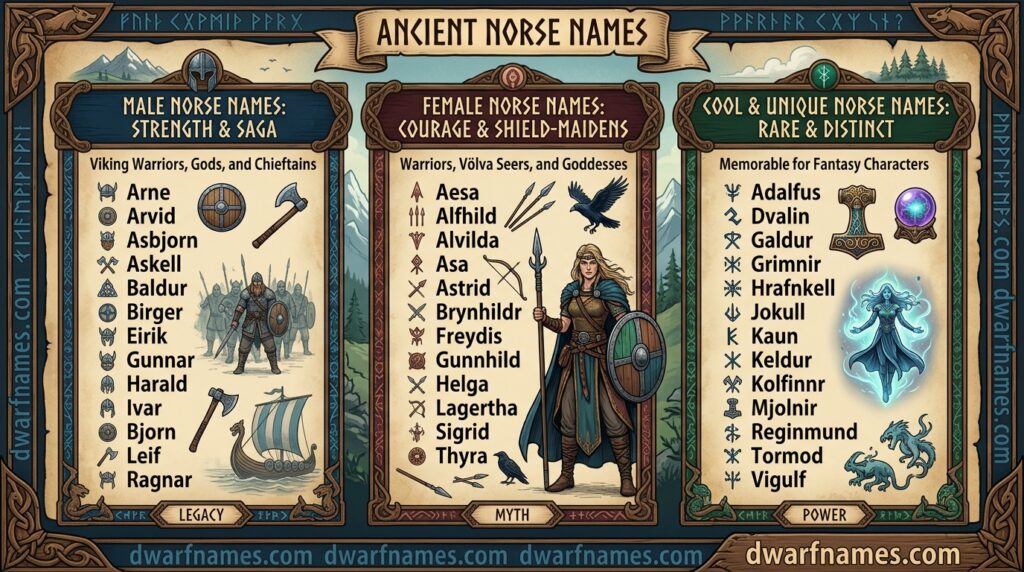
Male Norse Names
These names draw from Old Norse tradition, evoking the strength and spirit of Viking warriors, gods, and chieftains. Each name carries the weight of saga and myth.
- Arne
- Arvid
- Asbjorn
- Askell
- Baldur
- Birger
- Bjarne
- Bodvar
- Brandr
- Dagfinnr
- Egil
- Eindride
- Eirik
- Erlend
- Eysteinn
- Faste
- Floki
- Folkvar
- Frode
- Gunnar
- Gunnulf
- Halfdan
- Hallvard
- Hamund
- Harald
- Hauk
- Helgi
- Hjalmar
- Hrolleif
- Ivar
- Jorvik
- Kare
- Ketill
- Knud
- Kolbein
- Leifr
- Ljot
- Magnusson
- Njord
- Olvir
- Orm
- Osvald
- Ottar
- Ragnar
- Ragnvald
- Sigmund
- Sigurd
- Sindri
- Skuli
- Snorre
- Solmund
- Steinn
- Styrmir
- Svein
- Tore
- Torkel
- Torsten
- Ulf
- Valgard
- Vigdis
Female Norse Names
These names ring with the courage of shield-maidens, the wisdom of völva seers, and the grace of the Norse goddesses. Just like Hawaiian names carry the music of the sea in their syllables, Norse female names carry the music of wind and war.
- Aesa
- Alfhild
- Alvilda
- Asa
- Astrid
- Bergljot
- Bodil
- Brynhildr
- Dagny
- Disa
- Eira
- Eldrid
- Estrid
- Frea
- Freydis
- Gerd
- Gunnhild
- Gyda
- Halldora
- Helga
- Hervor
- Hildegunn
- Hrefna
- Hulda
- Ingrid
- Ingunn
- Jarnsaxa
- Jorunn
- Katla
- Kelda
- Lagertha
- Lilja
- Magnhild
- Nanna
- Ragnfrid
- Ragnhild
- Randi
- Revna
- Runa
- Sif
- Sigrid
- Sigrun
- Skadi
- Skuld
- Solveig
- Steinvor
- Svanhild
- Thora
- Thorunn
- Tofa
- Unn
- Ursula
- Valdis
- Vigdis
- Ylva
Cool and Unique Norse Names
These names stand apart from the common lists. They are rare, striking, and perfect for characters who need to feel distinct and memorable in any fantasy setting.
- Adalfus
- Arveig
- Asmund
- Branulf
- Dagvald
- Dvalin
- Eydis
- Fjolnir
- Galdur
- Geirmundr
- Grimnir
- Gunnvar
- Heidrun
- Hjortr
- Hrafnkell
- Hrolf
- Hrunting
- Jokull
- Kaun
- Keldur
- Kolfinnr
- Lodbrok
- Mjolnir
- Nauma
- Niord
- Ofnir
- Peringskjold
- Rauthulfr
- Reginmund
- Silfrtonn
- Skeggi
- Solbergr
- Svartr
- Tjodolf
- Tormod
- Vandrad
- Vestar
- Vestmar
- Vigulf
- Vili
Warrior and Badass Norse Names
These are the names that ring across battlefields, the names shouted by skalds in the mead-hall after a great victory. Strong, fierce, and deeply rooted in the warrior tradition. Much like German names project strength and authority, these warrior names project raw Viking power.
- Agnar
- Amundi
- Anvindr
- Armod
- Arnfinnr
- Arngrimr
- Asvald
- Atli
- Audolf
- Bersi
- Bjovulf
- Blodorn
- Brimir
- Dagar
- Dagreid
- Eyolf
- Finnbogi
- Freystein
- Gisli
- Glaumvor
- Gnupa
- Grimar
- Gunnbjorn
- Gunnthor
- Hakon
- Hallstein
- Hamdir
- Havardr
- Hord
- Hoskuldr
- Hundingr
- Ketilmund
- Kolgrimr
- Krakamal
- Leiknir
- Mordgrimr
- Oddgeirr
- Ornolfr
- Randver
- Siguror
- Skafti
- Skarphedin
- Thorbjorn
- Thrym
- Ulfhedin
- Valbrand
- Valgardr
- Vidurr
- Vigfus
- Vilmundr
Royal and Noble Norse Names
Noble blood ran through the veins of the great Norse dynasties. These names were given to jarls, kings, and the sons and daughters of god-touched lineages. They carry authority and ancient dignity.
- Adalbert
- Alfgeir
- Alfrekr
- Arngunnr
- Audbirna
- Audhildr
- Brynjolf
- Dagfinnr
- Domarr
- Einarr
- Erlendr
- Eyvindr
- Fjord
- Freymund
- Geirolf
- Gillaug
- Godrun
- Grimolf
- Gudrod
- Gullveig
- Gunhildr
- Hallfred
- Haraldr
- Hildirdr
- Hrafn
- Hvitserk
- Ingeborg
- Ingimund
- Ivarr
- Jorundur
- Ketilrid
- Magnr
- Njal
- Olvir
- Ragnarr
- Ragnheidr
- Sigfuss
- Snorri
- Steinolf
- Svanheidr
- Thornbjorg
- Torunn
- Ulfljot
- Vigfinnr
- Yngvar
- Yrsa
Traditional and Classic Norse Names
These are the names that appear again and again in the Eddas, the sagas, and the runic inscriptions. Classic, time-tested, and instantly recognizable as authentically Norse. If you enjoy the deep heritage of traditional naming conventions, you might also appreciate exploring Chinese names and how ancient cultures encoded identity into language.
- Bard
- Birna
- Bjorn
- Dagr
- Eirik
- Finn
- Frode
- Gudrun
- Gunnar
- Hallvard
- Hilda
- Hroar
- Idunn
- Ingvar
- Kari
- Knud
- Loki
- Magni
- Modi
- Njord
- Nora
- Odinn
- Ragnar
- Rolf
- Sigrid
- Sigrun
- Signe
- Snorri
- Thor
- Thora
- Torvald
- Tyr
- Ulf
- Unn
- Vali
- Vidar
- Vigdis
Norse Naming Traditions and Cultural Lore
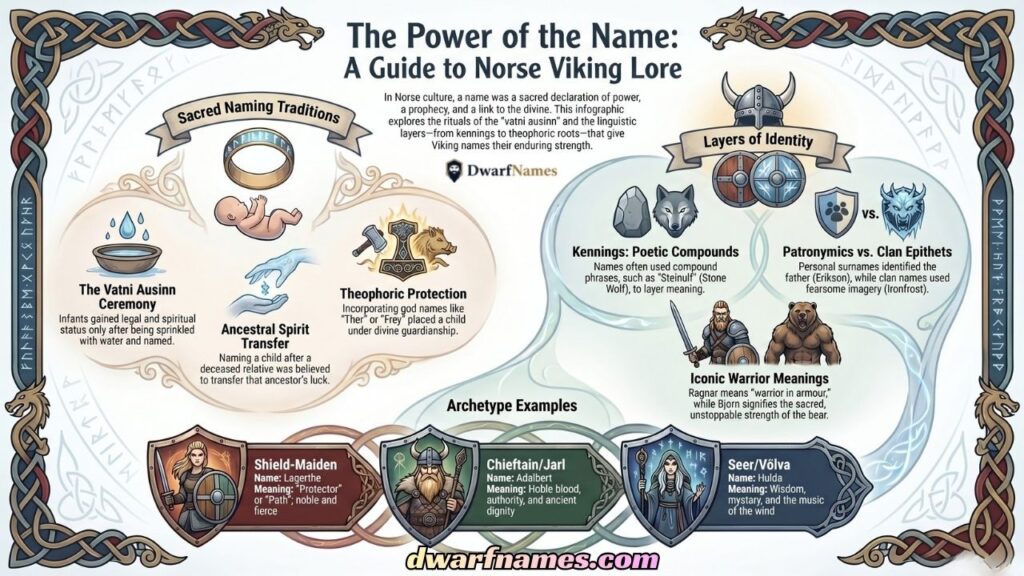
To name a child in ancient Scandinavia was a sacred act. It was not merely a matter of preference. It was a ritual woven into the fabric of fate itself.
The Naming Ceremony: A Norse child was not named at birth but shortly after, in a ceremony called the vatni ausinn, or ‘sprinkling with water.’ The father would lift the infant, sprinkle water upon them, and speak the name aloud. Until this ceremony was performed, the child had no legal or spiritual status. The name was the threshold between existence and belonging.
Ancestor Names: The most powerful naming tradition was that of naming children after deceased ancestors. This was believed to transfer the spirit, luck, and power of the ancestor into the newborn. A child named after a great warrior was expected to grow into that greatness. In fantasy worldbuilding, this creates extraordinary potential for character arcs built on inherited destiny.
Theophoric Names: Many Norse names incorporated the names of deities. Names containing ‘Thor’ such as Thorbjorn or Thorvald, or names containing ‘Frey’ such as Freystein, were extremely common. This practice placed the child under divine protection and declared the family’s devotion to a particular god.
Kenning Names: The Norse language was rich with kennings, poetic compound phrases that described things obliquely. This tradition fed into naming. Rather than naming a child ‘strong,’ they might be called Steinulf, ‘stone wolf,’ layering two powerful images into a single name.
Gender and Identity: Viking society had more nuance around gender roles than many assume. Shield-maidens like Hervor and Brynhildr crossed traditional boundaries, and this was reflected in naming conventions where certain names were shared across genders or carried dual meanings. Female warriors sometimes bore warrior names without any social penalty.
Norse Clan Names and Viking Surnames
Viking naming typically used patronymics rather than hereditary surnames. A son of Erik became Erikson; a daughter became Eriksdottir. But beyond personal names, clans, ships, and warrior bands took on fearsome compound epithets that functioned as group identities. Here are over 60 compound Norse clan and warrior names for your worldbuilding:
- Ashclaw
- Axeborn
- Axefrost
- Bearblood
- Bearmantle
- Blackfjord
- Blackthorn
- Bladewind
- Bloodmoon
- Bloodprow
- Coldstrike
- Corvenrock
- Darkwulf
- Deathbrow
- Deepstorm
- Dragonprow
- Dreadmantle
- Embervein
- Frostborn
- Frostmantle
- Galebreaker
- Gloomraven
- Greymantle
- Grimsteel
- Hammerfall
- Hellnord
- Iceborg
- Ironback
- Ironbrow
- Ironclaw
- Ironfoot
- Ironfrost
- Ironprow
- Ironside
- Ironwulf
- Mistcaller
- Nightblade
- Nightraven
- Ravenmark
- Ravenstorm
- Ridgebreaker
- Rimefrost
- Runeblade
- Seastorm
- Shadowfang
- Shieldbreaker
- Skullcrest
- Stonebreaker
- Stonevein
- Stormborn
- Stormclaw
- Stormcrest
- Stormfang
- Stormmantle
- Thornveil
- Thunderborn
- Voidfang
- Wargcrest
- Wavebreaker
- Wolfblood
- Wolfborn
- Wolfjaw
- Wolfmantle
Conclusion
Names are the first magic of any story. Before a hero swings a sword, before a villain speaks their first lie, before a völva casts her first rune — there is a name. And in the Norse tradition, that name is never accidental. It is a declaration, a prophecy, a gift from the gods and the ancestors who came before.
Whether you are naming a brutal berserker, a wise sea-queen, a cursed jarl, or a god-touched wanderer, the right Norse name will make your character feel real in a way that no amount of description can fully achieve. These 300 Norse names inspired by Viking gods and warriors are yours to use, to twist, to combine, and to make your own.
Build your world. Write your saga. Let the names ring out across the fjords.
Frequently Asked Questions
What makes Norse names unique compared to other fantasy name styles?
Norse names blend harsh consonants with poetic meaning, evoking power, nature, and myth in ways few other naming traditions can match for fantasy worldbuilding.
Can I use these Norse names for my D&D or tabletop RPG character?
Absolutely. These cool Norse names work perfectly for Vikings, barbarians, rangers, and any warrior archetype in D&D or any tabletop RPG setting.
Are these Norse names historically accurate or purely fantasy?
Many are rooted in Old Norse language and Viking Age records, while others are fantasy-inspired variations designed to capture authentic Norse sounds and meaning.
How do I create my own unique Norse names using these as inspiration?
Combine elements like Thor, Bjorn, Ulf, Sig, or Hild with suffixes like -ard, -mund, -rid, or -var to craft believable and unique Norse names for your characters.
What are the best Norse names for female warriors or shield-maidens?
Names like Brynhildr, Hervor, Valdis, Skadi, and Alfhild are ideal for fierce female warriors who command respect and carry deep mythological weight.
Do Norse last names work differently than modern surnames?
Yes. Traditional Norse surnames used patronymics, so Erikson means son of Erik. Fantasy writers can adapt this system to build rich family and clan identity in their worldbuilding.
Where can I find more fantasy name inspiration beyond Norse names?
Explore naming traditions from other cultures for additional inspiration. Warrior-themed names like half-orc D&D names or the lyrical beauty of Hawaiian names can complement Norse names in a rich, diverse fantasy world.