
In the ancient scrolls of the Middle Kingdom, names were never merely labels. They were declarations of destiny, whispered prayers from parent to child, and sometimes warnings carved into jade. A Chinese name carries the weight of generations, the scent of ink-brushed calligraphy, and the resonance of a culture older than most civilizations still walking the earth. For fantasy writers, RPG worldbuilders, and storytellers who want to craft characters with depth and authenticity, Chinese names offer a treasury unlike any other.
Whether you are building a mystical empire for your next novel, designing a warlord for your tabletop campaign, or searching for a name that feels both ancient and powerful, Chinese names deliver. They are melodic yet fierce, delicate yet unyielding. A single syllable can mean “dragon,” “jade,” or “heaven,” instantly planting a character in a world far richer than any descriptor paragraph could achieve. If you appreciate names drawn from ancient traditions, you might also enjoy exploring Norse names or German names for contrast and inspiration across different fantasy cultures.
This article presents over 300 Chinese names for boys and girls, organized by theme, tone, and archetype. Each name comes with its meaning, and throughout you will find lore notes, cultural traditions, and naming conventions that will help you use these names with intention and respect in your creative work. Whether your character is a silk-robed empress, a wandering sword saint, or a shadow-veiled assassin, there is a name here forged for them.
Famous Chinese Names From Literature and Games
Before diving into the lists, it is worth pausing to look at how Chinese names have shaped iconic characters in fiction and gaming. Names in Chinese storytelling are not decorative. They define a character’s nature, foretell their fate, and reflect their role in the cosmic order.
Sun Wukong from Journey to the West is perhaps the most famous Chinese fantasy name in world literature. “Sun” is a clan name, while “Wukong” means “Awakened to Emptiness,” a direct reflection of his spiritual journey from arrogant demon-monkey to enlightened guardian. The name itself tells his entire arc.
Wei Wuxian from the beloved novel and series The Grandmaster of Demonic Cultivation carries a name meaning “Not Knowing Envy,” a irony for a character who becomes the most envied and feared cultivator of his age. His name foreshadows his tragedy.
Hua Mulan, the legendary warrior woman, carries a name that means “Magnolia Flower,” a deliberate contrast to her battlefield ferocity. The tension between her name’s softness and her iron will is part of what makes her story timeless.
Zhen Ji, the lady strategist of the Three Kingdoms, bears a name meaning “Precious and Lucky.” In games like Dynasty Warriors, her name reinforces her dual role as both beautiful and dangerously capable. These examples show that Chinese names are never accidental. They are layered with symbolism from the very first stroke.
Male Chinese Names for Fantasy Characters
These names carry strength, ambition, and wisdom. Ideal for warriors, scholars, emperors, and wandering cultivators, these male Chinese names span from thunderous battle-ready sounds to elegant literary resonance.
- Bao (Precious, treasured)
- Cheng (Successful, accomplished)
- Daqian (Great universe)
- Erlong (Second dragon)
- Fengbo (Wind wave)
- Guangwei (Radiant prestige)
- Haoran (Vast and righteous)
- Jianyu (Sword feather)
- Kailong (Opening dragon)
- Lei (Thunder)
- Mingzhi (Bright wisdom)
- Nanfeng (Southern wind)
- Penglai (Island of immortals)
- Qianlong (Hidden dragon)
- Ruichen (Lucky minister)
- Shaolong (Young dragon)
- Tianlong (Heavenly dragon)
- Wanlei (Ten thousand thunders)
- Xianfeng (Pioneer wind)
- Yaoguang (Brilliant light)
- Zelong (Benefiting dragon)
- Chenghao (Vast achievement)
- Dajian (Great sword)
- Fenglei (Wind and thunder)
- Guanjian (Watchful sword)
- Hulong (Tiger dragon)
- Junwei (Noble prestige)
- Lingfeng (Spirit wind)
- Moyun (Ink cloud)
- Nanliu (Southern current)
- Panlong (Coiled dragon)
- Qionglong (Vast dragon)
- Shanwei (Mountain prestige)
- Tianhao (Heavenly vast)
- Wenshao (Cultured youth)
- Xuanlong (Mysterious dragon)
- Yangtian (Upward to heaven)
- Zhenfeng (True phoenix)
- Bolong (Surging dragon)
- Chaowei (Morning prestige)
Female Chinese Names for Fantasy Characters
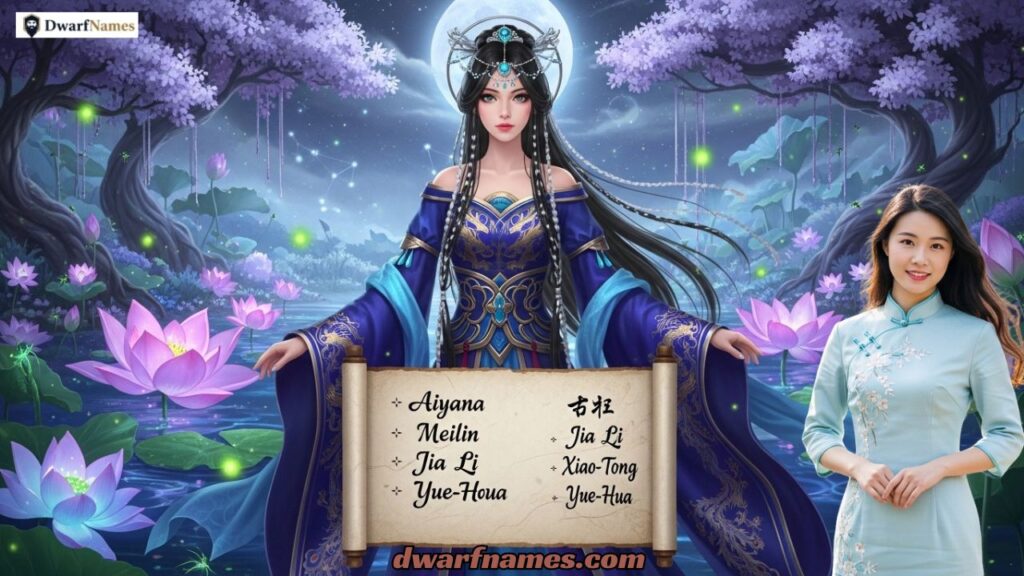
Feminine Chinese names carry poetic resonance, natural imagery, and hidden power. These names suit sorceresses, noble ladies, celestial guides, and warrior heroines equally.
- Bailu (White dew)
- Chunhua (Spring blossom)
- Danxia (Rosy cloud)
- Fengling (Spirit phoenix)
- Guiying (Noble flower)
- Huilan (Fragrant orchid)
- Jinghua (Pure blossom)
- Keran (Clear as a bell)
- Lihua (Pear blossom)
- Mengdie (Dream butterfly)
- Nianhua (Year blossom)
- Peiying (Companion blossom)
- Qinghe (Clear river)
- Ruolan (Like an orchid)
- Shanshan (Gentle and graceful)
- Tianxin (Heaven’s heart)
- Wanying (Ten thousand shadows)
- Xiaolian (Little lotus)
- Yanmei (Swallow plum)
- Zhilan (Iris orchid)
- Ailian (Love lotus)
- Bingbing (Crystal clear)
- Chunjuan (Spring graceful)
- Dailan (Elegant orchid)
- Feixia (Flying rosy cloud)
- Guanyin (Goddess of mercy)
- Huiniang (Wise maiden)
- Jiaying (Outstanding heroine)
- Lanhua (Orchid blossom)
- Meihui (Beautiful wisdom)
- Ningxia (Peaceful rosy cloud)
- Peilan (Fragrant jade orchid)
- Qiuyue (Autumn moon)
- Roulan (Gentle orchid)
- Shuilian (Water lotus)
- Tingjuan (Graceful and clear)
- Wenxiu (Cultured elegance)
- Xiulan (Elegant orchid)
- Yueying (Moonlight reflection)
- Zhimei (Graceful plum)
Cool and Unique Chinese Names
These names carry an edge. They feel exotic, mysterious, and immediately memorable, perfect for antiheroes, wanderers, and characters who defy simple categorization.
- Anying (Dark shadow)
- Beixuan (Northern mystery)
- Canglong (Azure dragon)
- Duhun (Solitary soul)
- Emei (Elegant brow)
- Fuyin (Hidden mark)
- Guying (Solitary shadow)
- Hunpo (Soul spirit)
- Jingye (Still night)
- Kongling (Hollow spirit)
- Lieyun (Fierce cloud)
- Miechen (Destroying dust)
- Niehun (Cursed soul)
- Poyue (Broken moon)
- Qingming (Clear and bright)
- Ruiyue (Sharp moon)
- Shaluo (Falling sand)
- Tianluo (Heaven’s net)
- Wuhun (Warrior soul)
- Xuanying (Mysterious shadow)
- Yeyuan (Night abyss)
- Zhanhun (Battle soul)
- Anlong (Hidden dragon)
- Biyue (Jade moon)
- Cangyue (Azure moon)
Warrior and Badass Chinese Names
These names were forged on battlefields and in iron. They belong to generals, blade masters, demon hunters, and legendary fighters whose reputations ripple across dynasties.
- Baquan (Dominating fist)
- Chanshou (Slaying hand)
- Daoshen (Sword spirit)
- Fengzhan (Phoenix war)
- Gonglie (Fierce attack)
- Huobao (Fire leopard)
- Jiansheng (Sword saint)
- Kuanglong (Wild dragon)
- Liebao (Fierce leopard)
- Menghu (Fierce tiger)
- Nihun (Blade soul)
- Poshan (Mountain breaker)
- Qiangjian (Strong sword)
- Ruilong (Sharp dragon)
- Shanjun (Mountain warrior)
- Tiejian (Iron sword)
- Wulong (Fierce dragon)
- Xuelang (Blood wolf)
- Yinglong (Shadow dragon)
- Zhantian (Heaven slayer)
- Baojian (Precious sword)
- Chiyou (God of war)
- Dulong (Lone dragon)
- Fengba (Phoenix dominator)
- Guhun (Lone warrior soul)
If you enjoy fierce warrior name aesthetics, you might also explore DnD half-orc names for similarly powerful battle-ready characters.
Royal and Noble Chinese Names
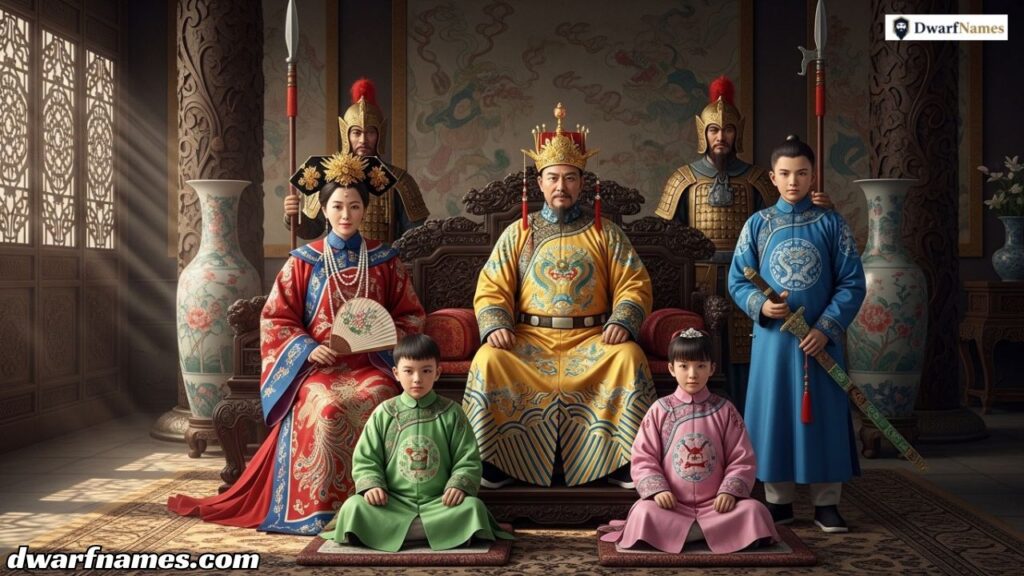
These names carry the gravity of imperial courts, silk robes, and jade thrones. They suit emperors, princes, court scholars, and celestial nobles with grace and weight.
- Baolong (Precious dragon)
- Chenglong (Prosperous dragon)
- Dijun (Emperor lord)
- Fengyuan (Phoenix origin)
- Guijun (Noble lord)
- Huanglong (Imperial dragon)
- Jinglong (Revered dragon)
- Languan (Royal official)
- Mingdi (Brilliant emperor)
- Nianwang (Sovereign of years)
- Pinjun (Noble master)
- Qianwang (Hidden king)
- Ruijun (Sharp noble)
- Shenglong (Sacred dragon)
- Tianzun (Heavenly honored)
- Wanglong (King dragon)
- Xuanjun (Mysterious lord)
- Yunlong (Cloud dragon)
- Zhenlong (True dragon)
- Baihuang (White emperor)
- Changdi (Eternal emperor)
- Dalong (Great dragon)
- Fenghuang (Phoenix emperor)
- Gongdi (Palace emperor)
- Haijun (Sea lord)
For female royals, consider these noble names carrying celestial weight:
- Baoyu (Precious jade)
- Chunguang (Spring radiance)
- Dailing (Elegant spirit)
- Feiyan (Flying swallow)
- Guifei (Noble consort)
- Huanghou (Empress)
- Jinniang (Golden maiden)
- Liangying (Bright heroine)
- Mingzhu (Bright pearl)
- Nianfei (Year consort)
- Peizhu (Jade-paired)
- Qianzhu (Thousand pearls)
Traditional and Classic Chinese Names
Rooted in Confucian virtue, Taoist harmony, and centuries of poetic tradition, these names feel timeless. They carry a steady, grounded energy that suits elders, scholars, and beloved heroes.
- Anping (Peaceful and calm)
- Boming (Bright hope)
- Chuanren (Passing virtue)
- Dechang (Moral prosperity)
- Erwen (Second literary)
- Fucheng (Prosperous city)
- Guangen (Rooted in virtue)
- Hechun (Harmonious spring)
- Jiaming (Home brilliance)
- Keming (Overcome to shine)
- Liren (Standing tall with virtue)
- Mingde (Bright virtue)
- Nianren (Righteous year)
- Pengcheng (Bird city)
- Qianwen (Hidden literary)
- Rensheng (Virtuous life)
- Shengwen (Sacred literary)
- Tianren (Heavenly virtue)
- Weizhong (Loyal middle)
- Xiaowen (Filial literary)
- Yanzheng (Upright and righteous)
- Zhengde (Righteous virtue)
- Anwen (Peaceful literary)
- Bocheng (Broad prosperity)
- Chunren (Spring virtue)
For those building full-blooded cultural settings, pairing Chinese names with influences from Hawaiian names can create vibrant island-empire hybrid worlds.
Chinese Naming Traditions and Cultural Lore
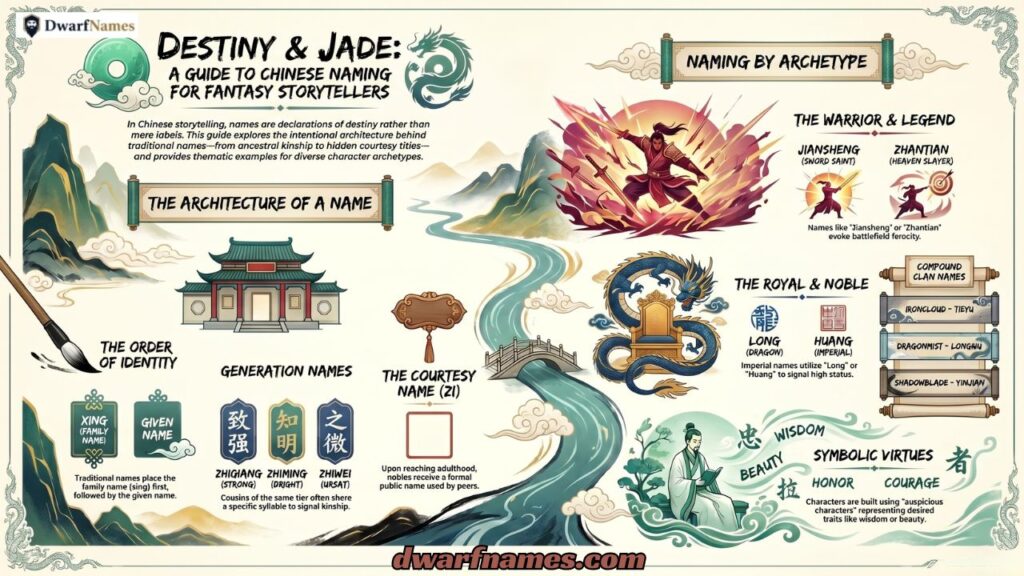
Understanding how Chinese names work transforms how you use them. In ancient China and across the fantasy realms inspired by it, names followed a deeply intentional architecture.
Given Names and Generation Names. A traditional Chinese name consists of a family name (xing) placed first, followed by a given name of one or two syllables. In many dynastic clans, a generation name was embedded within the given name, shared by all cousins of the same generational tier. A character named Liu Jianzhi and their cousin Liu Jianyun share the “Jian” generation syllable, immediately signaling kinship.
Courtesy Names. Upon reaching adulthood, scholars and nobles received a zi, or courtesy name, used by peers as a sign of respect. Only family and the emperor could use the birth name directly. For worldbuilders, giving your character a private birth name and a public courtesy name instantly creates layers of intimacy and social hierarchy.
Auspicious Characters. Parents selected characters for names based on desired virtues: “Long” (dragon) for power, “Hui” (wisdom) for scholars, “Mei” (beauty) for daughters, “Feng” (phoenix) for spiritual elevation. Combining two auspicious characters creates a layered meaning that works on multiple levels simultaneously.
Taboo Names. Naming a child after a living ancestor or a ruling emperor was strictly forbidden. In fantasy settings, a character who shares the name of a legendary emperor might face superstition, prophecy, or political danger simply because of what they are called.
Daoist and Buddhist Name Traditions. Monks and Taoist cultivators abandoned their birth names upon entering spiritual practice, taking names tied to their lineage sect or spiritual aspiration. A character who gives up a family name for a Daoist sect name signals a complete severance from worldly life, a powerful dramatic choice.
Chinese Clan Names and Compound Fantasy Surnames
These compound clan names and surnames carry epic fantasy weight. They work perfectly for noble houses, martial arts sects, imperial families, and legendary bloodlines.
- Ironcloud (Tieyu)
- Dragonmist (Longwu)
- Jadefall (Yudie)
- Shadowblade (Yinjian)
- Stonepeak (Shidian)
- Thunderveil (Leijuan)
- Silkwind (Sijian)
- Moonspire (Yuejian)
- Ashenlotus (Huilian)
- Crimsonpeak (Hongshan)
- Ghostwillow (Guiliu)
- Ironlotus (Tielian)
- Voidcrown (Konguan)
- Starlance (Xingjian)
- Emberdragon (Huolong)
- Frostclaw (Bingzhao)
- Goldenserpent (Jinshe)
- Heavenwall (Tianqiang)
- Inkspine (Moji)
- Jadepeaks (Yufeng)
- Knifecloud (Daoyun)
- Lavafist (Yanquan)
- Mirrorlake (Jinghu)
- Nightbloom (Yehua)
- Obsidianfall (Xuanpao)
- Pearlriver (Zhuzhu)
- Quietmountain (Jingshan)
- Redphoenix (Chifeng)
- Silverwave (Yinlang)
- Thousandblades (Wanjian)
- Tigerden (Huxue)
- Umbrafall (Yin Luo)
- Vaultstone (Baoyan)
- Whitecrane (Bairu)
- Xingtide (Starwave)
- Yellowdragon (Huanglong)
- Zenithhawk (Dingying)
- Ashwood (Huimu)
- Bloodpetal (Xuenhua)
- Coldmoon (Binyue)
- Deepwater (Shenshui)
- Eastwind (Dongfeng)
- Flamehill (Huoshan)
- Ghostmist (Guiwu)
- Honorblade (Rongjian)
Conclusion
A name does not merely identify a character. It breathes life into them. In Chinese naming tradition, whether ancient or fantasy-inspired, a name is a compact story, a destiny whispered into the world at the moment of arrival. When you name your empress Mingzhu (Bright Pearl), your sword saint Jiansheng (Sword Saint), or your rogue cultivator Anying (Dark Shadow), you are not just filling a character sheet. You are layering meaning into every moment they appear on the page or at the table.
The 300 Chinese names for boys and girls gathered here are your starting vault. Use them boldly. Combine them with your own invented surnames. Embed generation names into sibling groups. Give your elder characters courtesy names that mask their true identity. Let the cultural naming traditions shape your world’s social architecture and you will find that your readers and players feel a depth they cannot quite explain but absolutely feel.
Names are ancient magic. And these names have been waiting for stories worthy of them.
Frequently Asked Questions
What are the most powerful Chinese names for fantasy male characters?
Names like Tianlong (Heavenly Dragon), Jiansheng (Sword Saint), and Chiyou (God of War) carry immense power and suit warrior or legendary hero archetypes in fantasy settings.
What do Chinese girl names typically mean in fantasy contexts?
Female Chinese names often draw from nature, such as Qiuyue (Autumn Moon) or Mengdie (Dream Butterfly), blending beauty with mysticism to suit heroines and magical characters.
How are traditional Chinese names structured for worldbuilding?
Chinese names place the family name first, followed by one or two syllables. Many noble families also use shared generation syllables, ideal for building interconnected fantasy dynasties.
Can Chinese names work for non-human fantasy races?
Absolutely. Chinese names suit celestial beings, dragons, fox spirits, and cultivators. Their layered meanings make them especially powerful for mystical or ancient fantasy races.
What makes Chinese warrior names unique compared to other fantasy naming styles?
Chinese warrior names combine martial imagery with elemental forces, such as Xuelang (Blood Wolf) or Poshan (Mountain Breaker), creating names that feel both brutal and poetically resonant.
Are there Chinese naming traditions that add depth to RPG characters?
Yes. Using courtesy names (zi), generation names, and sect names from Daoist or Buddhist traditions adds rich social and spiritual layers to your RPG or tabletop characters.
Where can I find more fantasy name inspiration beyond Chinese names?
Explore traditions like Norse names for Viking-era power, German names for medieval gravitas, or Hawaiian names for ocean-island world flavor.