
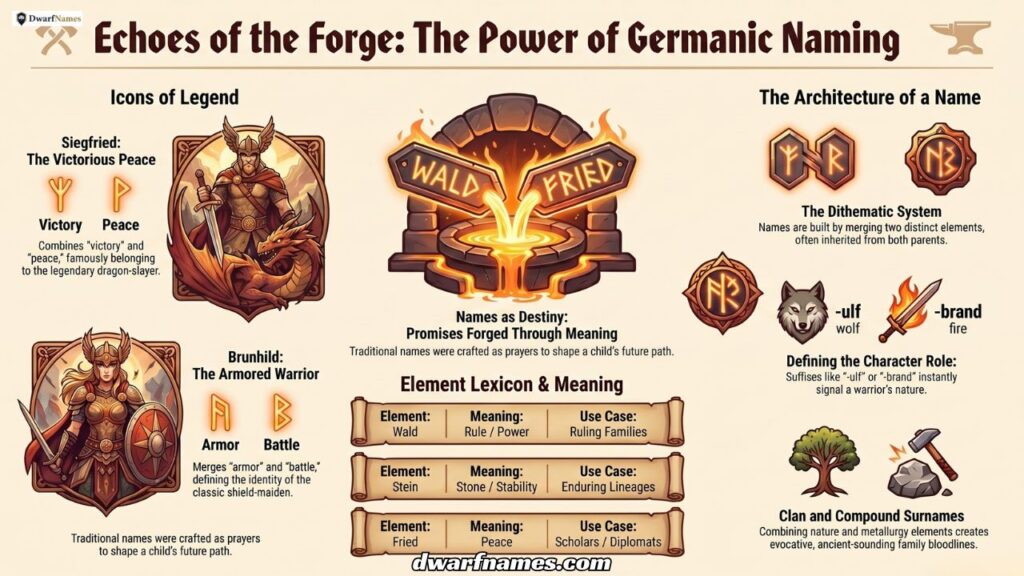

There is something ancient and powerful about a name rooted in the Germanic tradition. Long before knights rode through fog-drenched forests and scholars debated the mysteries of runes, names were more than labels. They were promises. They were prayers spoken aloud at a child’s first breath, carved into shields before battle, and whispered in forest shrines by those who understood that a name could shape a destiny.
German names carry that same weight today. Whether you are crafting a fantasy world, building a character for your next tabletop RPG campaign, naming a hero in your novel, or simply searching for a name that feels strong and timeless, the German naming tradition offers a treasure chest unlike any other. These names echo with stone castles, dark pine forests, river valleys wrapped in morning mist, and the deep resonance of a culture that has shaped European civilization for centuries.
The Germanic linguistic family gave birth to some of the most beloved names in fantasy literature, from brooding warriors to wise sorcerers and cunning queens. Names like these are not invented from thin air. They are forged through centuries of meaning, much like the way Norse names carry the spirit of the sea and the storm. German names carry the spirit of the forest and the forge.
If you are a writer, a gamer, or simply someone who loves names that carry real cultural depth, this is your ultimate guide to the finest German names for boys and girls, sorted by theme, personality, and fantasy role.
Famous German Names From Literature and Games
Before diving into the full lists, it is worth pausing to appreciate how German names have already shaped some of the most iconic fantasy characters ever created.
Siegfried is perhaps the most legendary of all German mythic heroes. His name, meaning “victory peace,” appears in the Nibelungenlied, one of the greatest medieval epics ever written. Siegfried slays dragons, bathes in their blood, and becomes nearly invincible. His name has become a symbol of heroic destiny, a perfect choice for any warrior protagonist whose fate is written in blood and gold.
Brunhild is the fierce shield-maiden of the same epic, a warrior queen whose name evokes armor, fire, and unbreakable will. Her identity is built into her name, with “Brun” meaning armor or breastplate and “hild” meaning battle. She is one of the original female fantasy warriors, centuries before the genre was even invented.
Albrecht, used in various Germanic tales and later in fantasy adaptations, carries the meaning “noble and bright.” It is a name that suits a wizard or a noble strategist, someone who commands both intellect and authority.
Hildegard, made famous by the medieval mystic Hildegard von Bingen, combines “hild” (battle) with “gard” (enclosure, protection). This is a name for a woman who is both a warrior in spirit and a guardian of sacred knowledge. It is a wonderful template for fantasy characters who walk the line between scholar and fighter.
These names show us something important. A well-chosen name does more than identify a character. It tells the reader who that character is before they speak a single word.
Male German Names
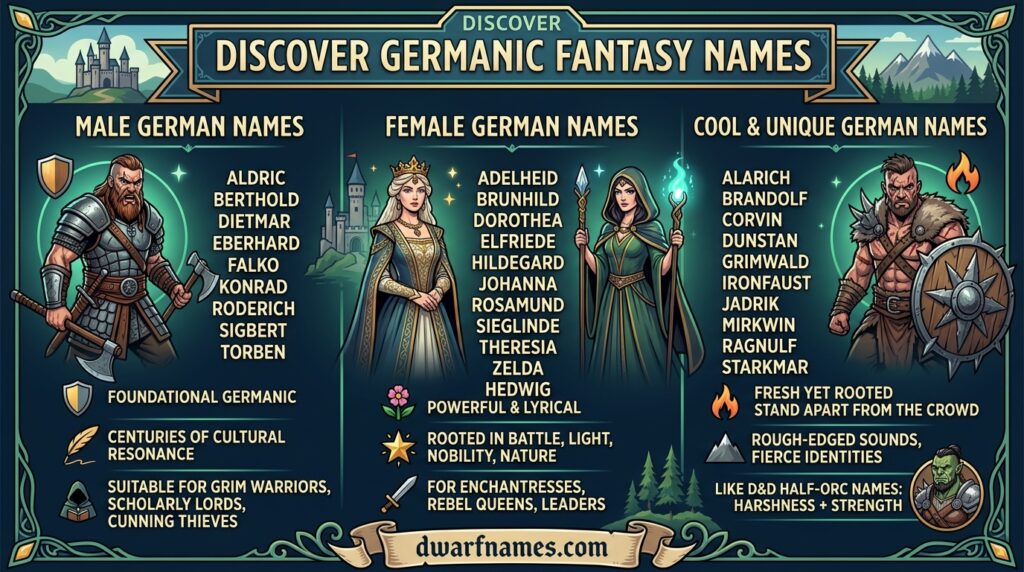
These are the foundational Germanic names for male characters. Each carries centuries of cultural resonance and works beautifully in fantasy settings, from grim barbarian warriors to scholarly lords and cunning thieves.
- Aldric
- Berthold
- Claus
- Dietmar
- Eberhard
- Falko
- Gerhard
- Hartwin
- Ingolf
- Jodok
- Konrad
- Ludolf
- Manfred
- Norbert
- Oswin
- Pieter
- Quirin
- Roderich
- Sigbert
- Torben
- Ulrich
- Volker
- Waldemar
- Xaver
- Yorick
- Zedric
- Albrecht
- Barnard
- Cedric
- Dietrich
- Eckehard
- Friedrich
- Gottfried
- Helmut
- Isidor
- Juergen
- Karl
- Leontius
- Meinhard
- Niclaus
- Otfried
- Philbert
- Rainald
- Severin
- Thaddaeus
- Ulfbert
- Vibert
- Wendelin
- Xerxes
- Zacharias
Female German Names
German female names are equally rich. Many are powerful and lyrical at once, blending soft syllables with meanings rooted in battle, light, nobility, and nature. These cool German names for girls suit everything from enchantresses to rebel queens.
- Adelheid
- Brunhild
- Clarissa
- Dorothea
- Elfriede
- Friederike
- Gertrude
- Hildegard
- Ilse
- Johanna
- Kunigunde
- Lieselotte
- Mechthild
- Nora
- Ottilie
- Petra
- Rosamund
- Sieglinde
- Theresia
- Ulla
- Veronika
- Walburga
- Xenia
- Yvonne
- Zelda
- Agathe
- Bertrada
- Clotilda
- Dietlinde
- Ermengard
- Franziska
- Gisela
- Hedwig
- Ingeborg
- Jutta
- Klara
- Leonora
- Mathilde
- Notburga
- Ortrud
- Philippa
- Richarda
- Salome
- Truda
- Ursula
- Vincenza
- Walpurga
- Xanthe
- Yrsa
- Zita
Cool and Unique German Names
These unique German names feel fresh even while rooted in tradition. They are the names that make readers stop and read twice, perfect for characters who are meant to stand apart from the crowd.
- Alarich
- Brandolf
- Corvin
- Dunstan
- Erwin
- Falconer
- Grimwald
- Hasard
- Ironfaust
- Jadrik
- Keldar
- Lorvald
- Mirkwin
- Norvik
- Olvind
- Pyrolt
- Quindor
- Ragnulf
- Starkmar
- Thalric
- Undrik
- Verold
- Wolfmar
- Xaldric
- Yovald
- Zurbad
- Aethelric
- Borvald
- Crestwin
- Dunmoor
For anyone who enjoys the rough-edged sound of names from conquest cultures, these also pair nicely with the kind of fierce identities found in DnD half-orc names, where harshness and strength come together in a single word.
Warrior and Strong German Names
Warriors in German tradition carried names that announced their nature. A name ending in “-ulf” (wolf), “-hard” (hardy, strong), or “-brand” (sword, fire) signaled a fighter before a single weapon was drawn. These badass German names are built for your most formidable characters.
- Arnulf
- Berchtold
- Cunibald
- Detlef
- Egilhard
- Florian the Fierce
- Gunther
- Hrodmund
- Ingobert
- Jormund
- Knuthard
- Liutbrand
- Mordwulf
- Nordhard
- Osberht
- Pramund
- Ragnhard
- Starkolf
- Thordric
- Ulvhard
- Valdric
- Wolfhard
- Xandric
- Ythulf
- Zvardric
- Adalwulf
- Bluthard
- Crimund
- Dornulf
- Eckhard
Royal and Noble German Names
These German noble names carry an air of authority and elegance. They are built for kings, queens, emperors, and the high lords of fantasy courts. The weight of lineage lives inside each syllable.
- Adalbert
- Basilius
- Clemens
- Damian
- Ernst
- Ferdinand
- Georg
- Heinrich
- Isambard
- Josias
- Kasimir
- Leopold
- Maximilian
- Nikolaus
- Othmar
- Philipp
- Reinhold
- Sigismund
- Theoderich
- Udo
- Vitus
- Wilhelm
- Xenophon
- Yaromir
- Zdenko
- Adelgunde
- Beatrix
- Clothilde
- Danizka
- Eleonora
Just as Chinese names carry deep symbolism about rank and lineage, German royal names were chosen to reflect the weight of dynastic expectation.
Traditional and Classic German Names
These are the timeless, classic German names that have endured for a thousand years. They are the names carved into monastery walls and whispered in ancient family chronicles. In a fantasy setting, they give your world a sense of deep history.
- Andreas
- Bartholomaeus
- Christian
- Daniel
- Emil
- Franz
- Gregor
- Hans
- Jakob
- Klaus
- Ludwig
- Michael
- Nikolai
- Otto
- Paul
- Rudolf
- Sebastian
- Thomas
- Urban
- Veit
- Werner
- Xanthus
- Yannick
- Zeno
- Anna
- Barbara
- Christine
- Dorota
- Elisabeth
- Franziska
German Naming Lore and Cultural Traditions
In the old Germanic world, names were never chosen lightly. They were constructed with intention, often combining two meaningful elements called “name elements” or “dithematic components.” A father might take the first element of his own name and the second element from his wife’s name to create a child’s name that literally wove their lineages together.
The element “wald” meant rule or power. “Fried” meant peace. “Helm” meant protection or helmet. “Burg” meant fortress. “Stein” meant stone. By combining these elements, a family could shape a name that expressed exactly what they hoped their child would become.
Warriors received names heavy with wolf imagery, fire, and iron. Scholars and priests leaned toward names tied to light, wisdom, and faith. Royalty favored names that spoke of rule, victory, and divine right.
This tradition also meant that families could be identified by the name elements they passed down through generations, much like a coat of arms expressed in sound. A clan that always used “-wald” in their names was known as a ruling family. A line that kept “-stein” in their names was known for endurance and stability.
This kind of naming lore offers extraordinary depth for worldbuilding. In your fantasy setting, you can use the same system to create entire noble houses, warrior clans, and peasant families whose identities are embedded in the very syllables of their names.
German Clan and Compound Names
For fantasy writers building noble houses, warrior bands, or ancient bloodlines, compound names and clan surnames offer an additional layer of richness. These German last names and clan identifiers feel like they were pulled directly from a medieval charter or carved into a fortress gate.
- Steinbrecher (Stone Breaker)
- Eisenwald (Iron Forest)
- Sturmfaust (Storm Fist)
- Kaltherz (Cold Heart)
- Wolfsblut (Wolf Blood)
- Drachenstein (Dragon Stone)
- Feuerbach (Fire Creek)
- Schwarzwald (Black Forest)
- Goldburg (Gold Fortress)
- Silberhelm (Silver Helm)
- Rittermark (Knight’s Border)
- Dunkelstein (Dark Stone)
- Blutberg (Blood Mountain)
- Eisenborn (Iron Born)
- Nachtschatten (Night Shadow)
- Wildfeuer (Wild Fire)
- Kriegsmann (War Man)
- Felsenberg (Rocky Mountain)
- Klausberg (Claw Mountain)
- Scharfklingen (Sharp Blades)
- Sturmdorn (Storm Thorn)
- Eisenkralle (Iron Claw)
- Hartfels (Hard Rock)
- Waldbrecher (Forest Breaker)
- Silberbach (Silver Creek)
- Frostwall (Frost Wall)
- Donnerfaust (Thunder Fist)
- Knochenbrecher (Bone Breaker)
- Steinwall (Stone Wall)
- Rotfeuer (Red Fire)
- Dunkelwald (Dark Forest)
- Blankschwert (Bright Sword)
- Kriegsberg (War Mountain)
- Eisensturm (Iron Storm)
- Mondlicht (Moon Light)
- Steinkralle (Stone Claw)
- Nachtblut (Night Blood)
- Flammenwald (Flame Forest)
- Holzberg (Wood Mountain)
- Silberfaust (Silver Fist)
These compound surnames are ideal for Hawaiian names-inspired worldbuilding experiments too, where you layer phonetics from multiple traditions to create something genuinely new.
Conclusion
Names are never just decoration. In fantasy literature, in RPG campaigns, in worldbuilding documents that will never be fully published but are deeply loved by their creators, names are the first act of creation. They set the tone, carry the culture, and define the soul of the person or place they belong to.
German names offer something rare in the vast landscape of fantasy naming traditions. They are simultaneously ancient and alive. They carry the weight of real history without being trapped by it. They can be soft or brutal, noble or common, strange or immediately familiar. A character named Hildegard carries the spirit of a shield-maiden and a mystic at once. A warrior called Arnulf carries the wolf and the eagle in a single breath.
Whether you are writing a sweeping epic, designing a dungeon for your gaming group, or simply building the kind of world you wish you could visit, the names in this guide are yours to use. Carve them into your maps, whisper them in your dialogue, give them to your heroes and villains alike.
The old Germanic tradition believed that a name was a kind of fate. Give your characters names worthy of the stories they are about to live.
Frequently Asked Questions
What makes German names ideal for fantasy characters?
German names combine strong consonants, rich history, and meaningful roots, giving fantasy characters an instantly immersive and powerful identity that feels authentic.
Are these German names suitable for DnD and tabletop RPGs?
Absolutely. German names work beautifully in fantasy RPGs, lending warriors, mages, and nobles a grounded, world-authentic feel that enriches any campaign setting.
Can I combine German name elements to create unique fantasy names?
Yes. Germanic names were traditionally built from two meaningful elements, so mixing roots like “stein,” “wald,” and “burg” lets you craft entirely original fantasy names.
What is the difference between traditional and warrior German names?
Traditional names lean toward faith, peace, and nobility. Warrior names use elements like “ulf” (wolf), “hard” (strong), and “brand” (sword) to signal strength and battle readiness.
Are German female names strong enough for powerful fantasy heroines?
Definitely. Names like Brunhild, Hildegard, and Mechthild carry deep warrior and mystic symbolism, perfect for fierce, complex female protagonists in any fantasy story.
How do German clan names work in fantasy worldbuilding?
German compound surnames combine two meaningful words to express identity, lineage, or reputation. They function beautifully as house names, guild titles, or warrior clan identifiers.
Where can I find more culturally inspired fantasy names beyond German traditions?
Exploring naming traditions from Norse, Hawaiian, and Chinese cultures can expand your worldbuilding vocabulary and help you create richly diverse fantasy civilizations.