
There is a kind of magic in a Celtic name. It rolls off the tongue like wind across a highland moor, carrying the weight of ancient forests, forgotten gods, and warriors who carved their legends into stone. Whether you are building a fantasy world from scratch, rolling a new character for your tabletop campaign, or simply searching for a name that feels alive with myth, Celtic names offer something no other naming tradition quite matches: a sense that the name itself is a living thing.
Celtic culture stretches across Ireland, Scotland, Wales, Brittany, Cornwall, and the Isle of Man, weaving together a rich tapestry of languages, stories, and spiritual traditions. The Celts believed in the power of words. A name was not merely a label; it was a declaration of identity, a bond to one’s ancestors, and sometimes a prophecy. Warriors took names that described their deeds. Druids named children after sacred animals, rivers, and the forces of nature. Even enemies feared to speak certain names aloud, believing the sound itself carried power.
For writers, gamers, and worldbuilders, that tradition is a goldmine. Celtic names carry natural musicality, strong consonant clusters, and vowel combinations that feel ancient without sounding alien. They work beautifully for elves, druids, rangers, witches, and high kings alike. If you have already explored traditions like Viking names or the sweeping romanticism of Spanish names for your characters, Celtic names will feel like discovering a whole new continent of inspiration.
This guide collects 250 of the finest Celtic names across multiple categories, complete with lore-style explanations, cultural naming traditions, and a bonus section of clan names to round out any fictional lineage. Let the naming begin.
Famous Celtic Names From Literature and Games
Before diving into the full lists, it helps to look at how Celtic names have already shaped the stories we love. The greatest fantasy and mythological characters carry names that feel earned rather than invented.
Cú Chulainn stands as perhaps the most legendary figure in Irish mythology. Born Setanta and renamed after slaying the hound of Culann, his name literally means “Hound of Culann.” The story behind the name defines the character: a warrior of impossible speed and fury who took responsibility for what he destroyed. His name is a vow made flesh.
Arianrhod comes from Welsh mythology and means “Silver Wheel” or “Silver Disc,” a reference to the moon. She is a figure of mystery, magic, and contested power, her name perfectly reflecting the shimmering, untouchable quality of her character in the Mabinogion. Any sorceress or lunar deity in your world could carry this name with authority.
Merlin, known in Welsh as Myrddin, is the archetypal fantasy wizard, and his name may derive from a fortress in Wales or from older Brittonic roots connected to the sea fort. His name became synonymous with wisdom wrapped in enigma. It is short, memorable, and has lost none of its power across centuries of storytelling.
Fionn mac Cumhaill (Finn MacCool) led the legendary Irish warriors known as the Fianna. His name means “fair” or “white,” yet he is anything but gentle. The contrast between his bright name and his fierce deeds is itself a Celtic naming tradition: names that carry one truth while the person carries another.
Male Celtic Names
These names carry the strength and depth of ancient bardic tradition. Each has a sound built for legend.
- Aedan
- Ailill
- Bran
- Brennus
- Cailan
- Caoilfhinn
- Cathal
- Cillian
- Coemgen
- Conall
- Conchobar
- Connlan
- Cormac
- Darragh
- Diarmuid
- Donnchadh
- Eamon
- Emrys
- Enda
- Fergus
- Fiachra
- Fingal
- Flann
- Gawain
- Geraint
- Goibhniu
- Gwydion
- Idwal
- Keiran
- Laighean
- Lorcan
- Lucan
- Mael
- Maelgwn
- Murchadh
- Niall
- Oengus
- Owain
- Padraig
- Riordan
- Ronan
- Ruadhri
- Seamus
- Sennach
- Tadhg
- Tigernach
- Torin
- Torcall
- Urien
- Vortigern
Female Celtic Names
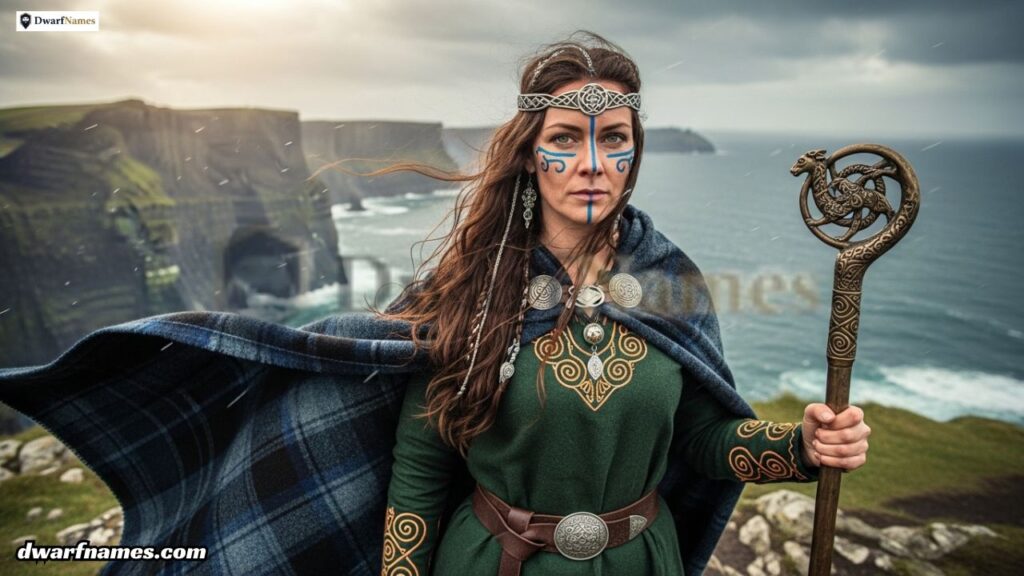
Celtic women in myth were warriors, seers, queens, and druids. Their names reflect both grace and iron.
- Aife
- Aine
- Aoibheann
- Aoife
- Arianrhod
- Bebhinn
- Blodeuedd
- Branwen
- Caoimhe
- Ceridwen
- Cliodhna
- Coinchend
- Creidne
- Dearbhla
- Deirdre
- Eimear
- Elspeth
- Emer
- Etain
- Fionnuala
- Glenys
- Gwenllian
- Iseult
- Lasair
- Liadan
- Luiseach
- Macha
- Maeve
- Morrigan
- Muirenn
- Nessa
- Niamh
- Orla
- Rhiannon
- Roisin
- Sabina
- Sadhbh
- Saoirse
- Scathach
- Sile
- Sinead
- Sorcha
- Talitha
- Tamsin
- Tegwen
- Una
- Viviane
- Wren
- Yseult
- Zephyrine
Cool and Unique Celtic Names
For worldbuilders who want something less familiar but still rooted in authentic Celtic tradition, these names bring unusual sounds and striking combinations.
- Abartach
- Ailbhe
- Aillen
- Alator
- Ambiorix
- Andarta
- Badb
- Balor
- Borvo
- Brigantia
- Cailleach
- Camulos
- Cathbad
- Coventina
- Cruachain
- Dagfinnr
- Damara
- Dian Cecht
- Donn
- Dumnorix
- Epona
- Esus
- Flidais
- Gobannon
- Grainne
- Lugh
- Manannan
- Medb
- Modron
- Nantosvelta
- Nuada
- Ogma
- Ricagambeda
- Senach
- Smertrios
- Sucellos
- Taranis
- Teutates
- Verbeia
- Viridios
Warrior and Badass Celtic Names
These names were made for battlefields, war councils, and characters who leave marks on the world whether they intend to or not. Think of Turkish names for parallel inspiration in warrior-naming traditions across cultures.
- Aengus
- Aldric
- Ambicatos
- Arminius
- Arverni
- Bellator
- Bolg
- Boudica
- Brannoc
- Briccriu
- Broccan
- Cadoc
- Caratacus
- Caractacus
- Cingetorix
- Conchobhar
- Cunobelin
- Donogh
- Drust
- Dubhghall
- Dunstan
- Fearghus
- Galahad
- Garbhan
- Gareth
- Gofannon
- Gwrtheyrn
- Ivar
- Labraid
- Laoch
- Mordred
- Morrigan
- Ossian
- Peredur
- Ruaidhri
- Talorcan
- Taran
- Tighearnach
- Tuathal
- Vercingetorix
Royal and Noble Celtic Names
These names carry the weight of crowns, courts, and bloodlines stretching back to the age of gods and giants.
- Ailill
- Arthmael
- Atrebates
- Beli
- Branoc
- Brioc
- Brychanus
- Cadwallon
- Caratacus
- Catigern
- Cerdic
- Cinbelin
- Clotri
- Conan
- Cunobelinus
- Dunmail
- Eochaidh
- Feidlimid
- Giric
- Gruffudd
- Gwenddoleu
- Gwenwynwyn
- Idris
- Ithel
- Loegaire
- Lugaid
- Maelgwn
- Murchertach
- Nechtan
- Rhydderch
- Riagall
- Rogan
- Sencha
- Sitric
- Tigernmas
- Toirdelbach
- Tuathal
- Turlough
- Uallach
- Urien
Traditional and Classic Celtic Names
The names that have endured for a thousand years across Ireland, Scotland, and Wales. These are the names carved into monastery walls and sung in old ballads.
- Aidan
- Alby
- Brendan
- Brian
- Brigid
- Caitlin
- Callum
- Ciara
- Colin
- Declan
- Donal
- Donagh
- Eithne
- Ewan
- Fionn
- Glen
- Grainne
- Hugh
- Kieran
- Liam
- Mairi
- Malcolm
- Margaret
- Moira
- Muriel
- Nora
- Oona
- Patrick
- Quinn
- Rory
- Seamus
- Shannon
- Sheila
- Siobhan
- Sinead
- Sloane
- Tara
- Teagan
- Tristan
- Yvaine
Celtic Cultural Naming Traditions
Understanding how Celts named their people can transform a flat character list into a living world with genuine depth.
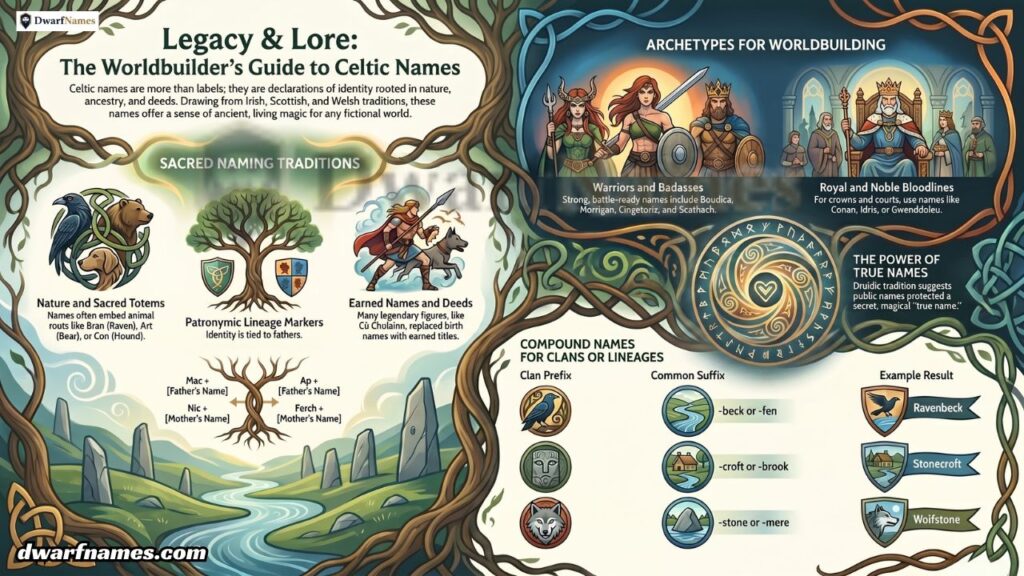
Patronymic Structure. In Irish tradition, children took their father’s name using the prefix “Mac” (son of) or “Nic” for daughters. In Welsh tradition, “ap” (son of) and “ferch” (daughter of) served the same purpose. A warrior named Cathal whose father was Fergus would be known as Cathal mac Fergusa. This is why so many Celtic surnames begin with Mac, Mc, or O.
Names Given at Deeds. The most dramatic Celtic naming tradition involves names earned rather than given at birth. Cú Chulainn is the most famous example, but the practice was widespread. A hunter who killed a legendary beast might take the creature’s name into their own. A druid who survived an impossible ordeal might be given a name by the tribe that reflected what was witnessed.
Nature and Sacred Animals. Celtic names frequently drew from the natural world. The wolf, raven, bear, stag, salmon, and hound all appear embedded in name roots. The prefix “Bran” means raven. “Art” means bear. “Con” or “Cu” means hound. A character whose name contains one of these roots carries an implicit totem, an animal guardian woven into their identity.
Seasonal and Elemental Names. Some children received names tied to the season of their birth or the natural phenomenon that occurred at their arrival. A child born during a great storm might be named Taran, meaning thunder. One born at the winter solstice might receive a name meaning “dark sun” or “the returning light.”
Druidic Naming Ceremonies. In many Celtic societies, a druid would observe the omens at a child’s birth and offer a true name that only the child and their closest family would know. A public name was used in daily life, but the true name held magical weight. This tradition is perfect for fantasy settings where names carry power and secrecy is protection.
Celtic Clan Names and Surnames
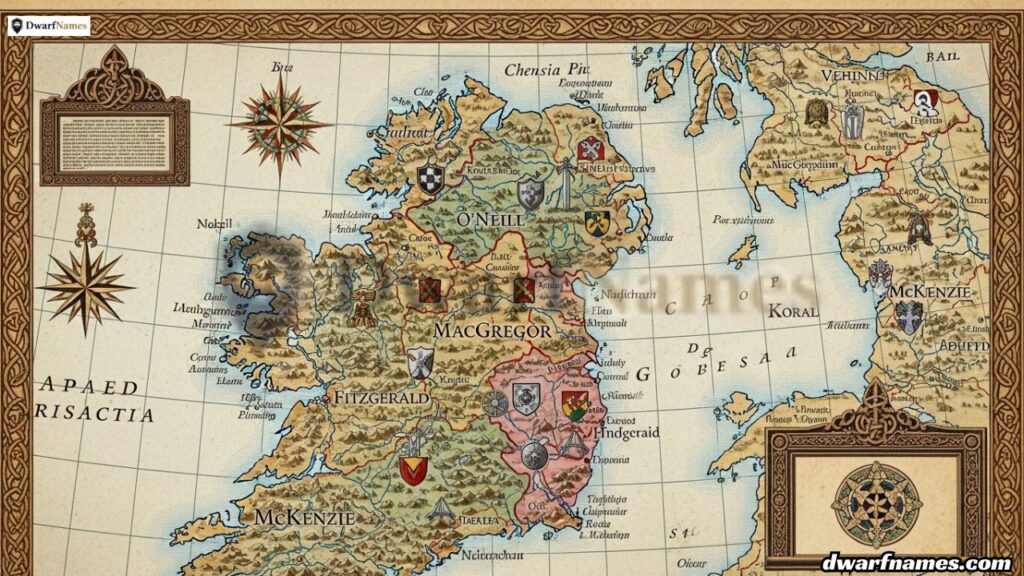
These compound and descriptive names work perfectly as clan identifiers, family names, or titles of renown for any fantasy character or faction. Each carries the feel of earned reputation.
- Blackthorn
- Bloodmoor
- Brightforge
- Bronzemantle
- Coldwater
- Copperhill
- Crowbane
- Darkfen
- Dawnward
- Deeproot
- Duskmantle
- Emberthorn
- Fernhollow
- Firemere
- Flintwall
- Ghostwater
- Goldenbough
- Greyfen
- Grimhollow
- Hawthorncrown
- Hillwatch
- Ironbranch
- Ironfen
- Ironmere
- Ironvale
- Longthorn
- Merestone
- Misthaven
- Mossfall
- Nightbough
- Oakenward
- Ravenbeck
- Ravenfen
- Redthorn
- Rivenbeck
- Silverfen
- Silverthorn
- Smokewater
- Stonebrook
- Stonecroft
- Stonefen
- Stormfen
- Stormhollow
- Thornback
- Thornfen
- Thornwall
- Tidewatch
- Wildfen
- Willowmere
- Windmere
- Wolfbough
- Wolfbrook
- Wolffen
- Wolfmere
- Wolfstone
- Woodmere
- Wyndfen
Conclusion
A name is never just a name. In Celtic tradition, in fantasy literature, and in the worlds you build at your desk or around a game table, a name is the first act of creation. It tells the reader who to trust, who to fear, and who carries something worth watching. The moment you choose the right name for a character, something shifts; they become real in a way that no amount of description can manufacture.
The 250 Celtic names in this guide are more than a list. They are doorways. Each one opens into a tradition of warriors, druids, queens, and wanderers who shaped some of the greatest stories in human history. Whether you choose the battle-forged sound of Vercingetorix, the lunar mystery of Arianrhod, or the quiet endurance of Ronan, you are borrowing from a tradition that understood the weight of naming better than almost any other.
Use these names boldly. Build the clans, write the lore, roll the character, and let the name do what Celtic names have always done: carry a whole life inside a handful of syllables.
Frequently Asked Questions
What makes Celtic names different from other fantasy name styles?
Celtic names blend ancient languages with nature symbolism, creating musical yet fierce sounds that feel both mystical and grounded in real cultural tradition.
Can I use Celtic names for non-human fantasy characters like elves or druids?
Absolutely. Celtic names suit elves, druids, fae, rangers, and witches especially well due to their natural imagery and ancient spiritual resonance.
What do the prefixes Mac, O, and Ap mean in Celtic names?
Mac means son of, O means grandson or descendant of, and Ap is the Welsh equivalent meaning son of, used in patronymic naming traditions.
Are there Celtic names that work for both male and female characters?
Yes. Names like Ronan, Quinn, Sloane, and Taran are considered flexible and work well across gender lines in fantasy worldbuilding contexts.
How do I pronounce difficult Celtic names like Siobhan or Caoimhe?
Siobhan is pronounced shih-VAWN and Caoimhe is KEE-va. Celtic phonics differ greatly from English spelling rules.
What is the best Celtic name for a warrior character?
Vercingetorix, Boudica, Scathach, and Conchobar are all legendary warrior names with powerful historical and mythological roots worth considering.
Where can I find more name inspiration beyond Celtic traditions?
Explore traditions like Viking names or Spanish names to build a diverse roster of memorable fantasy characters.