
There is something undeniably musical about a Spanish name. Whether whispered across candlelit rooms or called out across sun-scorched plazas, Spanish names carry centuries of culture, conquest, faith, and flame. They feel ancient and alive at the same time, rooted in Iberian soil yet branching into every corner of the world. For writers, game masters, and worldbuilders, they are nothing short of gold.
If you have ever been crafting a story set in a sun-drenched Mediterranean kingdom, a colonial-era port city, or a sprawling fantasy empire with Latin roots, you already know the frustration of reaching for the right name and coming up empty. Spanish names solve that problem elegantly. They carry weight, melody, and meaning all at once. A name like Rodrigo tells you something. So does Esperanza. So does Valentina. Names are not just labels; they are the first sentence of a character’s story.
In worldbuilding, the names your characters carry shape how readers perceive their culture, lineage, and destiny. Choosing a Spanish name for your fantasy realm is choosing a language that has given the world saints, conquerors, poets, and rebels. It is choosing a naming tradition that blends Latin roots with Visigothic pride, Moorish elegance, and New World fire. This article brings you over 300 of the finest Spanish names, organized by theme, tone, and purpose, so you can find exactly the name your next character deserves.
Whether you are building a noble house for your tabletop campaign, naming a ship captain in your novel, or simply searching for a beautiful baby name with real historical depth, this guide is your map through one of the richest naming traditions in the world. And if you are also exploring names from other powerful cultural traditions, you might enjoy this collection of Hindi names with deep cultural meaning alongside your Spanish research.
Famous Spanish Names From Literature and Games
Before diving into the full lists, it is worth pausing to appreciate how Spanish names have shaped some of fiction’s most iconic characters. These names do not merely identify a person; they define them.
Don Quixote is perhaps the most famous Spanish literary name of all time. Cervantes’ knight-errant carries a name that is both noble and absurd, a perfect reflection of his character. Quixote believed himself a hero in a world that had moved on from chivalry. His name became synonymous with idealism, madness, and the human need to believe in something greater.
Inigo Montoya from “The Princess Bride” is a name that became a battle cry. Inigo is a real Spanish name of Basque origin, meaning “my little one” or linked to the Latin Ignatius. Yet in fiction, it became a symbol of unrelenting purpose. A name can carry a mission.
Isabela Madrigal from the animated film “Encanto” represents the soft power of Spanish naming tradition. Isabela comes from the Hebrew Elisheba, meaning “God is my oath,” and it radiates the kind of grace and complexity the character embodies throughout the story.
Salazar Slytherin from the Harry Potter universe takes its first name from a deeply historical source. Antonio de Oliveira Salazar was a real historical figure, but the name itself has Iberian roots and carries a serpentine, aristocratic menace that Rowling used to brilliant effect. Names shape perception long before we know the character’s full story.
Male Spanish Names
Spanish male names tend to be bold and resonant. Many trace back to Latin or Germanic warrior names brought by Visigoths, transformed over centuries into something distinctly Iberian. These names suit knights, merchants, scholars, and kings alike.
- Alejandro
- Alfonso
- Álvaro
- Andrés
- Armando
- Arturo
- Augusto
- Aurelio
- Balthazar
- Basilio
- Bernardo
- Blas
- Camilo
- Carlos
- Casimiro
- Celestino
- Cornelio
- Cristóbal
- Damián
- Diego
- Edmundo
- Emilio
- Enrique
- Ernesto
- Esteban
- Ezequiel
- Fabián
- Felipe
- Fernando
- Florencio
- Francisco
- Gonzalo
- Gregorio
- Guillermo
- Héctor
- Hilario
- Ignacio
- Isidro
- Jacobo
- Javier
- Joaquín
- Jorge
- José
- Juan
- Julián
- Leandro
- Leonardo
- Lorenzo
- Lucas
- Luis
Female Spanish Names
Spanish female names are among the most poetic in any language. They flow like rivers and carry the weight of cathedrals. Many are rooted in Marian devotion, virtue, nature, or classical mythology filtered through centuries of Catholic Spain. Whether you need a queen, a healer, or a sorceress, these names serve beautifully.
- Adriana
- Agustina
- Alicia
- Amparo
- Ana
- Beatriz
- Belén
- Blanca
- Camila
- Caridad
- Carmen
- Catalina
- Cecilia
- Clara
- Claudia
- Concepción
- Consolación
- Cristina
- Delfina
- Dolores
- Elena
- Elvira
- Esmeralda
- Esperanza
- Estrella
- Eugenia
- Evangelina
- Fátima
- Fernanda
- Florencia
- Gabriela
- Gloria
- Graciela
- Guadalupe
- Inés
- Isabel
- Josefina
- Leonor
- Lorenza
- Lucía
- Luisa
- Magdalena
- Marisol
- Mercedes
- Milagros
- Natalia
- Paloma
- Pilar
- Remedios
- Rocío
Cool and Unique Spanish Names
Not every name needs to be common to be Spanish. Some Spanish names feel rare and otherworldly, names that would not feel out of place in a fantasy epic or a high-stakes RPG campaign. These are the names that make readers stop and pay attention.
- Absalón
- Adalberto
- Alipio
- Amancio
- Anacleto
- Anselmo
- Apolinar
- Aquilino
- Arcadio
- Argimiro
- Ariel
- Aristides
- Atanasio
- Azucena
- Baldovino
- Calixto
- Candelaria
- Celestina
- Cipriano
- Clodoveo
- Conrado
- Cosme
- Dagoberto
- Dalmacio
- Desiderio
- Eladio
- Elpidio
- Emeterio
- Epifanio
- Eufrosina
- Evaristo
- Fulgencio
- Genoveva
- Heliodoro
- Hermenegildo
- Idelfonso
- Iluminada
- Jacinta
- Juvenal
- Leocadia
Warrior and Strong Spanish Names
Warriors in Spanish history carried names that rang like steel. From the Reconquista to the conquest of the Americas, these names were carved into the stone of history by soldiers, generals, and kings who refused to yield. For any fighter, champion, or warlord in your story, this list delivers power.
If you enjoy exploring strong warrior naming conventions across cultures, the tradition of Viking names offers a fascinating contrast to Spanish warrior heritage.
- Abelardo
- Adalrico
- Alejo
- Almanzor
- Alonso
- Amaro
- Ansgar
- Archibaldo
- Arnaldo
- Bernabé
- Bernal
- Blasio
- Borja
- Braulio
- Cadmo
- Caín
- Ciro
- Claudio
- Cordobés
- Cortés
- Dario
- Demetrio
- Drago
- Edmaro
- Egidio
- Eldric
- Eligio
- Espada
- Fermin
- Fierro
- Florián
- Galindo
- Gálvez
- Garrido
- Gaspar
- Gelasio
- Gilberto
- Godofredo
- Gómez
- Grimaldo
Royal and Noble Spanish Names
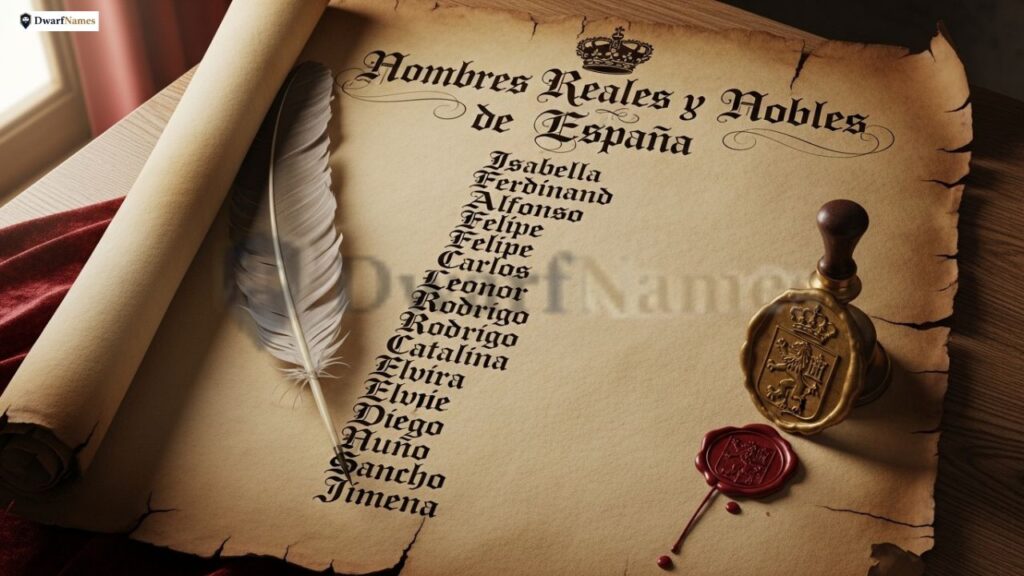
The courts of Spain, from the kingdoms of Castile and Aragon to the Viceroyalties of the New World, produced names that drip with authority and elegance. These names belong to rulers, heirs, diplomats, and the great houses of any fantasy empire inspired by Iberian grandeur.
For those designing elaborate noble families and school hierarchies for their worldbuilding, exploring school names can offer useful parallel inspiration for naming institutions, academies, and guilds alongside your character names.
- Afonso
- Alamiro
- Alarico
- Alfredo
- Alicio
- Almudena
- Alonzo
- Altamira
- Álvarez
- Amadeo
- Amalia
- Ambrosio
- Anastasio
- Anatolio
- Andrómeda
- Angélica
- Anunciación
- Aparicio
- Apolonia
- Arango
- Arantxa
- Arecio
- Argelia
- Ariadna
- Arísteo
- Armentario
- Arnau
- Arroyo
- Artemio
- Asunción
- Atilano
- Aureliano
- Aurelio
- Auxilio
- Avelino
- Azael
- Baldomero
- Balduino
- Bartolomé
- Bautista
Traditional and Classic Spanish Names
These are the names that have anchored Spanish culture for centuries. They appear in church records and royal decrees, in poetry and philosophy, in the mouths of grandmothers and village priests. Classic names carry timeless dignity.
- Abundio
- Acisclo
- Adela
- Adelaida
- Adolfo
- Agapito
- Agata
- Agripina
- Agueda
- Agustín
- Aida
- Aiora
- Aitana
- Aitor
- Alba
- Alberto
- Albino
- Alcibíades
- Alcides
- Alcira
- Alda
- Aldana
- Aldo
- Aldric
- Alegría
- Alejo
- Aleu
- Alevín
- Alexia
- Alfonsina
- Alfonzo
- Algimiro
- Alianza
- Alicea
- Alida
- Alina
- Alineida
- Alirio
- Alisio
- Alix
Spanish Naming Traditions and Cultural Lore
To truly understand Spanish names, you need to enter the world that produced them. Spanish naming tradition is one of the richest in Europe, shaped by millennia of cultural collision and synthesis.
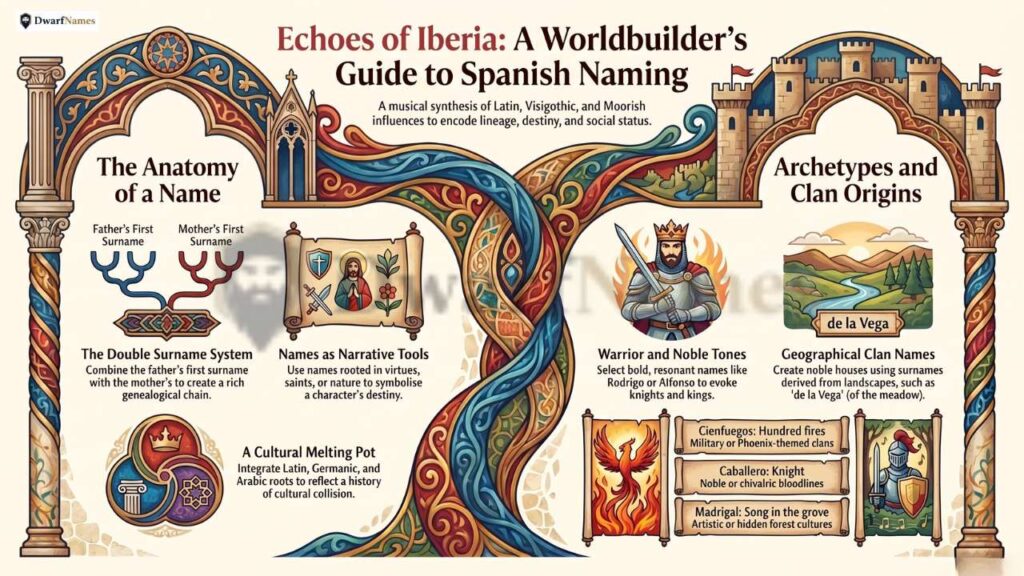
The Iberian Peninsula was home to Celts, Romans, Visigoths, Moors, and Jews, all leaving traces in the language and in the names people gave their children. Latin names like Marcus became Marcos. Germanic names like Roderich became Rodrigo. Arabic names like Aziz gave way to hybrid forms. The result is a naming tradition unlike any other.
Spanish custom traditionally gives a child two surnames: the first from the father, the second from the mother. So a child of Alejandro García Moreno and Carmen Reyes Villanueva would be named, say, Pablo García Reyes. This double surname system creates a beautiful genealogical chain. In fantasy worldbuilding, it offers a rich layer of lore: a character’s full name can encode alliances, betrayals, and lineage at a glance.
The Catholic calendar also shaped naming deeply. Saints’ days were celebrated, and children were often named for the saint of their birthdate. This is why names like Asunción, Concepción, and Natividad exist. They are not merely poetic; they were birth certificates written in theology.
In the colonial period, naming became an instrument of power. Indigenous peoples across Latin America were given Spanish names as part of conversion. Some of these names blended with local language, creating new hybrids. The fantasy writer can use this history to build morally complex colonial empires or liberation narratives in their own invented worlds.
Just as Spanish names carry rich narrative information, French names from the neighboring tradition carry their own court intrigue and romantic weight, and comparing the two traditions can sharpen any worldbuilder’s sense of how culture shapes naming.
Spanish Clan Names and Compound Surnames
In fantasy settings, surnames and clan names carry the weight of legacy. Spanish surnames often come from geography (de la Torre, meaning “of the tower”), occupation (Herrero, meaning “blacksmith”), or physical traits (Delgado, meaning “slender”). Below are 50 evocative Spanish-style clan and compound names perfect for noble houses, bandit clans, mercenary companies, and ancient bloodlines.
- Aguilar (eagle’s nest)
- Alvarado (white settlement)
- Arellano (eagle valley)
- Armendáriz (oak forest)
- Barrientos (clay lands)
- Bermúdez (son of Bermudo)
- Caballero (knight)
- Cabrera (goat hill)
- Calderón (great cauldron)
- Cárdenas (thistles)
- Castellanos (castle dwellers)
- Cienfuegos (hundred fires)
- Contreras (against the shores)
- Coronado (crowned one)
- De la Cruz (of the cross)
- De la Vega (of the meadow)
- Del Castillo (of the castle)
- Delgadillo (slender one)
- Domínguez (son of Domingo)
- Escobar (broom shrub land)
- Espinoza (thorny place)
- Fierro (iron)
- Fuentes (springs)
- Galaviz (unknown warrior)
- Galindo (bold youth)
- Gallardo (gallant)
- Garza (heron)
- Guerrero (warrior)
- Gutiérrez (son of Gutier)
- Herrera (iron forge)
- Hinojosa (fennel field)
- Hurtado (the stolen one)
- Ibarra (meadow by the river)
- Infante (young royal)
- Jaramillo (valley of the hills)
- Lara (citadel on the plain)
- Leyva (law-giver’s land)
- Linares (flax fields)
- Lozano (vigorous)
- Luján (light of the valley)
- Madrigal (song in the grove)
- Maldonado (ill-given)
- Mancilla (small hand)
- Medina (city)
- Mendoza (cold mountain)
- Montoya (highland assembly)
- Morales (mulberry grove)
- Navarrete (plains beside the mountains)
- Obregón (worker)
- Ocampo (in the field)
Conclusion
Names are maps. They tell you where a person came from, what their parents hoped for them, and sometimes what fate has written in their bones. Spanish names carry all of this and more. They carry the weight of cathedrals and the scent of orange groves. They carry the memory of conquest and the defiance of revolution. For any writer, gamer, or worldbuilder, they are an inexhaustible resource.
Whether you are crafting a noble house, building an empire, naming a wandering healer, or breathing life into a warrior who has seen too many wars, this collection of 300 Spanish names gives you everything you need. Take what resonates. Combine what inspires. Twist what you find into something entirely your own.
The best fantasy worlds are built on names that feel earned. Spanish naming tradition has been earning its names for more than two thousand years. Now they belong to your story.
Frequently Asked Questions
What makes Spanish names popular for fantasy and worldbuilding?
Spanish names carry rich history, melodic sound, and deep cultural meaning, making them ideal for creating immersive fantasy characters, kingdoms, and noble bloodlines.
Can Spanish names be used for non-Hispanic fantasy characters?
Absolutely. Spanish names work for any character in a Mediterranean-inspired, colonial, or Iberian-style fantasy world regardless of strict ethnic background.
What is the difference between Spanish first names and surnames?
Spanish first names identify individuals, while traditional surnames follow a double system combining the father’s and mother’s family names into a full identity.
Are there Spanish names that work for both male and female characters?
Yes, some Spanish names like Cruz, Ariel, and Trinidad are used across genders, offering flexible options for nonbinary or androgynous fantasy characters.
How do Spanish names reflect personality or destiny in storytelling?
Spanish names often derive from virtues, saints, nature, or history, giving writers built-in symbolic layers that enrich character identity and narrative depth.
Where do most classic Spanish names originally come from?
Most classic Spanish names trace back to Latin, Germanic Visigothic, Hebrew, or Arabic roots, reflecting centuries of cultural blending on the Iberian Peninsula.
How can I create original Spanish-style names for my fantasy world?
Combine familiar Spanish syllables, roots, and suffixes creatively. Study real naming patterns and adapt them to invent authentic-feeling names unique to your world.