
There is something quietly powerful about a British name. It carries centuries of myth, conquest, folklore, and culture within just a syllable or two. Whether you are building a world from scratch, crafting a noble lineage for your fantasy novel, or searching for the perfect name for your RPG character, British names offer a depth that few other naming traditions can match. They echo the rolling highlands of Scotland, the ancient stone circles of England, and the dragon-haunted mountains of Wales. They carry the weight of kings and the whisper of forgotten gods.
British names are not merely labels. They are stories compressed into sound. A name like “Edmund” speaks of ancient Anglo-Saxon valor, while “Elspeth” carries the quiet mysticism of the Scottish highlands. These names have been shaped by invading Normans, Celtic druids, Viking raiders, and Roman legions. The result is a naming tradition that feels both grounded and otherworldly, making British names irresistible for any writer or worldbuilder seeking authenticity with a touch of magic.
For writers, game masters, and creators of all kinds, the richness of British naming lore is an untapped treasure. The names below are drawn from that deep well of history, reimagined through a fantasy lens. Whether you need a stoic knight, a cunning sorceress, a wandering bard, or a ruthless warlord, you will find the perfect name here. And if you are also exploring names beyond the British Isles, be sure to browse through mystical Irish names or the enchanting tradition of Welsh names for even more inspiration.
Famous British Names From Literature and Games
Before diving into the lists, it helps to understand how the greatest storytellers have used British names to build legends.
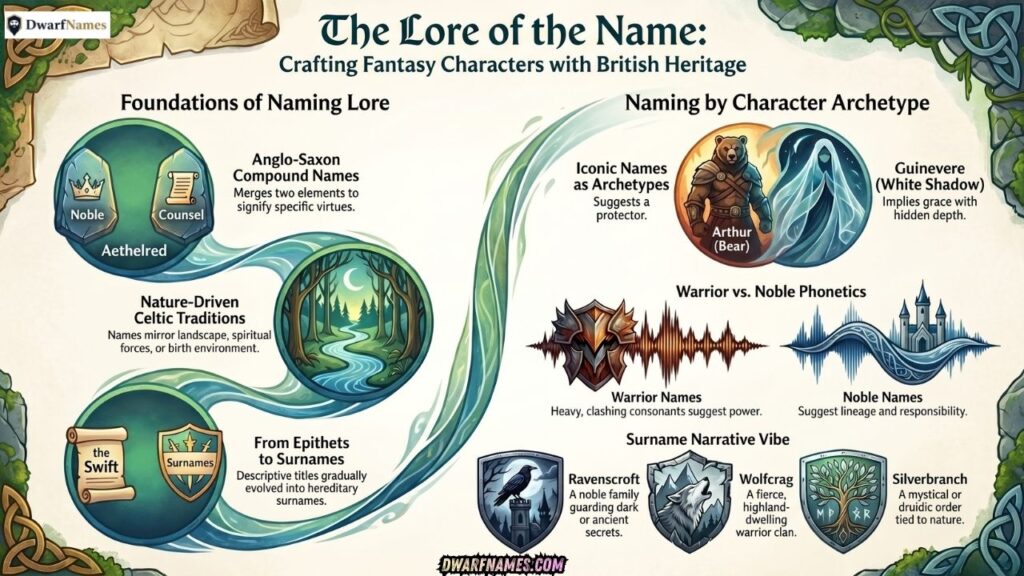
Arthur is perhaps the most iconic British name in fantasy. The legendary King Arthur of Camelot embodies chivalry, sacrifice, and the burden of destiny. His name has roots in the Celtic word “artos,” meaning bear, which perfectly mirrors his role as a powerful protector of his people. The name “Arthur” alone conjures round tables, enchanted swords, and the eternal promise of a king who will return.
Merlin is the archetypal wizard name, rooted in the Welsh “Myrddin,” associated with the fortress city of Carmarthen. Merlin represents wisdom, mystery, and the tension between fate and free will. In storytelling terms, his name sounds ancient and otherworldly, marking him immediately as someone touched by forces beyond mortal understanding.
Guinevere carries both beauty and tragedy. Derived from the Welsh “Gwenhwyfar,” meaning “white shadow” or “white enchantress,” it is a name that suggests grace hiding a darker current beneath. In RPGs and fantasy fiction, Guinevere-type names work brilliantly for morally complex female characters.
Edmund from C.S. Lewis’s Narnia series demonstrates how a classic Anglo-Saxon British name can carry themes of weakness, temptation, and redemption. The name itself means “wealthy protector,” creating an ironic contrast with Edmund’s early betrayal, making the arc of his character all the more satisfying.
These names show that great storytelling uses names as a first layer of character building. The right British name tells the reader something essential before a single line of dialogue is spoken.
Male British Names
Male British names tend to carry strength, heritage, and gravitas. Many have Anglo-Saxon roots that feel built for battlefields and throne rooms alike. These are names for heroes, villains, and everyone in between.
- Aldric
- Barnaby
- Benedict
- Caspian
- Cedric
- Clifford
- Cormac
- Denholm
- Duncan
- Edgar
- Edmund
- Eldred
- Everett
- Falconer
- Fergus
- Fletcher
- Godwin
- Graham
- Griffith
- Hadley
- Harold
- Hartley
- Heath
- Ivo
- Jasper
- Kenrick
- Lachlan
- Leofric
- Lionel
- Lucan
- Malachy
- Malcolm
- Montague
- Nigel
- Oswald
- Percy
- Radley
- Reginald
- Rowan
- Rupert
- Seamus
- Silvanus
- Sterling
- Theron
- Tobias
- Tristan
- Ulric
- Vance
- Warwick
- Whitmore
Female British Names
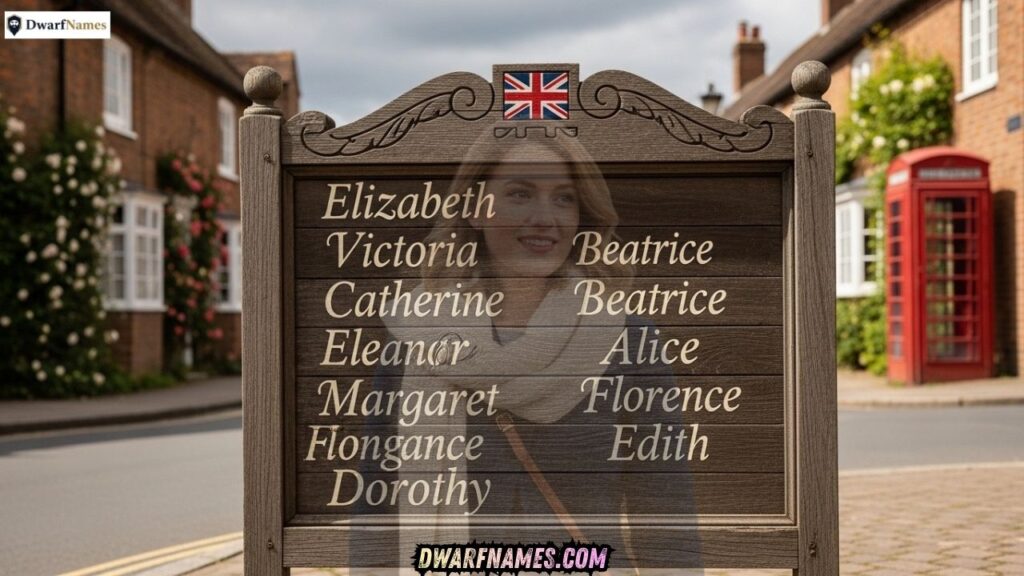
Female British names span a breathtaking range, from soft and melodic Gaelic names to sharp, regal Anglo-Norman choices. They suit priestesses, queens, adventurers, and scholars with equal elegance.
- Adela
- Aelith
- Agatha
- Aldith
- Arabella
- Beatrix
- Brenna
- Celia
- Cordelia
- Cornelia
- Davina
- Edith
- Elowen
- Elspeth
- Emmeline
- Fiora
- Fleur
- Guinevere
- Harriet
- Hesper
- Isolde
- Ivy
- Jessamine
- Jocasta
- Kezia
- Lavinia
- Leona
- Leticia
- Mabry
- Madelief
- Margery
- Meredith
- Millicent
- Morwenna
- Niamh
- Orinthia
- Rowena
- Seraphina
- Sibyl
- Sylvestra
- Tamsin
- Thalia
- Ursula
- Vesper
- Viola
- Winifred
- Ysabel
- Zelda
- Zephyrine
Cool and Unique British Names
These names push beyond the familiar into rarer, more striking territory. Perfect for characters who are meant to stand out, defy convention, or carry an air of the unusual.
- Aldwyn
- Ambrose
- Anselm
- Arwick
- Ashford
- Bastian
- Beorn
- Bodwyn
- Branoc
- Caius
- Celyn
- Cervantes
- Corvin
- Drest
- Emrys
- Evander
- Foxley
- Gawain
- Hereward
- Igraine
- Indulf
- Jareth
- Kestrel
- Leofwyn
- Lorcan
- Lysander
- Mabon
- Nerian
- Osric
- Penvro
- Quillan
- Raedwald
- Rendell
- Seren
- Sigebert
- Thane
- Ulwin
- Verity
- Wulfric
- Ygerne
Warrior and Strong British Names
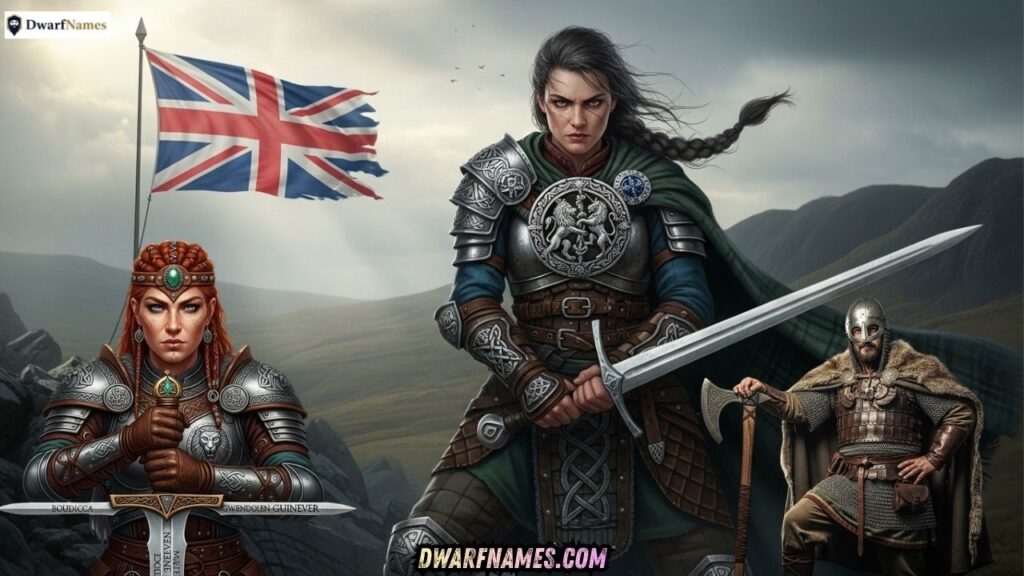
These names carry the sound of clashing shields and war horns. Drawn from Anglo-Saxon battle traditions and Celtic warrior culture, they suit fighters, mercenaries, warlords, and guardians. If you enjoy the energy of fierce naming traditions, you might also enjoy exploring Roman god names for divine warrior inspirations.
- Aldhelm
- Arwald
- Athelstan
- Beorhtwulf
- Beowulf
- Bran
- Brennan
- Cerdic
- Cynric
- Dunstan
- Eadwulf
- Erchembald
- Godric
- Gruffudd
- Gunnar
- Haldane
- Hardwin
- Ingulf
- Kenelm
- Leofstan
- Morcant
- Osbert
- Penda
- Ragnald
- Sigefrith
- Sweyn
- Tathere
- Thorfinn
- Ulfric
- Wilfrid
Royal and Noble British Names
These names carry crowns in their syllables. From the regal halls of medieval England to the ancient seats of Scottish clans, these names speak of lineage, power, and responsibility.
- Adelaide
- Aetheред
- Aldhelm
- Alphonso
- Alured
- Anselm of Canterbury
- Berenga
- Blanche
- Canmore
- Cecily
- Edred
- Eleanor
- Elfrida
- Ethelbert
- Euphemia
- Eustace
- Geoffrey
- Godiva
- Gunhild
- Isabeau
- Leopold
- Lothair
- Maud
- Morcar
- Petronia
- Philippa
- Ranulf
- Sybilla
- Tancred
- Waltheof
Traditional and Classic British Names
These names have been part of the British Isles for over a thousand years. They are rooted in history and feel naturally noble, honest, and enduring. They are the foundation on which all great British fantasy is built.
- Agnes
- Albert
- Alfred
- Alice
- Arthur
- Beatrice
- Cecil
- Charlotte
- Clarence
- Clement
- Cuthbert
- Diana
- Dorothy
- Ernest
- Florence
- Frances
- Frederick
- George
- Gertrude
- Gilbert
- Helena
- Herbert
- Hilda
- Horace
- Humphrey
- Leonard
- Margaret
- Neville
- Osmond
- Walter
British Naming Traditions and Lore
In a fantasy world rooted in British tradition, names are never given carelessly. They are bestowed by ceremony, earned through trial, or passed down through generations like sacred heirlooms. Understanding these traditions can help worldbuilders create a richer, more believable culture around their characters.
Among the Anglo-Saxon peoples of the early British Isles, names were often compound constructions, merging two meaningful elements to create a powerful whole. “Aethel” meant noble, while “red” or “raed” meant counsel. Combined, “Aethelred” became a name worthy of a king. This system allowed names to carry philosophical weight, suggesting the virtues a family hoped their child would embody.
Celtic British naming traditions worked differently. Names were frequently tied to nature, landscape, and spiritual forces. A child born during a storm might be named after thunder. A warrior who survived a battle near a river might take the river’s name as part of their own. The natural world was seen as deeply alive, and a name drawn from nature was seen as a form of blessing and connection. This tradition mirrors the practices seen in Celtic god names, where divine forces of nature were woven into identity itself.
In noble families, the firstborn son often received a name that honored the father’s lineage, while younger sons were given names that marked them as separate individuals with their own destiny to carve. Daughters were named for virtue, beauty, or devotion, but also sometimes for fearsome qualities in warrior cultures, a naming tradition that survived into the medieval period in Scotland and Wales.
The use of epithets was also common. A warrior known as “the Swift” or “the Red” might gradually absorb that description into their formal name, so that later generations recorded them as “Aldric the Swift” or simply “Aldric Swift,” which eventually evolved into a hereditary surname.
For your fantasy world, consider establishing naming rules that reflect your culture. Do names change when a character comes of age? Are some names forbidden because of a cursed ancestor? Are names whispered rather than spoken aloud to keep their power safe? These small details transform a list of names into a living language.
British Surnames and Clan Names
British surnames carry their own mythology. Many were originally descriptive, born from landscapes, trades, or personal traits. In a fantasy setting, these make excellent clan names, noble house names, or warrior titles.
- Ashbrook
- Blackmoor
- Blackthorn
- Brentwood
- Brightwell
- Brokenfield
- Coldwater
- Darkhollow
- Dunmore
- Eagleford
- Eldershaw
- Emberton
- Fairwind
- Farstone
- Frostmere
- Goldvale
- Greymantle
- Grimtower
- Harrowhaven
- Highgate
- Holloway
- Ironsword
- Kingswood
- Lakebourne
- Longthorn
- Mirefall
- Mosswick
- Nighthollow
- Norbrook
- Oakenshield
- Oldcastle
- Ravenscroft
- Redmoor
- Riverstone
- Rockfield
- Shadowfen
- Silverbranch
- Silvermarsh
- Stonewall
- Stormcroft
- Stormgate
- Sundale
- Swiftblade
- Thistledown
- Thornbury
- Thornwick
- Whitecliff
- Wildmere
- Windhollow
- Wolfcrag
These clan names work beautifully as house names in fantasy fiction. “House Ravenscroft” sounds like a noble family with dark secrets. “Clan Wolfcrag” feels right for a highland warrior people. “The Silverbranch Order” could name a druidic circle deep in an ancient forest.
If you enjoy compound naming traditions, the Korean names tradition also uses meaningful combinations beautifully, and studying it can inspire more creative approaches to building naming systems for fictional cultures.
Conclusion
Names are the first magic a storyteller wields. Before a character speaks, fights, loves, or betrays, their name has already told the audience something essential. British names carry within them an entire civilization of myth, faith, war, and wonder. They have been shaped by Celts, Romans, Anglo-Saxons, Vikings, and Normans, and that layered heritage is precisely what makes them so powerful in fantasy.
Whether you are writing a sweeping epic, building a tabletop RPG campaign, crafting a video game world, or simply searching for names that feel timeless and resonant, the British naming tradition offers endless inspiration. From the battlefield thunder of warrior names like Athelstan and Ulfric to the quiet magic of names like Elowen and Morwenna, there is a British name for every story you wish to tell.
Take these names. Make them your own. Build lineages with them, carve them into the stones of imaginary castles, whisper them in the dark of enchanted forests. The greatest names are the ones that feel inevitable, as though no other word could possibly fit the person who carries it. That is the gift the British naming tradition offers: names that feel not invented, but discovered.
Frequently Asked Questions
What makes British names ideal for fantasy worldbuilding?
British names carry centuries of mythology, culture, and history, giving fantasy characters immediate depth and a sense of authentic, lived-in heritage.
Are there differences between English, Scottish, Welsh, and Irish British names?
Yes, each tradition has distinct sounds and roots. Welsh names are lyrical and nature-based, Scottish names are rugged and clan-tied, and English names tend toward Norman or Anglo-Saxon origins.
Can I use old British names for modern fantasy novels?
Absolutely. Classic names like Aldric, Isolde, and Gawain feel timeless and translate beautifully into any fantasy setting without feeling dated or out of place.
What are some strong British names for warrior characters?
Names like Ulfric, Beowulf, Athelstan, Godric, and Haldane carry inherent strength and battle-readiness, making them excellent choices for warrior characters.
How do British surnames work as fantasy house or clan names?
British surnames often derive from landscapes or trades, making compounds like Blackthorn, Ravenscroft, or Wolfcrag perfect for noble houses and warrior clans.
Where can I find more culturally rich fantasy name ideas?
Explore traditions like Celtic, Irish, Welsh, and Roman naming conventions, all of which share deep historical links with British naming culture and mythology.
Are British names appropriate for non-European fantasy settings?
They can be adapted freely. Many British name sounds and structures feel universal enough to fit diverse fantasy worlds without feeling culturally misplaced.