
Long before the age of printed maps and iron kingdoms, there were the gods of the Celts. They did not rule from marble thrones or speak in riddles from the clouds. They walked through mist-soaked forests, stirred wars with a whisper, and breathed life into rivers that still run cold today. The Celtic pantheon is one of the most layered, mysterious, and deeply poetic in all of world mythology. For writers, gamers, and worldbuilders, these names carry weight. They hum with ancient meaning. They feel earned.
Celtic gods were not simply divine figures. They were forces of nature wearing faces. Lugh was not just a sun god. He was a craftsman, a warrior, and a king. The Morrigan was not just a goddess of death. She was prophecy made flesh, a crow-cloaked shapeshifter who chose which warriors would fall. This complexity is what makes Celtic god names so compelling for fantasy creation. Every name hides a story. Every syllable carries mythology.
Whether you are building a fantasy world, designing a tabletop RPG campaign, writing your next novel, or simply searching for a name that feels mythically powerful, this guide is your sacred text. Below you will find over 200 Celtic god names drawn from Irish, Welsh, Gaulish, and Breton traditions, complete with meanings, cultural context, and creative inspiration.
Names are not decoration in great storytelling. They are identity. A character named Lugh carries the light of mastery and skill. One named Cernunnos carries the primal edge of the forest. Choose wisely.
Famous Celtic God Names From Literature and Games
Before we descend into the full list, let us honor the names that have already crossed from myth into modern imagination.
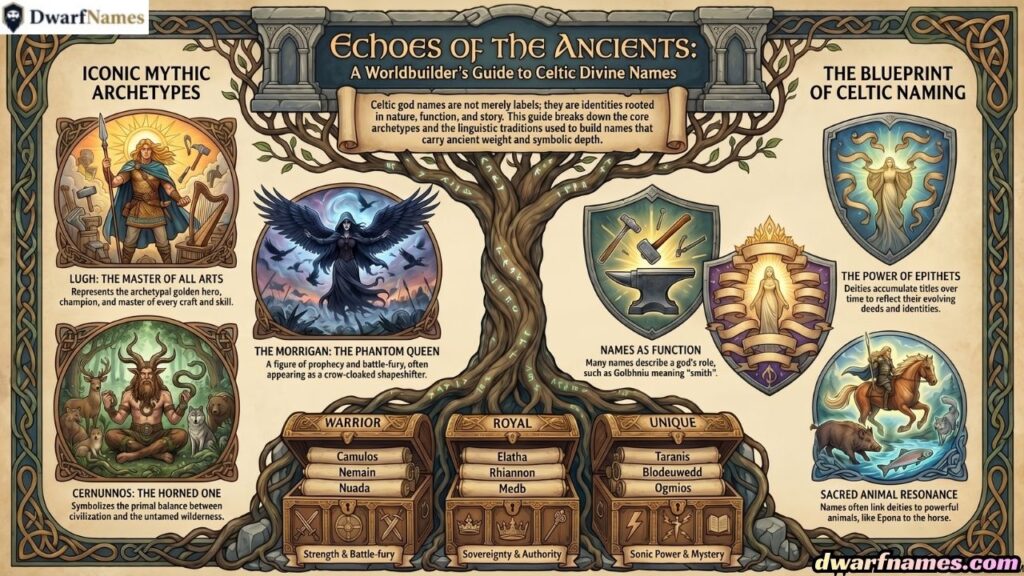
Lugh appears across modern fantasy as an archetype of the golden hero, the unmatched champion who masters every art. In Irish mythology, Lugh Lamhfhada (Lugh of the Long Arm) was the sun god and warrior who slew the tyrant Balor with a single sling stone. His name has been adapted in games like Smite and echoes through countless fantasy novels as a symbol of divine skill and radiant power.
The Morrigan is perhaps the most borrowed name in all of Celtic mythology. She appears in Assassin’s Creed: Syndicate, Dragon Age, and dozens of dark fantasy novels. Her name means “phantom queen” or “great queen,” and she is always portrayed as a figure of terrible beauty and prophetic doom. Her name alone tells a story.
Cernunnos, the antlered god of wild things, has become a go-to for druids and nature deities in fantasy roleplaying games. He represents the balance between civilization and wilderness, a concept endlessly fascinating to worldbuilders. The name itself is believed to mean “the horned one,” simple, primal, and unforgettable.
Danu, the mother goddess of the Tuatha De Danann, represents the divine feminine as a source of creation and mystery. She rarely appears in myth directly, which makes her all the more powerful as a figure. She is the name behind a people, and for fantasy writers, that kind of foundational naming is deeply inspiring.
These names work in fiction because they carry cultural resonance without needing explanation. If you are looking for names with similar depth from other traditions, exploring Irish mythology names or diving into the world of Welsh names can open even more doors for your worldbuilding.
Male Celtic God Names
The gods of the Celtic world were warriors, craftsmen, healers, tricksters, and kings. Their names reflect the full range of masculine power in a mythological sense: not just brute strength, but cleverness, artistry, and the weight of fate.
These male Celtic god names and their meanings span Irish, Welsh, and Gaulish traditions, offering a rich palette for any fantasy creator.
- Lugh
- Dagda
- Cernunnos
- Manannán
- Ogma
- Nuada
- Aengus
- Donn
- Mog Ruith
- Goibhniu
- Credne
- Luchta
- Bres
- Elatha
- Tethra
- Midir
- Bodb Derg
- Caer
- Fionn
- Diarmuid
- Ailill
- Conall
- Ruadh
- Taranis
- Esus
- Teutates
- Cú Chulainn
- Fergus
- Belenus
- Borvo
- Sucellus
- Albiorix
- Smertrios
- Visucius
- Camulos
- Epona
- Abellio
- Cernach
- Elcmar
- Dian Cecht
- Mac Cecht
- Mac Cuill
- Mac Gréine
- Rucht
- Friuch
Female Celtic Goddess Names
The goddesses of Celtic mythology were rarely gentle. They were sovereign figures. They held the land, stirred battle-fury, shaped prophecy, and ruled the underworld. A goddess in Celtic tradition was not a passive divinity. She was the land herself.
These female Celtic god names carry the particular power of a mythology that placed divine feminine energy at the center of creation, sovereignty, and fate.
- Morrigan
- Danu
- Brigid
- Badb
- Macha
- Nemain
- Áine
- Boann
- Étaín
- Tlachtga
- Flidais
- Clíodhna
- Ériu
- Banba
- Fódla
- Medb
- Niamh
- Síle
- Caer Ibormeith
- Blodeuwedd
- Arianrhod
- Rhiannon
- Cerridwen
- Branwen
- Modron
- Nimue
- Coventina
- Nantosuelta
- Rosmerta
- Epona
- Sirona
- Nemetona
- Damona
- Aveta
- Abnoba
- Sequana
- Elen
- Sabrina
- Verbeia
- Cuda
Cool and Unique Celtic God Names
Some names in the Celtic pantheon stand out not just for their mythological weight but for their sheer sonic power. These are the cool Celtic god names that feel immediately at home in fantasy fiction, a name you can build an entire character around.
- Cú Chulainn
- Taranis
- Mog Ruith
- Caer Ibormeith
- Elatha
- Smertrios
- Borvo
- Albiorix
- Camulos
- Blodeuwedd
- Arianrhod
- Visucius
- Toutatis
- Abellio
- Bricriu
- Crom Cruach
- Ogmios
- Brigantia
- Maponos
- Vindos
- Sucellus
- Nantosuelta
- Segomo
- Mullo
- Ritona
- Atepomarus
- Glanis
- Vesunna
- Ancamna
- Verbeia
For more naming inspiration from cultures that share Celtic roots and overlapping mythology, the world of Roman god names offers fascinating parallels, especially where Roman and Gaulish traditions merged.
Warrior and Badass Celtic God Names
The Celts were a warrior culture. Battle was sacred. Death in combat was honorable. The gods who governed war were not distant judges. They were screaming in the storm beside you, choosing the fallen, feeding the ravens. These warrior Celtic god names carry that edge.
- Morrigan
- Camulos
- Badb
- Nemain
- Macha
- Smertrios
- Taranis
- Cú Chulainn
- Segomo
- Nuada
- Lugh
- Ogma
- Donn
- Ruadh
- Cernach
- Bodb Derg
- Fergus
- Conall
- Cathbad
- Maponos
- Viradecdus
- Caturix
- Rigisamus
- Belatucadros
- Cocidius
- Lenus
- Corotiacus
- Neit
- Fionn
- Diarmuid
These names are ideal for war-gods, battle champions, and dark knights in any fantasy setting. If you enjoy names that carry martial weight across mythology, British names rooted in the same ancient warrior traditions offer equally powerful options.
Royal and Noble Celtic God Names
The sovereignty of land and people was a deeply sacred concept in Celtic mythology. Gods were kings. Kings were gods. The right to rule was granted by the land itself, often personified as a goddess. These royal Celtic god names reflect that divine authority.
- Nuada
- Dagda
- Elatha
- Midir
- Bres
- Lugh
- Aengus
- Manannán
- Ériu
- Medb
- Macha
- Rhiannon
- Arianrhod
- Branwen
- Modron
- Mac Cecht
- Mac Cuill
- Mac Gréine
- Bodb Derg
- Ailill
- Tethra
- Donn
- Ruadh
- Friuch
- Dian Cecht
Traditional and Classic Celtic God Names
Not every fantasy name needs to be unusual. Sometimes the most powerful choice is a name that has carried meaning across centuries. These are the traditional Celtic god names that have appeared in manuscripts, folk tales, and bardic poetry for thousands of years.
- Lugh
- Dagda
- Brigid
- Morrigan
- Manannán
- Ogma
- Danu
- Nuada
- Aengus
- Boann
- Badb
- Macha
- Fionn
- Rhiannon
- Cerridwen
- Cernunnos
- Epona
- Belenus
- Borvo
- Áine
- Étaín
- Niamh
- Clíodhna
- Flidais
- Rosmerta
These names have proven their power. They have survived because they carry something true. For writers who want their Celtic-inspired world to feel rooted in real tradition, these names are the foundation. You might also enjoy exploring Korean names for contrast, since pairing naming traditions from different cultures can make your fictional world feel genuinely layered.
Celtic God Naming Traditions and Lore
Understanding how the Celts named their gods opens a gateway to more authentic worldbuilding. Celtic divine names were rarely arbitrary. They emerged from nature, function, and the sacred relationship between the land and its people.
Names as Function. Many Celtic gods were named after what they did or what they controlled. Goibhniu comes from the Irish word for “smith.” Dian Cecht’s name relates to healing and swiftness. Manannán mac Lir means “son of the sea.” The name was a description, and in a world where names held magical power, description was destiny.
Epithets and Titles. Celtic gods rarely had just one name. They accumulated titles across regions and generations. Lugh was called Lamhfhada (Long Arm), Samhildánach (Master of All Arts), and Lonnbeimnech (Fierce Striker). The Dagda was called Eochaid Ollathair (Great Father) and Ruad Rofhessa (Lord of Great Knowledge). For worldbuilders, this tradition opens the door to naming characters not just by a single name but by an evolving identity that grows with their story.
Regional Variations. The same deity often appeared under different names in different Celtic regions. The Gaulish Epona, goddess of horses, was adopted by the Romans but kept her Celtic name. The Irish Brigid shares deep similarities with the Gaulish Brigantia. The Welsh Math fab Mathonwy echoes Gaulish and Irish divine figures. This means that as a worldbuilder, you can create variant names for the same divine concept across different regions of your fantasy world, just as the real Celts did.
Sacred Animals and Name Connections. The Celts believed animals carried divine power, and many god names reflected this. Epona (horse), Cernunnos (horned one, connected to stags), Flidais (goddess of deer and wild things), Morrigan (often a crow or raven). Giving your fantasy deity a name that echoes an animal creates immediate symbolic resonance for readers.
Gender Fluidity in Divine Names. Celtic mythology was surprisingly flexible about the gender of divine power. The Dagda was a figure of masculine excess and comedy but also deep wisdom. The Morrigan was terrifying but also a figure of sovereignty and protection. Some deities like Brigid held domain across what might seem like opposing realms: poetry, healing, and smithcraft. When naming your gods, do not feel constrained by simple gender categories. The Celts did not always.
Celtic God Clan and Compound Names (Bonus Section)
One of the most powerful naming techniques in Celtic mythology was the compound name: two concepts fused into one divine identity. This tradition produces names that feel immediately epic and worldbuilding-ready.
Here are 50 original compound names inspired by Celtic mythological naming conventions, perfect for clans, divine bloodlines, ancient orders, and legendary figures in your fantasy world.
- Ironhallow
- Stormweave
- Ashcrown
- Mistblade
- Oakmantle
- Ravensgrace
- Bronzefire
- Coldmoore
- Thornveil
- Duskspear
- Riverborn
- Stonechant
- Goldenhorn
- Ashveil
- Mistcaller
- Wolfcrown
- Emberthorn
- Silverwood
- Ironsong
- Darkhollow
- Bonemantle
- Crownshadow
- Bloodmeadow
- Stormcrown
- Greywarden
- Nightfall
- Thornwatch
- Oakenshield
- Firestone
- Mistwalker
- Ravenmark
- Deepwater
- Ironveil
- Stormhallow
- Ashmantle
- Bronzeborn
- Coldspear
- Goldenmoor
- Wolfstone
- Silverthorn
- Embercrown
- Darkweave
- Bloodveil
- Greyhallow
- Nightwalker
- Fireblade
- Oakcrown
- Rivenstone
- Deepmantle
- Stormsong
These compound names follow the same philosophy as Celtic god epithets: they describe nature, power, and identity in a single breath. Use them for noble houses, ancient clans, sacred orders, or legendary warriors in your fantasy world.
Conclusion
The gods of the Celts were never just mythological figures. They were the breath of the land, the roar of the sea, the reason warriors fought and poets wept. Their names survived because they carry something essential: the sense that the world is alive with meaning, and that names are a way of reaching toward that meaning.
Whether you are crafting an epic novel, building a fantasy RPG campaign, or simply searching for a name that feels charged with ancient power, Celtic god names offer something no modern invention can match. They have been shaped by generations of storytellers, tested in bardic halls, and whispered in sacred groves. They have earned their weight.
Use these names as your starting point, not your ending point. Let Lugh inspire a golden-armored champion. Let the Morrigan become your prophecy-weaving antagonist. Let Cernunnos walk the wildwood at the edge of your map. The mythology is a door. Your imagination is what lies beyond it.
Go build something worthy of the gods.
Frequently Asked Questions
What are the most popular Celtic god names used in fantasy today?
Lugh, Morrigan, Cernunnos, Dagda, and Brigid are among the most widely used Celtic god names in modern fantasy literature and games.
What do Celtic god names mean in mythology?
Most Celtic god names describe a divine function or natural force, such as Manannán meaning “son of the sea” and Goibhniu meaning “smith.”
Can I use Celtic god names for my fantasy characters?
Yes. Celtic god names are public domain mythological names ideal for fantasy characters, RPG heroes, and worldbuilding projects of all kinds.
Are Welsh god names different from Irish Celtic god names?
Yes. Welsh names like Rhiannon and Arianrhod differ linguistically from Irish names like Morrigan and Brigid, though both share Celtic roots.
What makes Celtic god names good for worldbuilding?
They carry built-in symbolism, epic sound, and mythological depth, making them ideal for creating believable, immersive fantasy worlds and characters.
Where can I find more names inspired by Celtic mythology?
Exploring Irish names and Welsh names provides hundreds of additional options rooted in authentic Celtic tradition.
Do Celtic gods have last names or surnames?
Not exactly. Celtic gods used patronymics and epithets instead, such as Manannán mac Lir meaning “Manannán, son of the sea.”