
There is something ancient and deliberate about a name. In the world of fantasy storytelling, a name is not merely a label. It is a bloodline, a destiny, a whisper of who someone was before the world tried to shape them into something else. Korean names carry exactly that kind of weight. Rooted in Hanja (classical Chinese characters adopted into Korean culture), shaped by centuries of Confucian tradition, royal dynasties, and poetic philosophy, Korean names vibrate with meaning in a way that feels tailor-made for epic fantasy, deep lore, and unforgettable characters.
Whether you are a novelist crafting a warrior born under a cursed moon, a dungeon master weaving a merchant kingdom steeped in silk and shadows, or a game developer building a civilization from the ground up, Korean names offer something that generic fantasy naming systems rarely do: real philosophical depth beneath their syllables. Names like Jisoo (wisdom and excellence), Hyunjae (wise and talented), or Areum (beauty) are not invented for aesthetics. They were given to real people, across real centuries, in the hope that the name would shape the soul.
In the grand tradition of names that carry mythic resonance, similar magic can be found in Roman god names and Celtic god names, which also use divine etymology to express character and fate. Korean names belong in that same conversation.
This guide presents 250 Korean names sorted into rich categories, paired with cultural lore, worldbuilding guidance, and storytelling inspiration. By the time you reach the end, you will not just have a list. You will have a naming system worthy of a civilization.
Famous Korean Names From Literature and Games
Before diving into the full name collection, it helps to see how Korean names function in storytelling, both in real-world media and the fantasy worlds inspired by them.
Yi Sun-sin is perhaps the most legendary name in Korean history. A naval commander who defended the Joseon Dynasty against overwhelming odds, his name has become synonymous with unyielding loyalty and genius strategy. In fantasy terms, Yi Sun-sin reads like a paladin’s name: precise, composed, carrying the weight of duty. A fantasy warrior named “Yi” immediately inherits a sense of calculated valor.
Seoyeon appears frequently in Korean mythology-inspired fiction as a name given to women of noble spirit or divine origin. The syllables “Seo” (auspicious, like floating clouds) and “yeon” (lotus or connection) create a poetic combination that suggests someone touched by fate. In RPG settings, this name suits a druid, a seer, or a celestial-born diplomat.
Taehyung, meaning “great abundance” or “great prosperity,” has appeared in modern Korean pop culture but draws on classical naming conventions. In a fantasy context, it reads as a name suited for a merchant prince, a golden-age ruler, or a chosen hero whose arrival signals a turning of fortune.
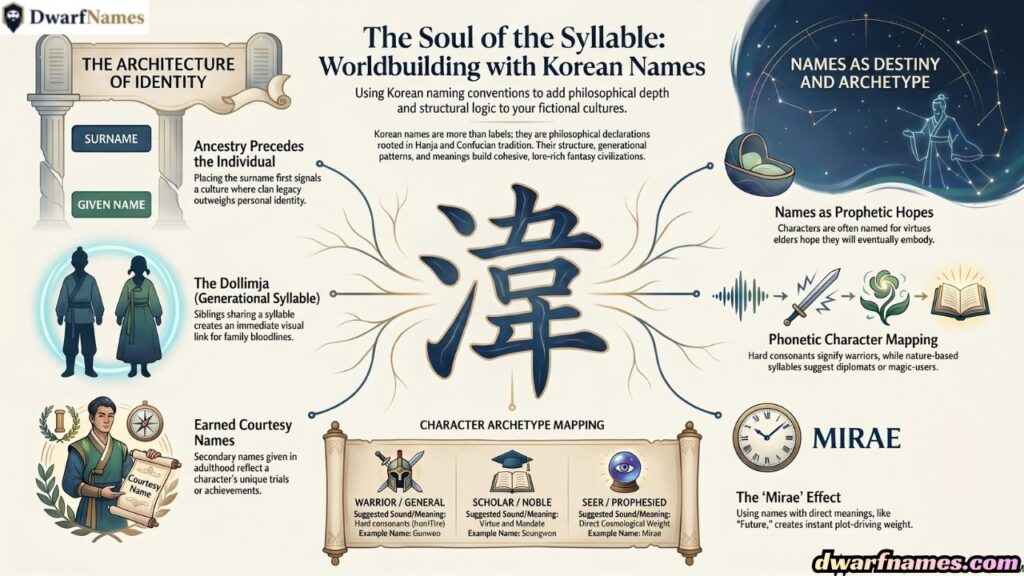
Mirae means “the future” in Korean. Few names in any language carry such direct cosmological weight. A character named Mirae in a fantasy story is immediately someone the prophecy revolves around. Not because it sounds mystical, but because the name literally means what the story needs them to be.
These examples reveal something essential about Korean naming tradition: the name is not decorative. It is philosophical.
Male Korean Names for Fantasy Characters
Korean male names tend to project strength, wisdom, ambition, and virtue. The following names are ideal for warriors, scholars, kings, and wandering swords for hire. Each one carries a classical resonance that translates beautifully into fantasy settings.
- Daehyun
- Junwoo
- Minjae
- Seongho
- Taesoo
- Hyunwoo
- Jungmin
- Kiho
- Sangjun
- Wonbin
- Jaehoon
- Dokyung
- Yoonsang
- Cheolmin
- Byungho
- Sungjin
- Inhwan
- Myungsu
- Kangmin
- Haejun
- Wonjae
- Chunsoo
- Giho
- Seokjin
- Namgil
- Dohyun
- Junseok
- Taejun
- Byungseok
- Chanwoo
Female Korean Names for Fantasy Characters
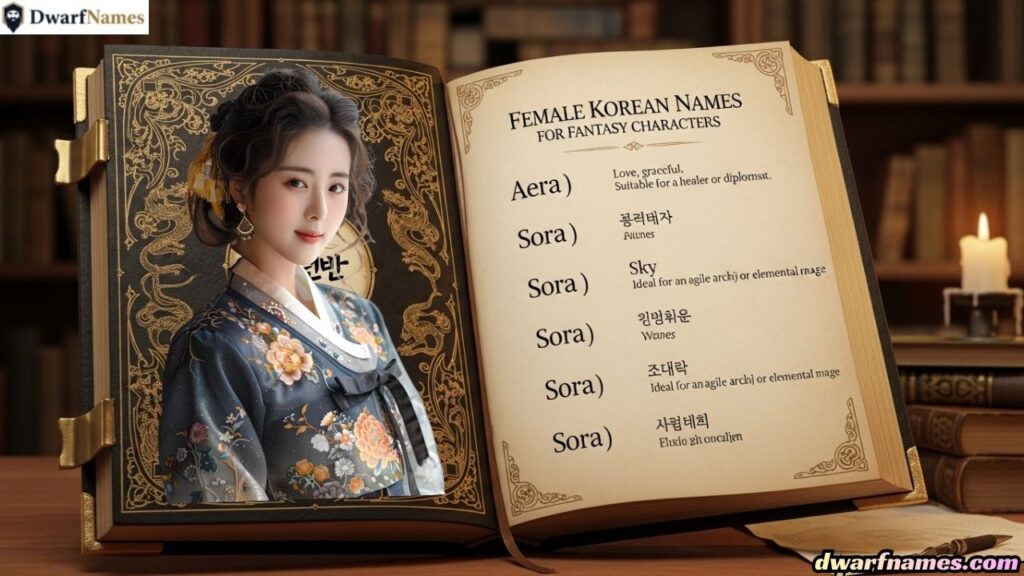
Female Korean names frequently draw on imagery from nature, light, and virtue. Names built from syllables meaning “lotus,” “moon,” “jade,” “grace,” and “blossom” appear frequently. They carry a quiet elegance well-suited to characters who wield influence through wisdom, sorcery, or diplomatic cunning rather than brute force.
- Areum
- Bora
- Chaerin
- Dahye
- Eunji
- Jiyeon
- Haena
- Iseul
- Jinae
- Kyungmi
- Nari
- Minji
- Soojin
- Yuna
- Haeun
- Soyeon
- Mijin
- Chorong
- Boeun
- Hyerim
- Seulgi
- Yejin
- Narae
- Jihyun
- Sunhee
- Chowon
- Seohyun
- Dawon
- Hayoon
- Jiyu
Cool and Unique Korean Names
Some Korean names feel charged with an otherworldly quality. They roll off the tongue like incantations, fitting for arcane casters, shadow operatives, or legendary figures whose names become titles. These are the names that feel like they were carved into temple walls rather than given at birth.
- Raon
- Iorin
- Hyewon
- Zeon
- Kanu
- Yulchan
- Seorin
- Taewi
- Joran
- Hyunrae
- Dayul
- Cheoru
- Mirae
- Wonrae
- Jarim
- Seodam
- Naeun
- Byeori
- Cheondo
- Geurae
- Hanul
- Iseori
- Jaeun
- Choryu
- Nuri
- Oreum
- Dori
- Seolha
- Gyeoul
- Byeolbit
Just as writers seeking uncommon inspiration might explore Irish names for their melodic strangeness, these Korean names offer a similarly captivating sound palette.
Korean Warrior and Badass Fantasy Names
These names were chosen for their hard consonants, commanding syllables, and classical associations with strength, iron, and fire. They belong to generals, warlords, weapon-masters, and anyone whose presence causes silence to fall across a battlefield.
- Gunwoo
- Taekang
- Cheolsoo
- Bongchul
- Musang
- Hyeokjin
- Kangho
- Wolcheon
- Chorang
- Dojin
- Geomchi
- Hwangbo
- Sonamu
- Byeokchun
- Jangsu
- Munsang
- Swordwall (Geombyeok)
- Cheolbong
- Rangjin
- Doheon
- Sangmu
- Jaewoong
- Yokcheon
- Cheolgong
- Wolgang
- Musoo
- Rangcheon
- Kangwol
- Dojeon
- Byeongjin
Royal and Noble Korean Names
These names carry the weight of silk robes, gilded thrones, and court politics. Names of royal lineage in the Joseon Dynasty period were often chosen for their Hanja meaning, projecting virtue and divine mandate. In fantasy worldbuilding, these names belong to emperors, queens, high priests, and noble houses whose legacy spans generations.
- Seungwon
- Hyejong
- Jeongsoo
- Taewon
- Inhwa
- Sungjong
- Gyeonghui
- Miryung
- Wonhyun
- Seojong
- Daewon
- Hyunmyung
- Junghwa
- Taegyung
- Inseong
- Hyejae
- Myungjong
- Sanghyun
- Wonjong
- Seungmyung
- Jeonghui
- Daejong
- Inwon
- Taehyun
- Hyesoo
- Seunghwa
- Wonhui
- Myungseong
- Jungheon
- Daehwa
Traditional and Classic Korean Names
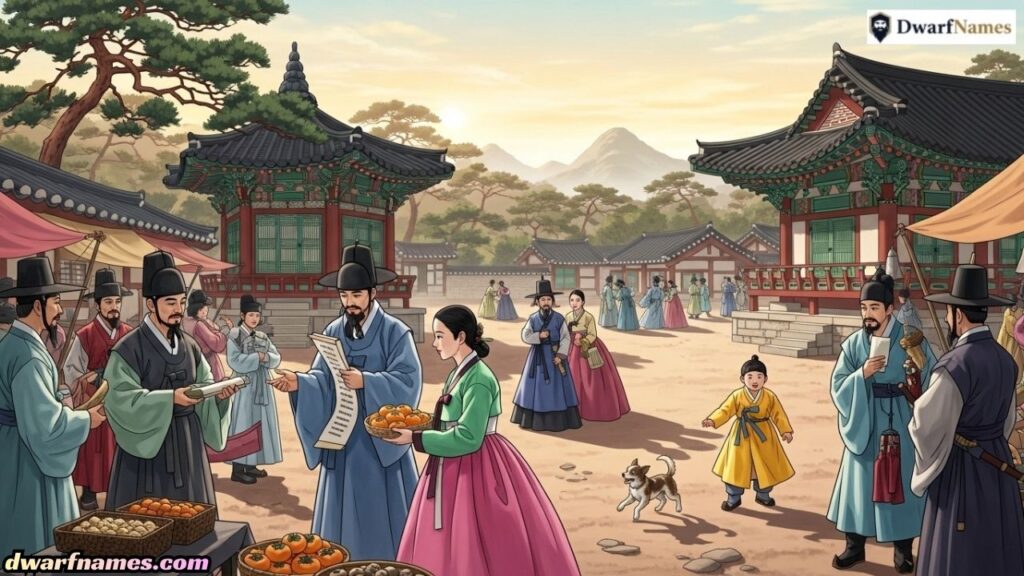
These names echo through centuries of Korean history. They follow classical naming conventions, using Hanja characters associated with virtue, prosperity, loyalty, and wisdom. For storytellers building ancient kingdoms, ancestral lineages, or historical fantasy settings, these names feel rooted in something real and enduring.
- Cheolsu
- Soonjoo
- Byunghee
- Myungsook
- Gyunghee
- Jungsook
- Inshil
- Soonyi
- Bongsook
- Changsoo
- Chunja
- Gilsu
- Haksoo
- Ingoo
- Jongsu
- Kyungsook
- Mansu
- Namsoon
- Okja
- Pyungho
- Sangchul
- Taesik
- Uisuk
- Yangja
- Chungsim
- Dooshim
- Eungoo
- Hyunshik
- Jungsim
- Kyungja
Those drawn to names with deep ancestral roots might also find interest in Welsh names, which share a similar reverence for lineage and land.
Korean Naming Traditions and Worldbuilding Lore
Understanding how Korean names actually work is a shortcut to building a fictional culture with authentic depth.
The Structure of the Name. A traditional Korean name consists of a family name (surname) followed by a given name of one or two syllables. The family name comes first, a reversal of Western convention that immediately signals a culture where ancestry precedes individual identity. This is powerful worldbuilding fuel: in your fantasy kingdom, the family name leading means the clan matters more than the person, which shapes politics, loyalty systems, and inheritance rules.
Generational Syllables. One of the most distinctive Korean naming traditions is the “Dollimja” or generation syllable. Siblings and cousins within the same generation often share one syllable in their given name, while the second syllable differentiates individuals. So three brothers might be named Jaemin, Jaehoon, and Jaesoo. In fantasy terms, this creates an immediate visual cue for readers: anyone whose name begins with “Jae” belongs to that generation of a noble house.
Names as Hopes. Korean names are frequently chosen by grandparents or elders, selected for the meaning of their Hanja characters. A child named Hyunjae receives the aspiration of “wise and talented.” A child named Areum is named “beautiful.” This is not vanity but prophecy: the name is given in the hope that the child will grow to fulfill its meaning. In fantasy terms, this is a naming tradition that practically writes itself into plot hooks. What happens when a warrior named Pyungho (peaceful) cannot find peace? What happens when a girl named Mirae (the future) is told she has none?
Courtesy Names. In historical Korea, scholars and nobles sometimes received a secondary name upon reaching adulthood, known as a “ja.” This was a poetic name chosen by a teacher or respected elder to describe the person’s character or aspirations. For fantasy characters, this tradition of earning a second name through deeds or trials is an elegant mechanic that mirrors classic hero archetypes.
Korean Clan and Surname Fantasy Names
These are fictional clan names built in the spirit of Korean naming tradition. They combine honorable Hanja-inspired syllables to create surnames worthy of noble houses, warrior bloodlines, and ancient dynasties. Each one could anchor a fictional family tree or serve as the name of a guild, faction, or legendary lineage.
- Hwan-Song
- Bak-Cheon
- Yoon-Ryong
- Jang-Seo
- Choi-Wolgang
- Han-Cheol
- Seo-Mugang
- Oh-Dohwa
- Kwon-Sangyeon
- Nam-Jungrim
- Park-Rangcheon
- Im-Geumdae
- Shin-Byeoksan
- Lim-Cheonjin
- Moon-Seondae
- Baek-Namsang
- Jung-Rangma
- Yun-Haecheon
- Ryu-Geomso
- Kang-Wolchul
- Ahn-Cheolsan
- Son-Dogang
- Gil-Munsang
- Ko-Sangwol
- Noh-Inwol
- Woo-Byeongsam
- Cho-Wolbin
- Hwang-Seomun
- Heo-Rangsam
- Yang-Mugyeol
For writers seeking to understand how neighboring naming cultures build similar clan traditions, a look at British names reveals fascinating parallels in how surnames once described occupation, landscape, and lineage.
Conclusion: The Power Hidden in a Name
A name is the first gift a world gives to a character, and the last thing a reader forgets. Korean names are extraordinary tools for storytellers precisely because they are not hollow sounds. Every syllable was once chosen with intention, in a culture that believed the name shaped the soul as much as the soul shaped the name.
Whether you are writing a fantasy epic set in a kingdom of jade towers and warrior monks, running a tabletop campaign where politics and honor determine survival, or building a game world where every NPC carries a believable identity, Korean names offer something rare: beauty grounded in meaning.
The 250 names gathered in this guide carry that legacy. Use them with care. Give them to characters who deserve the weight of them. Let a girl named Mirae truly become the future. Let a warrior named Geomchi earn the blade his name suggests. Let a king named Seungjong rule as though the heavens sanctioned it.
In a world built from imagination, naming is one of the most powerful spells a storyteller can cast. Cast it well.
Frequently Asked Questions
What makes Korean names different from other Asian fantasy names?
Korean names are built from Hanja characters with direct philosophical meanings, making each name a miniature declaration of virtue, hope, or identity perfect for layered storytelling.
Can I use Korean names for non-Korean fantasy settings?
Absolutely. Korean naming sounds and structures work beautifully in any East Asian-inspired or linguistically unique fantasy world where depth and authenticity matter.
How do Korean surnames work in fantasy worldbuilding?
Korean surnames traditionally precede given names, reflecting that lineage outranks the individual, which is a powerful cultural rule for building clan-based fantasy societies.
What is the best Korean name for a fantasy warrior character?
Names like Gunwoo, Cheolsoo, or Kangho carry hard sounds and classical associations with iron and battle that suit warrior archetypes across all fantasy genres.
Are Korean fantasy names suitable for RPG campaigns?
Yes, Korean names add cultural richness to any RPG campaign, providing memorable, pronounceable names with built-in lore potential for GMs and players alike.
What does the generational syllable tradition mean for fantasy families?
Sharing one syllable across siblings in a generation creates instant visual kinship in fiction, helping readers track noble houses, bloodlines, and dynastic rivalries effortlessly.
Where can I find more inspiration for fantasy names from real-world cultures?
Exploring mythological naming traditions, such as Roman god names or Celtic deity names, provides rich parallels to the philosophical depth found in Korean naming customs.