

There is something undeniably enchanting about French names. They carry a whisper of cobblestone streets, candlelit cathedrals, and ancient lineages stretching back through centuries of romance and revolution. Whether spoken softly at a cradle side or called out across a sun-drenched courtyard, French names feel like poetry in the mouth. They are names that have graced knights and queens, artists and explorers, rebels and saints.
For parents searching for the perfect name in 2026, French names offer a treasure chest unlike any other. They bridge the timeless and the modern, the elegant and the fierce, the tender and the strong. A French name does not merely label a child. It shapes an identity. It whispers of heritage, of grace, and of a story waiting to be told.
For writers, game designers, and worldbuilders, French names serve a deeper purpose still. They build atmosphere. A character named Thierry or Madeleine carries centuries of cultural weight with just a syllable. They tell the reader something before a single deed is described. Just as fantasy worldbuilders spend hours crafting DnD Minotaur names to reflect a race’s power and culture, French names carry their own lore rooted in real history, myth, and language.
This guide is your complete companion to 300 French names for 2026, organized by category, enriched with lore and cultural meaning, and designed to inspire parents, storytellers, and anyone who simply loves beautiful names.
Famous French Names From Literature and History
Before diving into the full lists, it is worth pausing to appreciate the names that have already made their mark on the world’s imagination. These are the names that shaped the mold.
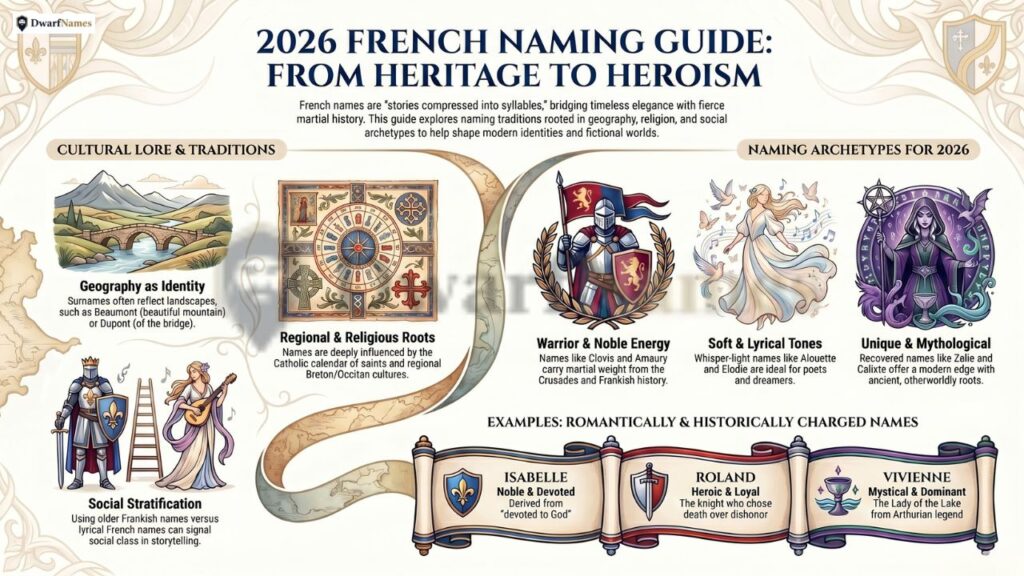
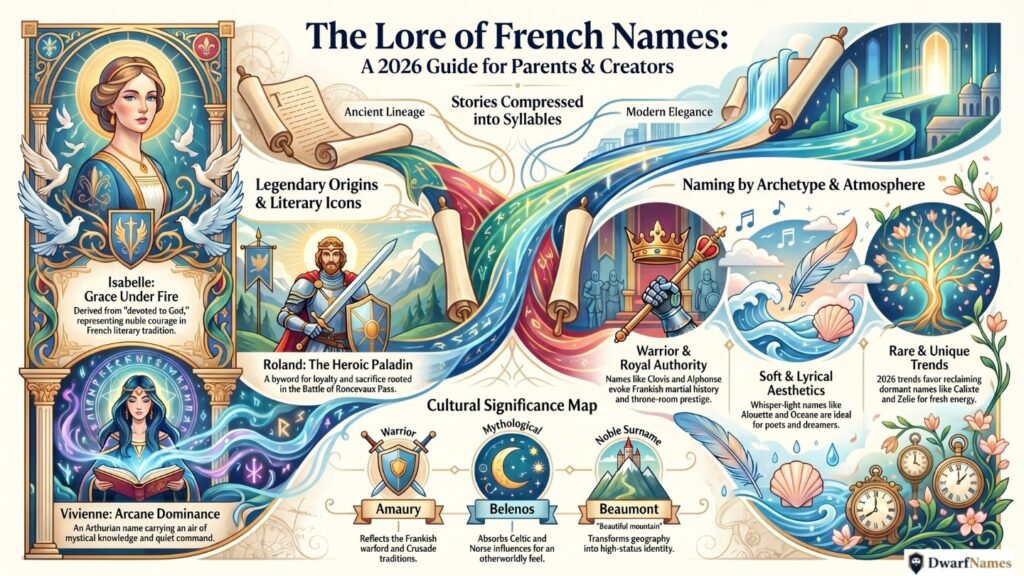
Isabelle is perhaps the most romantically charged name in French literary tradition. Derived from the Hebrew Elisheba, meaning “devoted to God,” it became quintessentially French through centuries of noble use. In countless tales, Isabelle is the noblewoman whose quiet courage outlasts the loudest swords. She is grace under fire.
Roland is the name that echoes through the most celebrated French epic, La Chanson de Roland. He is the knight who chose death over dishonor at the Battle of Roncevaux Pass. His name became a byword for loyalty and heroic sacrifice. In any fantasy setting, Roland is the paladin who never retreats.
Vivienne comes straight out of Arthurian legend, the Lady of the Lake who raised Lancelot and later imprisoned Merlin. The name feels mystical and commanding in equal measure, and it has never once felt old-fashioned. To this day, Vivienne carries an air of arcane knowledge and quiet dominance.
Gaston brings a different kind of energy. Famous as a bold, swaggering nobleman in French folklore and later reimagined in popular culture, Gaston is the name of someone who commands every room and knows it. But in older French tradition, the name simply meant “from Gascony,” a province famous for producing headstrong, fearless people.
These famous examples reveal the truth about French names: they are not just sounds. They are stories compressed into syllables, carrying personality, mythology, and meaning that can elevate any character or child who carries them.
Classic Male French Names
The classic French male names have survived centuries because they carry a particular weight. They are names of kings, knights, and scholars. Each one sounds equally at home in a medieval court or a modern nursery.
- Henri
- Louis
- Armand
- Etienne
- Bertrand
- Gilles
- Raoul
- Lucien
- Edouard
- Florian
- Julien
- Maxime
- Olivier
- Bastien
- Adrien
- Clement
- Damien
- Emile
- Felix
- Gauthier
- Herve
- Jerome
- Laurent
- Marcel
- Nathan
- Pascal
- Quentin
- Remy
- Simon
- Tristan
- Valentin
- Victor
- Xavier
- Yves
- Zacharie
- Albert
- Bernard
- Claude
- Denis
- Francois
Classic Female French Names
French female names are legendary for their elegance. These names flow like the Seine, carrying softness and strength in equal measure. Many have graced the pages of history and literature for centuries.
- Amelie
- Celeste
- Delphine
- Eloise
- Fleur
- Genevieve
- Heloise
- Inès
- Josephine
- Laurence
- Margot
- Nathalie
- Odette
- Pauline
- Renée
- Sabine
- Therese
- Valerie
- Yvette
- Adele
- Beatrice
- Camille
- Danielle
- Estelle
- Francoise
- Giselle
- Henriette
- Isabeau
- Jeannette
- Lisette
- Mireille
- Nicole
- Ophelie
- Perrine
- Rosalie
- Sylvie
- Tiphaine
- Violette
- Waleska
- Yolande
Cool and Unique French Names in 2026
Some French names feel ahead of their time no matter what era you encounter them. These are the names with an edge, a spark, something that makes people pause when they hear them. For parents searching for unique French names that stand out in 2026, this list is your starting point.
- Azalée
- Brice
- Calixte
- Davin
- Elowen
- Fantin
- Galaad
- Hyacinthe
- Iskander
- Josse
- Kaolin
- Lazare
- Maëlys
- Narcisse
- Ondine
- Phenix
- Quiara
- Roane
- Solène
- Taliesin
- Urvan
- Veran
- Wistan
- Xavière
- Ysabeau
- Zelie
- Aurèle
- Brieuc
- Cliodna
- Dagomar
Strong and Warrior French Names
France has a warrior tradition stretching from the Frankish warlords through the Crusades and the Napoleonic campaigns. These names carry that martial energy. For fantasy writers building knights, generals, or battle-hardened heroes, these French warrior names are pure gold. They would sit as naturally in a war epic as they would alongside powerful Hindi names in a multicultural fantasy setting.
- Amaury
- Baudouin
- Clovis
- Dreux
- Enguerrand
- Foulques
- Guerric
- Hugues
- Joscelin
- Konan
- Landry
- Mael
- Norgal
- Odon
- Perceval
- Renaud
- Sigbert
- Tancred
- Ulfric
- Vaillant
- Walbert
- Xander
- Yvain
- Zael
- Aldric
- Brenwulf
- Corentyn
- Donat
- Erwan
- Falcon
Royal and Noble French Names
French royalty gave the world some of its most magnificent names. These names belong to throne rooms, grand halls, and family crests. They carry authority in every vowel.
- Alphonse
- Blanche
- Constance
- Dagobert
- Eleanor
- Foulque
- Guilhem
- Hildegarde
- Isabelle
- Jacques
- Katherine
- Leopold
- Mathilde
- Noel
- Oriande
- Philippe
- Richilde
- Sibylle
- Theodore
- Urraque
- Viviane
- Wenceslas
- Yolande
- Adelaide
- Baudoin
- Cecile
- Diane
- Ermengarde
- Felicite
- Guillaume
Soft and Lyrical French Names
Not all French names are martial or grand. Some are whisper-light, musical, and tender. These names feel like spring mornings and candlelit evenings. They are perfect for gentle characters, poets, healers, and dreamers.
- Alouette
- Bijou
- Celine
- Douce
- Elodie
- Fauvette
- Gaëlle
- Hirondelle
- Isolde
- Jolie
- Lalie
- Maëlle
- Niobe
- Oceane
- Prune
- Queline
- Rosanne
- Sylvaine
- Tendre
- Urielle
- Veronique
- Willette
- Yaëlle
- Zephyrine
- Annaëlle
- Beline
- Coralie
- Douceline
- Emmeline
- Floralie
French Names With Mythological Roots
French culture absorbed Roman, Celtic, and Norse mythologies, producing names that feel ancient and otherworldly. These are particularly useful for fantasy worldbuilders constructing gods, oracles, and legendary figures. You can pair these alongside well-crafted school names and institutions when building a fully realized fantasy world.
- Ariel
- Belenos
- Cerunnos
- Druida
- Epona
- Fortuna
- Galiene
- Hesper
- Iolair
- Juventas
- Kerridwen
- Lug
- Mabon
- Nemetona
- Ogmios
- Prisca
- Quirinus
- Rhianna
- Sucellos
- Toutatis
- Urganda
- Vercana
- Witege
- Xandria
- Yseult
- Zalmoxis
- Alesia
- Borvo
- Coventina
- Damona
French Clan Names and Noble House Surnames
In the great tradition of French heraldry, noble families carried surnames that reflected their lands, deeds, and legends. These compound names would work brilliantly as family names, house names, or clan identifiers in any fantasy story.
- Beaumont
- Chateaufort
- Duvalcourt
- Fierreval
- Grandlance
- Hautechamp
- Ironfaucon
- Jadecroix
- Kevalier
- Lioncoeur
- Montbrave
- Noirblason
- Orgueilfort
- Pierrefort
- Quintevalor
- Rougeépée
- Saintelamme
- Tonnechamp
- Urfontaine
- Valclair
- Wildechasse
- Xaintrailles
- Yvermont
- Zelecourt
- Argentval
- Belacour
- Cascaval
- Dragonfeu
- Eaglecrest
- Ferroclair
- Glaisval
- Hautbois
- Ivremont
- Jourdeval
- Kaerfort
The Cultural Lore of French Naming Traditions
French naming is not a casual affair. In centuries past, names were carefully chosen to reflect family lineage, religious devotion, and regional identity. A child from Brittany might receive a Celtic Breton name like Maëlys or Erwan, carrying echoes of an older language and culture that predates French itself. A child from Provence might receive a name shaped by the Occitan troubadour tradition, lyrical and sun-warmed.
The Catholic calendar played an enormous role. Many French children were named after saints whose feast days fell near their birth. This is why names like Therese, Bernard, and Cecile feel so deeply woven into French culture. They are not merely personal names. They are a connection to a sacred calendar shared by millions.
Noble families constructed naming patterns across generations. The eldest son often carried the grandfather’s name. Compound names using Marie or Jean were standard, creating names like Jean-Baptiste or Marie-Claire that function as single units of identity. In fantasy worldbuilding terms, this mirrors the clan naming traditions of dwarves or elves, where a name carries genealogical information in its very structure.
Regional surnames tell stories too. Names beginning with De or Du suggest noble origin, meaning “of” a particular place. Beaumont means “beautiful mountain.” Dupont means “of the bridge.” Valcourt means “of the valley court.” Every noble house surname in France was once a piece of geography transformed into identity.
Modern French naming in 2026 blends all of this heritage with contemporary tastes. Parents today might choose a classic like Louis for its timeless strength, or they might reach for something rarer like Calixte or Zelie, reclaiming old names that fell dormant for generations and bringing them back with fresh energy.
How to Use French Names in Fantasy Worldbuilding
French names are among the most versatile tools in a fantasy writer’s naming arsenal. Because they sit at the crossroads of Latin, Germanic, Celtic, and Norse influences, they feel simultaneously ancient and refined, suitable for kingdoms ranging from sun-drenched Mediterranean empires to fog-wrapped northern realms.
When building a noble fantasy kingdom, consider giving the ruling class French-influenced names (Eloise, Bertrand, Vivienne) while reserving older, harder Frankish names (Clovis, Aldric, Hildegarde) for warrior clans or frontier houses. This creates an instant sense of social stratification through language alone.
For magic users and scholars, lean toward the lyrical and mythological names: Ondine, Phenix, Galaad, Coventina. These names carry an air of arcane learning that needs no further explanation.
For common folk and merchants in your world, the softer, shorter names (Remy, Fleur, Julien, Lisette) feel approachable and warm, grounding the reader in the everyday life of your fictional society.
Conclusion
French names are among the great gifts of European linguistic heritage. Whether you are a parent searching for the perfect name for a child born in 2026, a novelist crafting a character who needs to feel both real and legendary, or a game designer building a kingdom that breathes with cultural authenticity, the names in this guide offer something rare: beauty with substance.
A great name does more than identify. It conjures. It carries mood, history, and personality into a single word. Isabelle feels different from Hilde. Florian sounds different from Falcon. Those differences are not accidents. They are centuries of culture compressed into sound.
Use these names boldly. Let them shape the people and characters you create. A name chosen with care becomes a small act of worldbuilding all on its own, the first story your character tells before they speak a single word.
Frequently Asked Questions
What makes French names unique compared to other European names?
French names blend Latin, Celtic, and Germanic roots, giving them a rare elegance that feels both ancient and effortlessly modern across cultures.
Are French names suitable for fantasy characters and worldbuilding?
Absolutely. French names carry strong historical weight, mythological depth, and lyrical beauty that enrich any fantasy world or fictional character.
Which French names are trending for babies in 2026?
Names like Zelie, Maëlys, Calixte, Solène, and Aurèle are gaining popularity in 2026 for their rare, beautiful sound and deep cultural roots.
How do French noble surnames work in fantasy settings?
French noble surnames often reference geography or virtues. Names like Beaumont or Valclair work perfectly as fantasy house names reflecting power and heritage.
Can French names work for both male and female characters?
Yes. Many French names like Camille, Valentin, and Claude are traditionally used for both genders, offering great flexibility in storytelling.
What are the most classic French names that never go out of style?
Names like Henri, Louis, Eloise, Margot, and Josephine have remained beloved for centuries and continue to feel timeless and elegant in 2026.
How can I combine French names to create unique fantasy character names?
Pair a classic first name with a noble compound surname. Try combinations like Etienne Valclair, Viviane Hautechamp, or Florian Beaumont for instant character depth.