
There is a certain music to Italian names that no other language quite captures. They roll off the tongue like verse from an ancient epic vowel-rich, melodic, and layered with centuries of meaning. Whether you are crafting a Renaissance-era fantasy kingdom, building a noble house for your tabletop RPG campaign, or writing a sweeping historical fiction where power and passion collide beneath sun-drenched vistas, Italian names carry an immediate sense of gravitas, elegance, and drama.
Italian naming culture draws from a deep well: Latin roots, Catholic tradition, regional dialects from Venice to Sicily, and the fierce identity of medieval city-states. A name was never merely a label it was a lineage, a declaration, a fate. The Medicis, the Borgias, the Sforzas their names alone conjured entire worlds of intrigue, betrayal, and brilliance. That kind of naming power translates flawlessly into fantasy.
For writers, gamers, and worldbuilders, Italian names offer something rare: they feel simultaneously ancient and alive. They work equally well for a silver-tongued merchant prince, a warrior of a sunlit coastal empire, a cunning alchemist, or a divine oracle. If you have already explored blood elf names or browsed ethereal naming traditions, Italian names bring a grounded, human grandeur that complements those otherworldly styles beautifully.
This guide is your definitive atlas to trending Italian names organized, lore-enriched, and ready to inspire your next great character.
Famous Italian Names From Literature & Games
Before diving into the lists, it is worth pausing on a few legendary examples that show how powerfully a name can shape a character’s identity.
Lorenzo — Inspired by Lorenzo de’ Medici, the Magnificent, this name conjures a man of vast intellect, cultural patronage, and ruthless political genius. In fantasy, a Lorenzo commands rooms, brokers alliances, and always seems to know more than he reveals.
Beatrice — Immortalized by Dante as his guide through the heavens in The Divine Comedy, Beatrice is a name wrapped in spiritual light and unattainable grace. For a healer, a prophetess, or a celestial being in your world, few names carry more poetic weight.
Cesare — Derived from Caesar and made infamous by Cesare Borgia, this name drips with ambition, charisma, and danger. A Cesare in your story is never just a soldier he is a force of nature wearing a charming smile.
Fiora — Used memorably in the world of competitive gaming and fantasy card art, Fiora embodies the disciplined, aristocratic duelist archetype. Swift, precise, and proud, the name feels like the flash of a rapier in candlelight.
Male Italian Fantasy Names
These names carry the weight of stone towers, merchant fleets, and papal courts. They are names for lords, scholars, warriors, and wanderers.
- Alessandro
- Aurelio
- Benedetto
- Calogero
- Dante
- Emanuele
- Fabrizio
- Giancarlo
- Leandro
- Marcello
- Niccolò
- Orazio
- Pierluigi
- Quintino
- Renato
- Salvatore
- Teodoro
- Umberto
- Valentino
- Aldo
- Brando
- Costantino
- Demetrio
- Ferrante
- Galeazzo
- Ippolito
- Lazzaro
- Matteo
- Nereo
- Ottavio
- Pasquale
- Roberto
- Serafino
- Taddeo
- Valerio
- Zeffiro
- Amerigo
- Bernardo
- Ciro
- Donato
Female Italian Fantasy Names
Feminine Italian names carry a lilting, lyrical quality ideal for noblewomen, sorceresses, saints, and queens who bend the world to their will.
- Adriana
- Allegra
- Bianca
- Camilla
- Donatella
- Eleonora
- Fiamma
- Ginevra
- Isadora
- Lavinia
- Maddalena
- Nicoletta
- Ornella
- Primavera
- Quintessa
- Rossella
- Seraphina
- Teodora
- Ursula
- Viola
- Agnese
- Brunella
- Chiara
- Diamante
- Elettra
- Fiorenza
- Grazia
- Ilaria
- Leonora
- Mirella
- Nadia
- Ottavia
- Palma
- Raffaella
- Simonetta
- Tiziana
- Valentina
- Wanda
- Zelinda
- Arabella
Cool & Unique Italian Fantasy Names
These are the names that stop readers mid-sentence unusual enough to feel fantastical, yet anchored in real Italian phonetic tradition. Writers building worlds that echo the style of DnD half-elf names will find these especially complementary for mixed-heritage characters.
- Altavilla
- Braccio
- Caravaggio
- Dolfin
- Evaristo
- Falconieri
- Grimalda
- Hadriano
- Imperia
- Jandolo
- Lavarello
- Melisenda
- Novello
- Oberto
- Peverelli
- Quercino
- Ridolfo
- Scaligero
- Tornabuoni
- Ulpiano
- Veronelli
- Wandelino
- Xantippo
- Ysolda
- Zagabria
- Arlotto
- Balestrieri
- Cervolini
- Dragonetti
- Ferruccio
Warrior & Badass Italian Names
For characters who carry swords and earn their names on battlefields, in arenas, or through sheer unstoppable will. These names feel hardened, commanding, and dangerous.
- Azzo
- Bonifacio
- Corrado
- Diago
- Errico
- Ferrante
- Gismondo
- Horatio
- Italo
- Lamberto
- Manfredi
- Nardo
- Ottone
- Prudenzio
- Rainaldo
- Sigismondo
- Tancredi
- Uberto
- Vitale
- Zaccaria
- Arnaldo
- Bertrando
- Coriolano
- Drago
- Enrico
- Fulco
- Grimaldo
- Ingelberto
- Leobruno
- Marzio
Royal & Noble Italian Names
Crowns, gilded halls, and the scent of old power — these names were forged to sit above thrones and pass through generations like heirlooms. Fans of worldbuilding who also love the stately gravitas of Norse god names will find a similar mythic grandeur in this collection.
- Alphonso
- Borromeo
- Carlotta
- Duchess Valeria
- Emilio
- Filiberto
- Galeotto
- Henrietta
- Isabella
- Jacopo
- Livia
- Massimiliano
- Nicolò
- Ottaviano
- Pia
- Raniero
- Saveria
- Tristano
- Ugolino
- Vincenza
- Arcangela
- Beatrix
- Costanza
- Diodata
- Elisa
- Ferdinando
- Gaspara
- Incoronata
- Leonessa
- Margherita
Traditional & Classic Italian Names
These are the names that never fade — rooted in saints’ calendars, Roman lineages, and village churches. They feel timeless because they are.
- Andrea
- Bruno
- Carlo
- Dino
- Elena
- Franco
- Giorgio
- Luigi
- Marco
- Nino
- Piero
- Rosaria
- Stefano
- Teresa
- Ugo
- Vittorio
- Angelo
- Claudia
- Elia
- Federica
- Giovanni
- Irene
- Luca
- Maria
- Nunzia
- Olga
- Paolo
- Quirino
- Regina
- Silvio
Italian Cultural Naming Traditions — The Lore Behind the Names
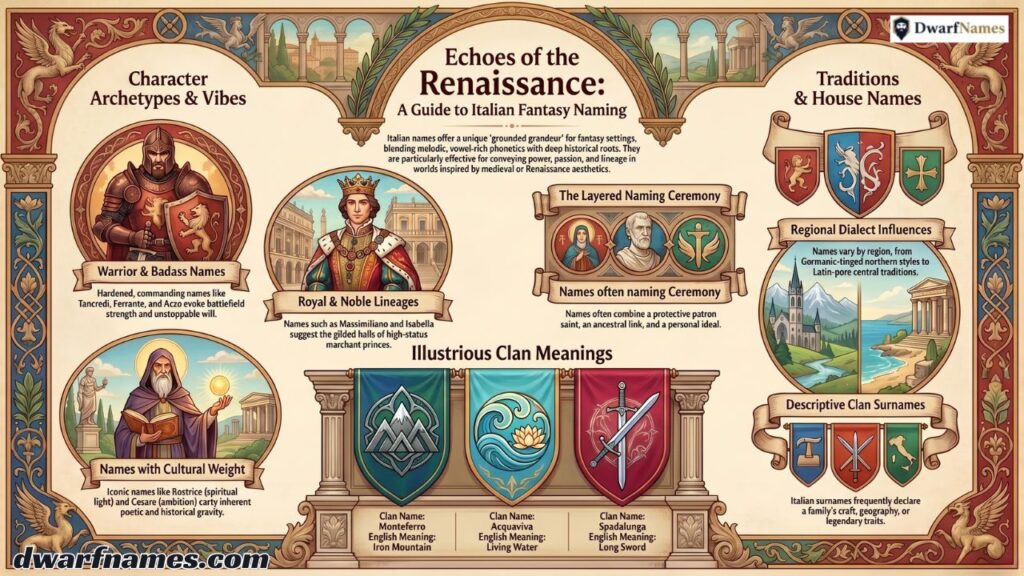
In the great city-states of the fantasy Italian world, names are not chosen lightly. A child receives their name through a layered ceremony: the patron saint’s name first, as protection and spiritual anchor; then the grandfather’s name, as a chain linking generations; and finally a personal name chosen for the quality the family hopes the child will embody — Grazia for grace, Fortino for strength, Sereno for tranquility.
Noble houses carry the tradition even further. A firstborn son bears his father’s name with a Roman numeral, but a second son is named for an ideal — Ardente (ardent), Valoroso (valorous), Luminoso (luminous). Daughters of high houses are often named for gems, virtues, or flowers, as if the name itself were a dowry.
In the rough coastal regions and fishing villages of the fantasy Italian world, names are compressed, affectionate, and blunt. Salvatore becomes Tore. Bartolomeo becomes Meo. Even the fiercest warrior-lords go by the short form among family — a reminder that behind the armor, there is a person someone once rocked to sleep.
Regional identity shapes names heavily. Northern families favor Germanic-tinged names like Lamberto, Gisella, and Brunhilde — remnants of the Lombard invasions. Southern families, particularly in Sicily, carry echoes of Japanese names and Arabic phonetics in their oldest bloodlines, producing unusual clusters like Calogero, Agata, and Zosima. In the mountainous center, Latin purity dominates: Tiberio, Flavia, Octavian.
Naming in the fantasy Italian tradition is also tied to occupation over generations. A family of sword-makers might pass the name Ferràcio (iron-hard) through five generations. A line of physicians might honor Salvo (salvation) in their male heirs. A family of scholars favors Clemente (merciful, learned) as a generational constant.
Italian Clan Names & Noble House Surnames
One of the most distinctive features of the Italian naming tradition is the surname — a declaration of clan, craft, geography, or ancestor. These compound and evocative house names are perfect for great families in your fantasy world. Writers building brutal half-blood characters with layered heritage may also want to compare these against DnD half-orc names for interesting contrasts in naming philosophy.
- Acquaviva (Living Water)
- Baldovino (Bold friend)
- Castiglione (Castle Town)
- Dellacroce (Of the Cross)
- Ercolani (Of Hercules)
- Falconbridge (Falcon Bridge)
- Gattamelata (Honey Cat)
- Hauteville (High Town)
- Ironmantle
- Jettatura (Evil Eye — cursed lineage)
- Kinglancer
- Lampedusa (Lamp Island)
- Monteferro (Iron Mountain)
- Nardoverde (Dark Green)
- Oltramare (Beyond the Sea)
- Pallavicini (Pale Victory)
- Querciaforte (Strong Oak)
- Rovereto (Little Oak Grove)
- Spadalunga (Long Sword)
- Terracina (Clay-Born)
- Umbriaco (Shadow-Touched)
- Valorosi (The Valorous)
- Warbanner
- Xaverino (New House)
- Zanniboni (Good Tooth — fierce biters in war)
- Aldobrandi (Old Brand — ancient flame)
- Bentivogli (We Mean Well — ironic noble house)
- Colonna (The Column — pillars of empire)
- Dragonara (Dragon’s Lair)
- Ferrara-Visconti (Iron & Serpent — merged houses)
- Guelfi (Wolf-Pack Loyalists)
- Halfspear
- Ironveil
- Jelloverde (Jealous Green)
- Kingsbane
- Lancebreaker
- Montecassino (Mountain Fortress)
- Northmantello
- Occhiobello (Beautiful Eye — seers)
- Perugino (City of Wings)
- Quaresima (Lent-Born — those born in sacrifice)
- Ravennate (Of the Raven)
- Sandstone
- Torchbearer
- Ulivo (The Olive Tree — peacekeepers)
- Vespertino (Evening-Born)
- Windveil
- Xenocrates (Foreign Power)
- Yronforge
- Zelante (The Zealous)
Conclusion
A name is the first gift you give a character — and in the Italian tradition, it is also a prophecy, a legacy, and a declaration of self. Whether your story is set in a sun-gilded Renaissance city, a volcanic island kingdom ruled by merchant-princes, or a frozen northern duchy where Latin prayers still echo in the cathedral vaults, Italian names bring an unmatched combination of beauty, weight, and meaning.
The names in this guide span the full spectrum of Italian naming culture — from the martial thunder of Tancredi and Ferrante to the ethereal grace of Seraphina and Allegra, from ancient clan surnames like Colonna and Monteferro to the wildly inventive compound names that will make your noble houses feel truly alive. Just as those who build layered, multicultural worlds often draw from traditions as diverse as Hawaiian names or Japanese god names to add depth and contrast, Italian names serve as a rich and versatile foundation that pairs beautifully with almost any fantasy setting.
Use them boldly. Let your Lorenzo plot in candlelight, your Valentina command fleets, your House Monteferro rise or fall in fire and glory. The right name does not just identify a character — it conjures them into existence.
Your world is waiting. Name it accordingly.
Frequently Asked Questions
What makes Italian names ideal for fantasy worldbuilding?
Italian names blend Latin roots, melodic vowel sounds, and rich historical connotations, making them perfect for worldbuilding where elegance, power, and cultural depth matter most.
Are Italian fantasy names suitable for RPG characters?
Absolutely. Italian names work brilliantly across RPG classes — from noble paladins to cunning rogues — giving characters an instantly recognizable, memorable identity at the table.
What are the most popular trending Italian names for male characters?
Alessandro, Dante, Leandro, Tancredi, and Matteo consistently trend as top choices for male Italian fantasy characters due to their strong, versatile phonetic appeal.
Can Italian surnames be used as fantasy clan or house names?
Yes. Italian surnames like Colonna, Monteferro, and Dragonara function as excellent fantasy house names, conveying lineage, geography, and personality in a single striking word.
How do I choose the right Italian name for my fantasy character?
Match the name’s phonetic energy to the character’s role — sharp, hard names for warriors; flowing, vowel-rich names for healers and nobles; compressed nicknames for street-level or regional characters.
Do Italian names work in non-Renaissance fantasy settings?
Yes. Italian names adapt well across settings — ancient empires, coastal seafaring kingdoms, dark gothic cities, or sun-drenched Mediterranean-inspired worlds all welcome them naturally.
Where can I find more fantasy name inspiration beyond Italian names?
Explore culturally rich traditions like Norse mythology, Japanese mythology, or hybrid fantasy races to build a diverse, immersive naming system for your world.