
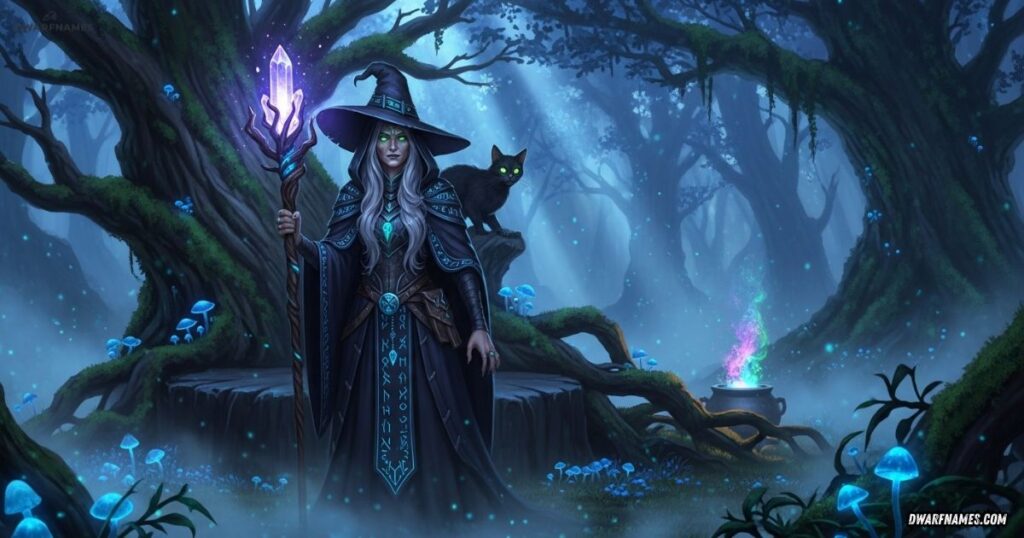

There is a particular kind of magic that lives inside a name. Not the ordinary magic of labels and titles, but something older—something that hums with intent and crackles with hidden power. When a witch speaks her name, the air shifts, subtle yet undeniable. When she writes it, the ink seems to breathe, as if aware of the power it carries.
Across fantasy traditions, from ancient folklore whispered around fires to modern tabletop campaigns filled with dice and destiny, the witch stands apart. She is not defined by spells alone, but by the mystery and gravity of her identity.
Witches remain some of storytelling’s most enduring figures. They appear as wise women at the forest’s edge, shadowy queens murmuring curses into candle smoke, or solitary hedge witches trading in roots, secrets, and ravens.
Some walk in darkness, others drift between light and shadow, but all carry a legacy shaped by names layered with meaning. From ancient myths to modern fantasy fiction, the witch archetype endures because it reflects something deeply human—power that challenges rules, bends fate, and refuses to be confined.
Famous Witch Names From Literature & Games
Before we dive into the lists, it’s worth pausing at the altar of inspiration. The most iconic witch names in fiction didn’t arrive by accident—they were crafted with intention, and studying them tells us something vital about the art of naming.
Morgana le Fay — Perhaps the most legendary witch name in Western tradition, Morgana (or Morgan le Fay) from Arthurian legend is a masterclass in how a name can hold contradictions. “Morgana” derives from Celtic roots suggesting “sea circle” or “great queen,” while “le Fay” marks her as fae-touched, otherworldly. Her name is liquid and beautiful, yet it masks a calculating mind. She is villain, healer, and tragic figure all at once, and her name invites all three readings simultaneously.
Baba Yaga — From Slavic folklore, Baba Yaga is perhaps the most tonally perfect witch name ever spoken aloud. “Baba” means old woman or grandmother, while “Yaga” may derive from words meaning horror, illness, or serpent. The name is blunt, guttural, and utterly uncompromising—perfectly matching the character of a wild old crone who lives in a house on chicken legs and may eat you or help you, depending entirely on her mood. It teaches us that the best witch names don’t explain themselves; they simply are.
Elphaba (from Wicked by Gregory Maguire) — Named as a phonetic tribute to L. Frank Baum’s initials (L.F.B.), Elphaba is the original Wicked Witch of the West reimagined as a passionate, misunderstood idealist. The name sounds like something between “elfin” and “fable,” giving it a slightly magical, slightly mournful quality that suits her story perfectly. It shows how invented names can carry emotional resonance when they sound like something we almost recognize.
Flemeth (from Dragon Age) — The Witch of the Wilds from BioWare’s beloved RPG series carries a name that is ancient and cold, with hard consonants that bite. Flemeth is centuries old, terrifyingly powerful, and utterly inscrutable. Her name sounds like a language older than any spoken by humans, which is precisely the point. For worldbuilders designing elder witches or figures of ancient, cosmic-level power, this naming approach—names that feel pre-linguistic—is extraordinarily effective.
Female Witch Names
These are the names most naturally associated with the witch archetype across fantasy traditions. They range from softly mystical to darkly commanding, suited for healers, hexers, seers, and sorceresses alike.
- Morvaine
- Thessaly
- Calyx
- Seraphel
- Vexara
- Noctis
- Aelindra
- Morrigan
- Sybilline
- Hestara
- Ravenna
- Isolde
- Calista
- Nyxara
- Vyndara
- Wrenith
- Selvara
- Caelith
- Thessara
- Mordechai
- Briarwyn
- Lycanthe
- Velindra
- Ashara
- Malvara
- Thessindra
- Corvinna
- Nightshade
- Silvreth
- Morwenna
- Thessaly
- Dariya
- Halowyn
- Zephyra
- Umbral
- Mireille
- Calinda
- Vexith
- Selenith
- Ysabel
- Lunara
- Caerwyn
- Threnody
- Noxara
- Velantha
Male Witch Names
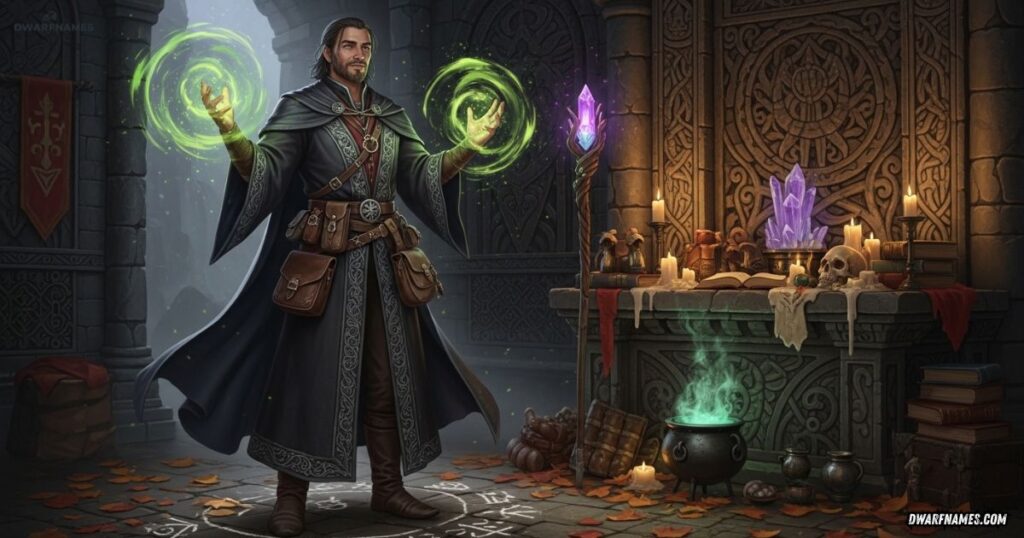
Male witches—sometimes called warlocks, hexers, or simply witches depending on tradition—carry names with equal gravity and mystique. These names suit sorcerers, hedge wizards, and practitioners of the old ways.
- Mordrek
- Caulden
- Vespar
- Aethor
- Grimveil
- Caldrix
- Hexan
- Dravoss
- Myrkon
- Velanthor
- Ashbane
- Thornvex
- Serevyn
- Caelvorn
- Duskrath
- Hexfar
- Morkath
- Noctrel
- Selvorn
- Vaundrel
- Ashkarn
- Calvrex
- Thorindel
- Vyreth
- Drakonis
- Mordhelm
- Cauldren
- Hexvorn
- Serathis
- Noxvel
- Umbrath
- Mirekar
- Ashvorn
- Caeldrex
- Velixar
- Thornrath
- Mordivex
- Duskvarn
- Rythex
- Hexalorn
Cool & Unique Witch Names
For those seeking something beyond the familiar archetypes—names that feel fresh, evocative, and genuinely original. These are the names that linger in the mind like smoke after a spell.
- Velarix
- Thornmere
- Ashcinder
- Solvaine
- Myrellith
- Hexvara
- Caldrith
- Noctivyne
- Velundra
- Sybiloth
- Ashthorn
- Selendrith
- Mirkova
- Vexalind
- Caelraith
- Thornveil
- Ashenwren
- Moriventis
- Duskvelith
- Hexelorn
- Silvenvane
- Caldenwych
- Noxvelith
- Wyrmara
- Umbravex
- Thornalind
- Solvindra
- Morvelith
- Caelindor
- Ashevorne
- Hexilara
- Velinthos
- Dreadmere
- Noctivale
- Calindrix
- Myrenvex
- Thornalith
- Ashverith
- Solvexara
- Lunindra
These kinds of distinctive names sit beautifully alongside other mystical archetypes—if you’re building a rich fantasy world, browsing dark elf names or demon names can spark additional inspiration for naming the magical denizens of your world.
Dark & Sinister Witch Names
Not all witches walk a neutral path. These names belong to the ones who embrace shadow, who trade in hexes and damnation, who are the thing that parents warn their children about. Perfect for antagonists, cursed figures, and morally complex villains.
- Malefica
- Vexmourne
- Dreadwyn
- Hexara
- Malverath
- Ashvex
- Nightmara
- Cruciavel
- Mordanthis
- Shadowveil
- Darkcalyx
- Hexmourne
- Dreadvelith
- Soulmara
- Blightwyn
- Cursevaine
- Hexeldra
- Doomvelith
- Vexmara
- Nightvex
- Mournindra
- Blightvex
- Hexaldrix
- Darkvela
- Souldrix
- Ashenmourne
- Cruciavex
- Dreadnoctis
- Malvorith
- Hexeldrix
Wise Woman & Hedge Witch Names
These names belong to the quiet practitioners—the herbalists, the seers, the village wise women who heal as often as they hex. They have earthy, grounded tones with a thread of mystery running beneath the surface.
- Briarwick
- Mossara
- Willowend
- Fernvale
- Rootmere
- Thicketwyn
- Hollowood
- Dawnveil
- Larkspur
- Thistlevyne
- Heathern
- Cloverith
- Moonwhisper
- Morningveil
- Yarrowith
- Murmurbrook
- Ashenwillow
- Elderwick
- Frostmoss
- Heronvale
- Siltsara
- Dewveil
- Thornwick
- Fernalind
- Ashmeadow
- Hazelborne
- Reedvale
- Stonemark
- Marjorath
- Briarend
These earthy, nature-connected names share a spiritual kinship with druid names, which lean into similar themes of natural magic and ancient wisdom.
Royal & High Coven Witch Names
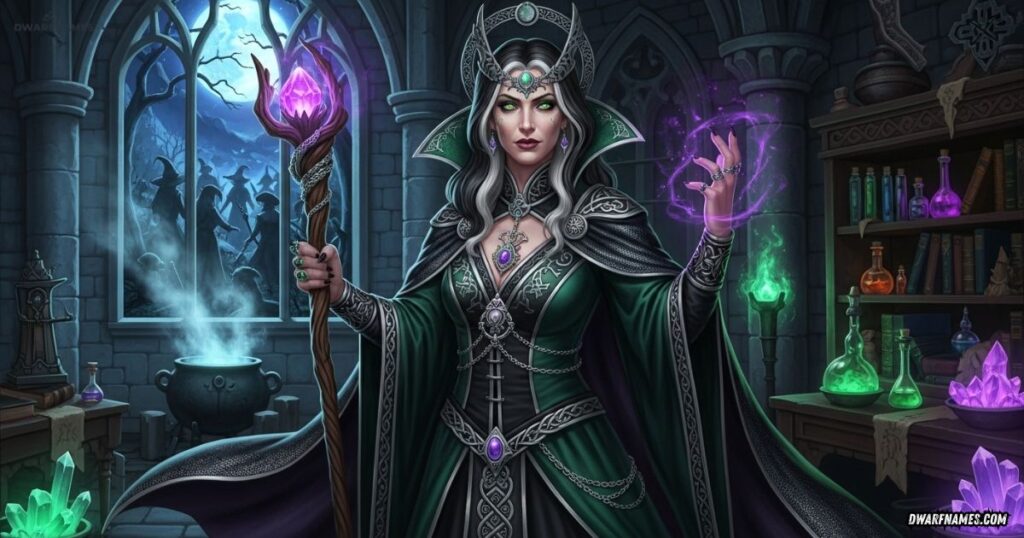
Witches in positions of power—coven leaders, queens of the night, mistresses of grand magical orders—require names that carry authority and grandeur.
- Sovereign Morrith
- Vexlindra the Elder
- Noctaress
- High Calyx
- Archmorrith
- Grandvexara
- Selenqueen
- Noctress Vael
- Exalted Morvaine
- Thornregent
- Duskmistress
- Ashqueen
- Hexdominion
- Velindra Prime
- Caelvareth
- Grandveil
- Morningthorn
- Selenarch
- Noctborn Ara
- Veliqueen
- Ashthrone
- Hexregent
- Caeldominion
- Thornprime
- Morvelara
For those building entire fantasy kingdoms where witches hold political power, pairing these names with kingdom names or world names can help create a fully realized setting.
The Lore of Witch Naming Traditions
How Witches Choose Their Names
In most fantasy traditions, a witch’s name is not simply given at birth. It is earned, discovered, or bestowed by the craft itself. The naming customs vary by tradition, and worldbuilders can use these to deepen their lore.
The Oath Name — When a witch formally enters a coven or completes her initiation, she takes a new name. This name is chosen to reflect her magical specialty, her spirit animal, her greatest strength, or her deepest fear conquered. It is considered more true than her birth name—more real, more permanent.
The Hidden Name — In many traditions, a witch’s true name is never spoken aloud. The name given to outsiders is a mask—a speaking name—while the true name is written only in her grimoire and whispered to the moon on the night of her greatest spell. Knowing a witch’s true name grants power over her; this is why she guards it so fiercely.
The Inherited Name — Some witches inherit the names of powerful ancestors, taking them on as both honor and burden. These names carry accumulated magical resonance from every witch who bore them before. In coven traditions, particularly old lineages, the eldest daughter of each generation may bear the same name, creating a chain of identity stretching back centuries.
Coven Names vs. Solitary Names — Coven witches tend toward names that harmonize—they often share phoneme clusters, rhyming elements, or thematic connections (all nature-based, or all celestial, or all derived from ancient languages). Solitary witches, by contrast, choose names that stand alone, that need no harmony because they answer to no one.
The Elements of a Witch’s Name
The most resonant witch names in fantasy tend to draw on a handful of sound categories:
Dark consonants like V, X, and Z carry menace and mystery—Vexara, Hexal, Zyndra all feel inherently magical. Soft consonants like W, L, and M create names that feel older, more mournful—Morvaine, Willowend, Lunara. Hard stops like K, T, and D build names that feel sharp and purposeful—Caldrith, Thornvex, Duskmara.
The best witch names often combine both—a soft opening that sharpens into something harder, like Velvaine or Morindra—reflecting the dual nature of the witch herself: beautiful on the surface, dangerous underneath.
Witch Coven Names & Titles
Every coven has an identity beyond its individual members. These are group names and titles for magical orders, circles, and cabals.
- The Thornveil Circle
- Order of Ashenvane
- The Noctis Covenant
- Sisters of the Moonshroud
- The Hexmourne Sisterhood
- Coven of the Blighted Oak
- The Velindra Conclave
- Circle of Dawnwalkers
- The Shadowwicker Assembly
- Order of Cruciavel
- The Dreadveil Compact
- Circle of Silverthorn
- Sisterhood of the Ashwoven
- The Hexeldra Enclave
- Order of the Nightmere
- Coven of Blightwick
- The Velundra Circle
- Sisters of the Iron Moon
- The Noxvelith Assembly
- Order of Morvaine
- The Thornwick Covenant
- Circle of Ashencrow
- The Duskveil Sisterhood
- Order of Solvaine
- The Hexmara Conclave
- Coven of the Wailing Ash
- The Caelraith Circle
- Sisters of Darkwood
- The Ashvexen Order
- Circle of the Grimoire
Witch Last Names & Surnames
In fantasy settings where witches carry family names or adopted surnames, these compound and evocative options work beautifully:
- Ashborne
- Nighthollow
- Thornveil
- Hexmire
- Duskcroft
- Grimwick
- Shadowmere
- Coldvane
- Raventhorne
- Hexfallow
- Moonshroud
- Ashenwood
- Blighthaven
- Darkhollow
- Thornmire
- Coldvex
- Nightwick
- Hexborne
- Grimshroud
- Ashenthorn
- Moonveil
- Darkwick
- Ravenhollow
- Blightmere
- Coldthorn
- Grimfallow
- Shadowvane
- Nightborne
- Hexhollow
- Darkborn
- Ashenmire
- Thornfallow
- Ravenwick
- Blightborne
- Coldhollow
- Moonshroud
- Grimvane
- Shadowthorn
- Nightfallow
- Hexmere
Witch Name Generator Ideas
For writers and game masters who want to create their own witch names from scratch, understanding the building blocks is essential. Witch names are typically assembled from a handful of evocative components that can be mixed and matched.
Opening syllables that feel magical: Ash-, Cal-, Hex-, Mor-, Noc-, Sel-, Thor-, Vel-, Vex-, Wren-
Middle connectors: -al-, -en-, -in-, -ith-, -or-, -un-, -vel-, -wyn-
Closing syllables: -ara, -ath, -dra, -eth, -ith, -mire, -orn, -rith, -vane, -wyn
Combine freely: Ash + vel + ith = Ashvelith. Cal + or + wyn = Calorwyn. Hex + un + dra = Hexundra.
For even more naming inspiration across different arcane traditions, exploring wizard names reveals how magic-user naming conventions differ across archetypes—while looking at tiefling names or high elf names can show how race and magical heritage influence the sound and structure of names in fantasy worlds.
Witches in the Wider Fantasy World
A witch does not exist in isolation. She is part of a broader tapestry of magic, history, and culture. The names she carries reflect not just her personal power, but the world she inhabits.
In settings where witches coexist with mermaids, their names often share watery, flowing consonants—long vowels and liquid sounds that suggest both worlds. Where witches rule alongside knights, their names become sharper, more formal, carrying the weight of court and political power. In worlds populated by dragons, witches who traffic in draconic magic adopt harder, more ancient sounds—names that feel forged rather than spoken.
The world shapes the name. The name shapes the witch.
This is why dedicated worldbuilders think carefully about the geography, history, and magical ecosystem of their settings before naming their characters. A witch who lives in a frozen tundra won’t have the same naming conventions as one from a sun-baked desert empire. A witch from an ancient noble lineage won’t sound like a self-taught forest hermit. If you’re building your setting from the ground up, resources like country names can help you establish the cultural framework that makes naming feel organic and consistent.
Conclusion: The Magic in the Name
A witch’s name is her first spell.
Before she speaks a single incantation, before she lifts a finger to summon or bind or bless, her name has already done work in the world. It has created expectation, evoked atmosphere, and whispered a hundred small truths to anyone who hears it. In fiction and in games, this power is real—perhaps not magically, but creatively, which in its own way matters just as much.
Whether you’ve found the name you were searching for in these lists, or whether you’ve used these as raw material to forge something entirely your own, the most important thing is this: choose deliberately. Let the name carry weight. Let it reflect who your witch is, what she wants, what she fears, and what makes her unforgettable.
The greatest witches in fantasy—the ones who endure across centuries of storytelling—are remembered by name long after their stories are finished. Morgana. Baba Yaga. Flemeth. Elphaba. Their names are spells cast upon the reader’s imagination, and they never quite wear off.
Your witch deserves the same.
Now go write her into the world. And if you need names for the other magical beings who share her realm, the grimoire doesn’t end here—explore witch names for even more options, or venture into the broader universe of fantasy naming to find exactly what your story needs.
The ink is ready. The candle is lit. The page is waiting.