

The ancient world still breathes. Somewhere between crumbling stone arches and the echo of legions marching across cobblestone roads, the names of Rome endure. These are not merely labels carved into marble monuments. They are identities forged in conquest, piety, honor, and ambition. A Roman name carried a family’s entire legacy, a citizen’s rank in society, and often a prophecy of the life they would lead.
For writers, game masters, and worldbuilders, Roman names offer something irreplaceable: a sense of grounded grandeur. They feel old without feeling alien. They carry weight without feeling clunky. Whether you are crafting an empire-spanning fantasy realm, running a Dungeons and Dragons campaign set in a civilization of proud warriors and cunning senators, or writing a historical epic, the right name transforms a character from a placeholder into a legend.
Roman naming conventions blended personal identity with family heritage and divine meaning. A name was never given lightly. It connected the bearer to ancestors, gods, and destiny all at once. That is why Roman-inspired names remain among the most powerful tools in a fantasy writer’s arsenal. You can explore similar naming depth in cultures like Greek god names, where divinity and identity are equally entwined.
This guide gives you over 250 authentic, immersive, and varied Roman names sorted into every category you need. Male, female, warrior, noble, traditional, unusual — they are all here, ready to breathe life into your next story, campaign, or world.
Famous Roman Names From Literature and Games
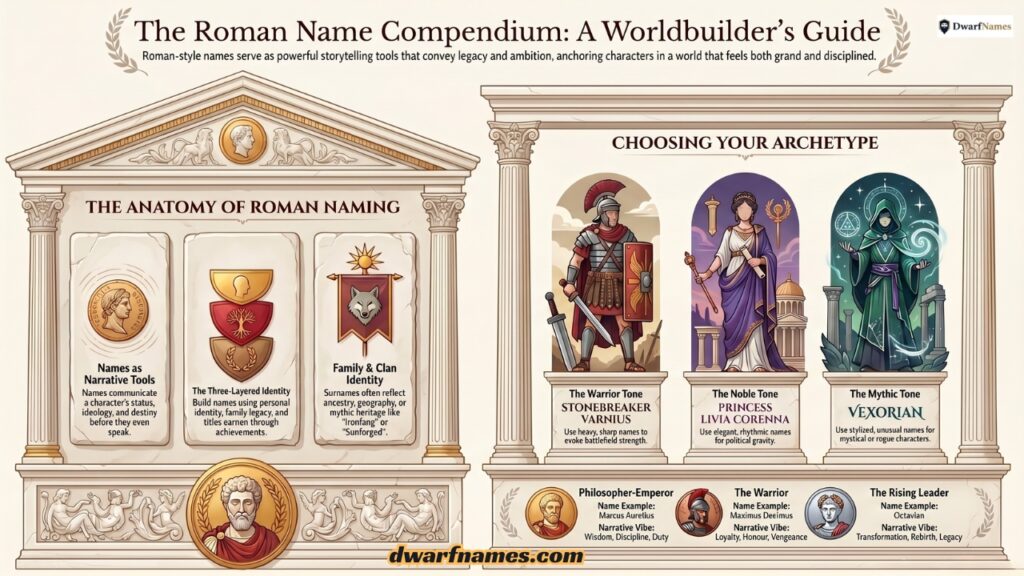
Before diving into the lists, it helps to understand how Roman names function as storytelling tools. A name is never just a sound. It is a signal.
Marcus Aurelius stands as one of history’s most recognized Roman names because it perfectly captures the dual identity of its bearer: Marcus, earthy and common, grounding him among his people; Aurelius, golden and elevated, marking his imperial destiny. In fantasy, a character named Marcus carries the weight of practicality and strength. Add a noble surname and he immediately suggests a general, a governor, a reluctant hero.
Livia Drusilla is a masterclass in quiet menace. Soft in sound, lethal in execution. Fantasy writers often overlook how feminine Roman names carry enormous power. Livia, derived from the Latin for “blue” or “envious,” is the perfect name for a court schemer, a high priestess, or a queen who rules from the shadows.
Julius Caesar — arguably the most famous Roman name ever spoken — shows how a name can become synonymous with a concept. Caesar eventually became a title. In worldbuilding, giving a character a name that sounds like it could evolve into a title is the mark of a legendary figure. Consider how human names across fantasy traditions follow the same principle: the great ones always sound like they were born to lead.
Coriolanus, made immortal by Shakespeare, demonstrates how harsh consonants create a character who feels unyielding and proud. Fantasy warriors and warlords benefit enormously from names that sound like the clanging of armor. His story of pride and exile resonates in any fantasy setting where loyalty and identity are central themes.
Male Roman Names
The Roman male name tradition was built on strength, lineage, and civic duty. These names range from rugged soldiers to philosophical emperors. Each carries a different flavor of Roman masculinity.
- Aemilius
- Agrippa
- Albinus
- Antoninus
- Appius
- Aquila
- Arminius
- Arvina
- Atticus
- Augurinus
- Augustus
- Aurelius
- Balbus
- Bassus
- Bestia
- Brutus
- Caelianus
- Calvinus
- Camillus
- Cassius
- Cato
- Censorinus
- Cicero
- Cincinnatus
- Claudianus
- Clemens
- Constans
- Cordus
- Cornelius
- Corvinus
- Crassus
- Cursor
- Decianus
- Decius
- Drusus
- Fabianus
- Fabricius
- Falco
- Fannius
- Faustus
- Felix
- Festus
- Flaccus
- Flavianus
- Florianus
- Fortunatus
Female Roman Names
Roman women carried names of remarkable beauty and gravity. Many were derived from family names, goddesses, or virtues. These are perfect for queens, oracles, noble ladies, assassins, and high priestesses in your world.
- Aelia
- Aemilia
- Agrippina
- Albina
- Antonia
- Aquilina
- Arria
- Atia
- Aurelia
- Balbina
- Caesonia
- Caelia
- Calpurnia
- Camilla
- Claudia
- Coelia
- Cornelia
- Drusilla
- Fabia
- Fausta
- Faustina
- Felicia
- Flavia
- Florentia
- Fulvia
- Galla
- Gratia
- Hostilia
- Hortensia
- Iulia
- Laelia
- Lavinia
- Licinia
- Livia
- Lucilla
- Lucretia
- Maecia
- Marcia
- Messalina
- Minucia
- Naevia
- Octavia
- Oppia
- Orbiana
- Petronia
- Plautilla
- Pompeia
- Porcia
- Postumia
- Prisca
Cool and Unique Roman Names
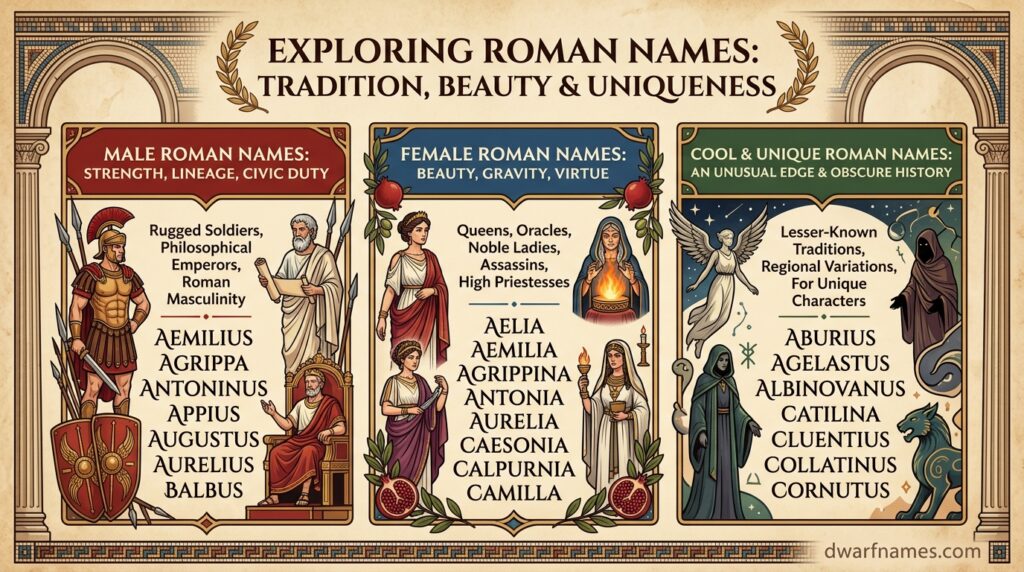
These names carry an unusual edge. Some are less commonly heard, drawn from obscure historical figures, regional variations, or lesser-known Roman traditions. They are ideal for unique fantasy species names or characters meant to stand out from the crowd.
- Aburius
- Acidinus
- Agelastus
- Albinovanus
- Ambivius
- Apronius
- Ardea
- Atratinus
- Aufidianus
- Axianus
- Blaesus
- Brocchus
- Burrus
- Caecina
- Calpetanus
- Camurinus
- Catilina
- Cerrinius
- Cisonius
- Cluentius
- Collatinus
- Cornutus
- Cotta
- Cubitus
- Curio
- Densus
- Dio
- Dives
- Dolabella
- Duilius
- Durmius
- Egnatius
- Ennius
- Eppius
- Erucius
- Escilla
- Etruscus
- Eurysaces
- Exoratus
- Faenius
- Falernianus
- Fimbria
- Firmus
- Fontanus
- Fregellanus
- Fuficius
- Fufidius
- Funisulanus
Warrior and Badass Roman Names
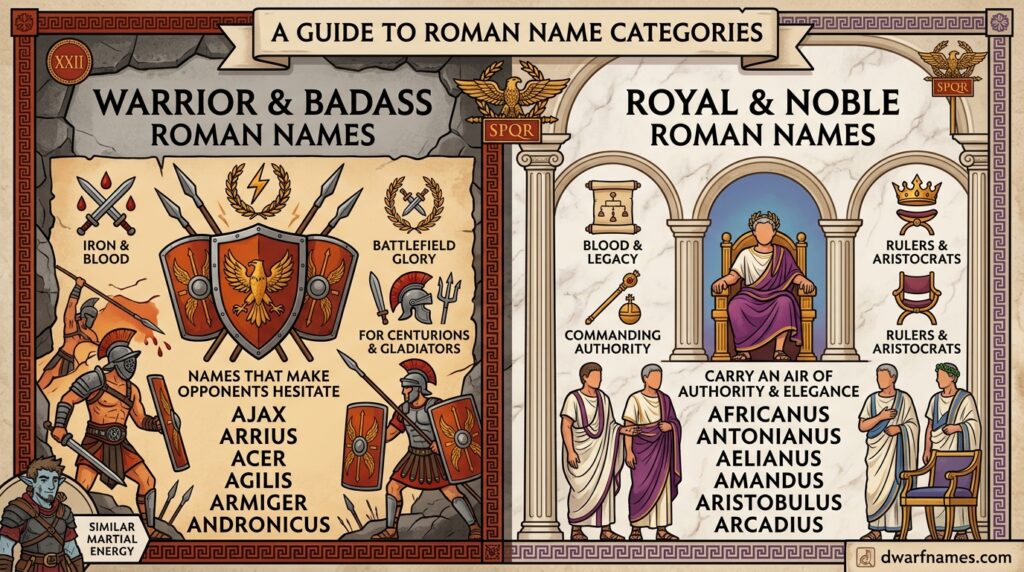
Rome was built on war. These names carry the sound of iron, blood, and battlefield glory. Use them for centurions, gladiators, generals, and any character whose very name should make opponents hesitate. You might find a similar martial energy in DnD Firbolg names when building fearsome warrior characters across different fantasy traditions.
- Acer
- Acratus
- Adversus
- Afer
- Agilis
- Ajax
- Albanus
- Alector
- Andronicus
- Arion
- Armiger
- Arrius
- Arvalis
- Astus
- Ater
- Atropos
- Audax
- Augendus
- Aulus
- Avitus
- Balista
- Barbatus
- Bellator
- Bellicus
- Bestia
- Blaesianus
- Boldus
- Braccatus
- Bravinus
- Breucus
- Brutianus
- Buccinator
- Bulbus
- Burrienus
- Calidus
- Callidus
- Calvus
- Capito
- Capricornus
- Carbunculus
- Carinus
- Carnifex
- Castus
- Catulus
- Celer
- Certus
- Chaerea
- Civis
- Clarus
- Clemens Rex
Royal and Noble Roman Names
Nobility in Rome was a serious matter of blood and legacy. These names belong in throne rooms, senates, and palatial halls. They carry an air of commanding authority while retaining the elegance required of rulers and aristocrats.
- Aelianus
- Africanus
- Albanicus
- Alexandrianus
- Amandus
- Ambiorix
- Amelianus
- Anastasius
- Annianus
- Antonianus
- Aquilianus
- Arcadianus
- Arcelianus
- Aremenianus
- Aristobulus
- Armenianus
- Arrian
- Arvandus
- Asiaticus
- Asinius
- Athenodorus
- Atilianus
- Atilius
- Attalus
- Augustianus
- Aurelianus
- Avianus
- Avienus
- Avitus Rex
- Axiochus
- Baebianus
- Bassianus
- Bestianus
- Blaesianus
- Bobilius
- Bonitus
- Caesarianus
- Caligula
- Callinicus
- Calpurnianus
- Camillianus
- Carausius
- Cascellius
- Cassiodorus
- Castrensis
- Censorianus
- Cerealis
- Chaeremon
- Christodorus
- Chrysanthus
Traditional and Classic Roman Names
These are the foundational names of Roman civilization. They appear on ancient inscriptions, in the histories of Livy and Tacitus, and in the forums of the Eternal City itself. If you want names that feel genuinely classical and timeless, these are your anchor points.
- Aeneas
- Anchises
- Ancus
- Appius
- Brennus
- Caius
- Camillus
- Claudius
- Cnaeus
- Decimus
- Diocletian
- Domitian
- Fabius
- Galba
- Gaius
- Gracchus
- Hadrian
- Horatius
- Hostus
- Jovian
- Julius
- Junius
- Laevinus
- Lepidus
- Lucius
- Macrinus
- Maelius
- Mamercus
- Marcus
- Marius
- Masurius
- Maximus
- Mucius
- Nero
- Nerva
- Numerius
- Opimius
- Otho
- Paullus
- Petronius
- Plautus
- Pompeius
- Postumus
- Publius
- Quintus
- Regulus
- Romulus
- Rufus
- Servius
- Tiberius
Roman Naming Traditions and Cultural Lore
To use Roman names authentically in your worldbuilding, you need to understand how they actually worked. The Romans used a system called the tria nomina, meaning three names, which formed the complete identity of a Roman citizen.
The first name, the praenomen, was the personal name, essentially what we would call a first name today. It was one of a relatively small set of traditional names, and Roman families often recycled the same praenomens across generations. This created deliberate echoes of ancestors in every child named Marcus or Gaius.
The second name, the nomen, was the family or clan name. It indicated which gens, or ancestral family group, the person belonged to. This was their most publicly important name in legal, civic, and social contexts. Names like Julius, Claudius, and Cornelius are nomens they tell you the bearer belongs to the Julii, Claudii, or Cornelii families.
The third name, the cognomen, was an additional identifier, often originally a nickname that described a physical trait, an achievement, or a family branch distinction. Caesar is believed to derive from a word meaning “thick hair” or possibly relating to a cesarean birth. Brutus means “heavy” or “dull.” Scipio means “staff.” These cognomens could become so powerful that they eclipsed the other names entirely.
Women in Rome followed a related but different system. Most Roman women were simply given the feminine form of their father’s nomen. The daughter of a man from the Cornelia gens would simply be called Cornelia. If there were multiple daughters, they might be distinguished as Cornelia Prima and Cornelia Secunda. This simplicity masks the enormous social power Roman women actually wielded. Just as halfling names often reflect the warmth and community of their culture, Roman female names reflected an identity deeply embedded in family and lineage.
For fantasy worldbuilding, this system is extraordinarily useful. You can build an entire aristocratic class simply by creating a set of gens names and then varying the praenomens and cognomens. It immediately gives your world a sense of dynastic depth.
Roman Clan Names and Surnames
The great families of Rome echo through history as much as any individual name. These clan and surname constructs are ideal for noble houses, military legions, or the ruling dynasties of your fantasy empire. Many work beautifully as compound names for houses or organizations in your world.
- Aelius
- Aemilius
- Afranus
- Agrippa
- Albanus
- Albinus
- Alfidius
- Alliarius
- Allobrogicus
- Alpinus
- Altinus
- Ambibulus
- Amerinus
- Amidianus
- Amulius
- Anatolius
- Ancarius
- Andius
- Annalius
- Antistius
- Antonius
- Anulius
- Apicius
- Appalius
- Appuleius
- Aquilius
- Arborius
- Archelaus
- Arienus
- Arminius
- Arrianus
- Arruncius
- Articulejus
- Arvina
- Asconius
- Asinius
- Asper
- Asprenus
- Astius
- Atilius
- Atratinus
- Atrianus
- Atrius
- Attianus
- Audaculus
- Aufidius
- Augurinus
- Augurius
- Auillius
- Aulius
- Auspex
- Autronius
- Avidius
- Avienus
- Avilius
- Avillius
- Avinius
- Axianus
- Axius
Conclusion
Rome endures in names. Long after its legions dissolved and its forums fell to ruin, the names of its citizens continue to inspire writers, worldbuilders, and storytellers. They carry the echo of empire in every syllable.
A well-chosen Roman name does not just label a character. It defines them. It connects them to legacy, to power, to purpose. The senator who schemes in the lamplight, the centurion who bleeds for a cause he no longer believes in, the empress who writes the real laws — they all deserve names that feel worthy of the roles they inhabit.
Whether your story is set in a world of marble and togas or a high fantasy empire of magic and monsters, Roman names give you a foundation of authenticity and grandeur that few other naming traditions can match. They pair beautifully with broader pirate names if you are building a world of seafaring legions, or with divine traditions found among Greek god names when your fantasy pantheon needs names that feel ancient and all-powerful.
The names in this guide are waiting. Give them to your heroes. Give them to your villains. Give them to the quiet clerk who changes the fate of an empire with a single forged document. Let these names carry the weight of history into your world, and your world will feel all the richer for it.
Frequently Asked Questions
What makes Roman names good for fantasy writing?
Roman names carry historical weight, strong phonetics, and layered meaning that instantly convey power, culture, and character depth in any fantasy setting.
Can I use Roman names in a DnD campaign?
Absolutely. Roman names work excellently for human civilizations, noble classes, imperial factions, and warrior characters in any DnD campaign or tabletop RPG.
What is the difference between a praenomen and a cognomen?
The praenomen is a Roman personal first name, while the cognomen is a third distinguishing name, often describing a trait or branch of the family.
Are Roman female names suitable for strong fantasy heroines?
Yes. Names like Cornelia, Livia, Aurelia, and Fulvia carry elegance and strength, perfect for queens, warriors, priestesses, and political masterminds alike.
How do I create a Roman-sounding fantasy name?
Combine Latin roots, use hard consonants like C, R, and X, add classical endings like -us, -ius, -inus for males, and -a, -ia, -ina for females to craft convincing names.
What Roman names work best for villain characters?
Names like Carnifex, Catilina, Nero, Caligula, and Densus carry dark or historically sinister associations that make them ideal for antagonists and morally complex figures.
Do Roman clan names work as fantasy house names?
Perfectly. Names like Cornelius, Aemilius, Antonius, and Arvina function beautifully as great house names, noble family surnames, or the names of powerful military legions.