

There is something quietly powerful about a Japanese surname. It carries the weight of mountains, rivers, seasons, and centuries of tradition. Whether you are a fantasy writer hunting for the perfect name for your protagonist, a game developer building an immersive world, or simply curious about the deep roots of Japanese naming culture, surnames from Japan offer a treasure trove unlike any other. They are not merely labels. They are stories compressed into two or three syllables, whispering of ancestral lands, noble houses, and the natural world.
Japanese last names have a layered beauty that rewards exploration. Many are composed of kanji characters that evoke vivid imagery: a mountain ridge at dusk, the space between cherry blossoms, the crashing of a waterfall in spring. These are not random combinations. Each name carries intentional meaning, often tied to the geography, occupation, or spiritual beliefs of a family’s ancestors. For a worldbuilder or storyteller, that kind of depth is priceless.
This guide is your definitive atlas of Japanese surnames. We have gathered over 500 names, organized them into themes and categories, and added layers of cultural context and lore that will inspire your next character, clan, kingdom, or adventure. Whether you need something ancient and noble or something cool and modern, you will find it here.
Most Popular Japanese Last Names on FamilyEducation
Before diving into specialized lists, it helps to understand which Japanese surnames are most recognized around the world. These names appear in literature, anime, martial arts history, and fantasy fiction alike. They serve as touchstones for the entire tradition of Japanese naming.
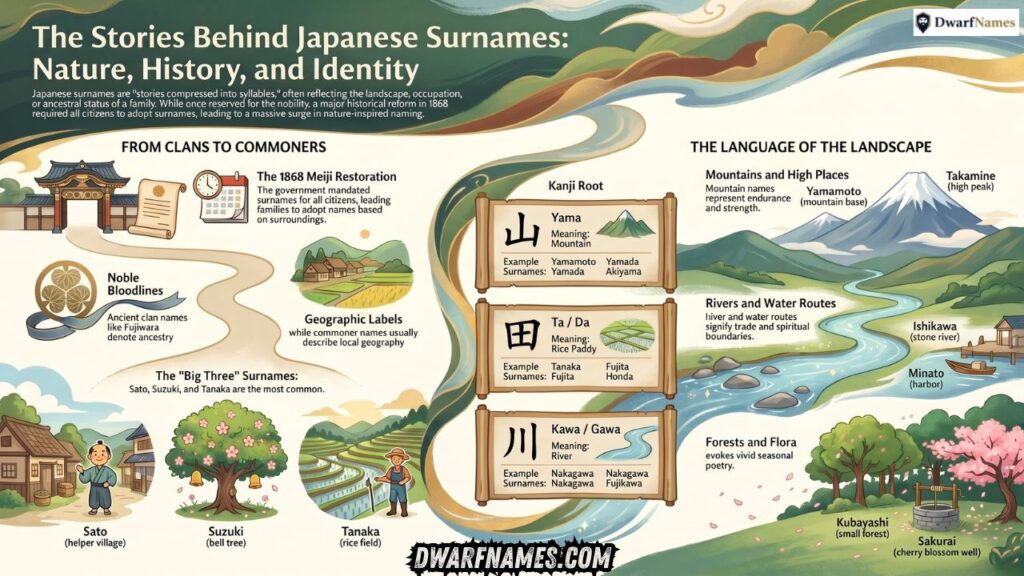
Sato is the single most common Japanese surname, meaning “to help” or “aid village.” Its simplicity belies its prevalence. Suzuki follows close behind, originally linked to the bell tree plant, once used in ancient Shinto rituals. Tanaka means “dweller in the rice fields” and evokes the rural heartland of old Japan. Watanabe translates roughly as “one who crosses the ferry,” painting a picture of ancient river travelers and trade routes.
Ito, Nakamura, Kobayashi, Kato, Yamamoto, and Hayashi round out the most frequently encountered names. Each carries its own visual poetry. Yamamoto means “base of the mountain,” Hayashi means “forest,” and Nakamura places its bearer at the very heart of the village. These names remain timeless anchors for anyone building a world inspired by Japanese culture, much like how British names anchor fiction set in medieval England.
History of Japanese Surnames
For much of Japanese history, only the nobility and samurai class carried hereditary surnames. Common farmers, craftspeople, and merchants were simply known by their given names or the names of their villages. It was not until the Meiji Restoration of 1868 that the Japanese government mandated that every citizen adopt a family surname. This sweeping reform created an extraordinary moment in cultural history. Millions of families, suddenly required to invent or adopt surnames, turned to the landscape around them.
A farmer living near a mountain might take the name Yamada, meaning “mountain rice paddy.” A fisherman on a narrow river might become Hosokawa, meaning “narrow river.” A family dwelling near a bamboo grove might choose Takeda, meaning “bamboo rice field.” The result was an organic tapestry of surnames that reads like a map of old Japan. This naming tradition shares something deep with how Celtic god names drew from nature and myth, encoding identity in landscape and legacy.
Before the Meiji era, clans like the Fujiwara, Minamoto, Taira, and Tachibana held immense power and their surnames carried dynastic weight. These names did not describe physical locations so much as bloodlines and divine ancestry. The Fujiwara, for example, claimed descent from a god of thunder and their name means “wisteria plain,” suggesting both beauty and power.
Common Japanese Surnames and Meanings
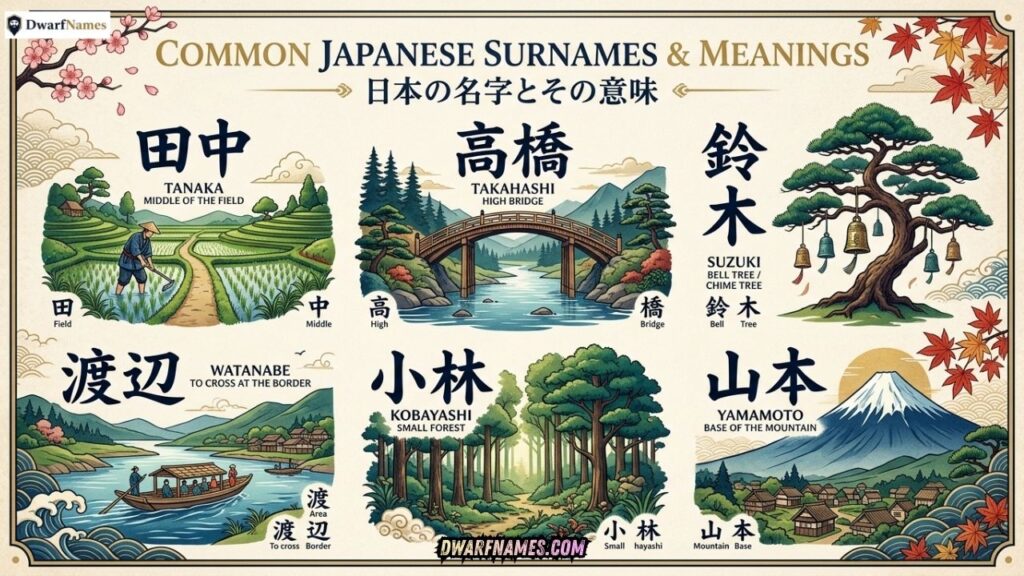
These are the workhorses of Japanese naming, the surnames you will encounter again and again in novels, films, and games. They are worth mastering for any worldbuilder who wants authenticity.
- Sato – One who helps, the helper village
- Suzuki – Bell tree, linked to Shinto ritual
- Tanaka – Dweller in the rice fields
- Watanabe – One who crosses the river
- Ito – Thread, woven legacy
- Yamamoto – Base of the mountain
- Nakamura – Middle of the village
- Kobayashi – Small forest
- Saito – Western aid, ceremonial helper
- Kato – Increasing wisteria
- Yoshida – Lucky rice paddy
- Yamada – Mountain rice paddy
- Sasaki – Helpful tree, shade tree
- Matsumoto – Base of the pine tree
- Inoue – Above the well
- Kimura – Tree village
- Hayashi – Forest dweller
- Shimizu – Clear, pure water
- Yamazaki – Mountain cape, mountain point
- Mori – Forest guardian
- Abe – Peace, comfortable dwelling
- Ikeda – Pond rice paddy
- Hashimoto – Base of the bridge
- Yamashita – Below the mountain
- Ishikawa – Stone river
- Ogawa – Small river
- Goto – Behind the wisteria, going east
- Okamoto – Base of the hill
- Hasegawa – Long swift river
- Fujita – Wisteria rice paddy
Nature Inspired Japanese Surnames
Japan’s deep reverence for the natural world made it inevitable that the landscape would become the primary source of surnames. Mountains, rivers, forests, stones, and seasons gave families their identities. These names feel alive with imagery, perfect for fantasy characters who draw power from the world around them.
Mountain and Sky Names
Mountains hold sacred meaning in Japanese culture. To carry a mountain name is to carry endurance, solitude, and strength.
- Fujiwara – Wisteria plain (Fujiwara clan, ancient nobility)
- Takayama – High mountain
- Moriyama – Forest mountain
- Nishiyama – West mountain
- Kitayama – North mountain
- Yamaguchi – Mountain pass, mountain entrance
- Yamaoka – Mountain hill
- Fujishima – Wisteria island
- Takamine – High peak
- Minami – Southern ridge
- Miyama – Deep mountain
- Kurayama – Dark mountain
- Shiraiyama – White rock mountain
- Kazama – Wind between the peaks
- Kumo – Cloud, one born above the mist
- Arashiyama – Storm mountain
- Iwayama – Stone mountain
- Oshiro – Great white castle rock
- Tsuruyama – Crane mountain
- Kageyama – Shadow mountain
River and Water Names
Water carries memory in Japanese tradition. Rivers were trade routes, spiritual borders, and the veins of civilization.
- Kawamoto – Base of the river
- Nakaizumi – Spring water at the center
- Fujikawa – Wisteria river
- Yoshikawa – Lucky river
- Ishikawa – Stone river
- Nakagawa – Middle river
- Tagawa – Rice paddy river
- Onogawa – Plains river
- Kuroda – Black rice paddy
- Tsuji – Crossroads by the water
- Mizushima – Water island
- Nagata – Long rice paddy
- Shimazaki – Island cape
- Kawakami – Upper river
- Takigawa – Waterfall river
- Shimoda – Below the rice paddy
- Uminaka – Middle of the sea
- Shiotani – Salt valley
- Kaifu – Sea wind
- Minato – Harbor, safe port
Forest and Flora Names
Trees, bamboo, plum blossoms, and ferns wove themselves into family identities across Japan’s mountainous terrain.
- Matsuki – Pine tree spirit
- Fujimoto – Base of the wisteria
- Morishita – Below the forest
- Takahashi – High bridge in the forest
- Umeda – Plum rice paddy
- Hanamura – Flower village
- Sakurai – Cherry blossom well
- Matsubara – Pine plain
- Yanagi – Willow tree
- Takenaka – Inside the bamboo
- Sugiura – Cedar inlet
- Kusunoki – Camphor tree (legendary samurai name)
- Nishimura – West village, vine grove
- Hayashida – Forest rice paddy
- Kusakabe – Grass, open meadow
- Fujinoki – Wisteria tree
- Hanaoka – Flower hill
- Tokinaga – Eternal blossoms, lasting fragrance
- Asagiri – Morning mist through the pines
- Wakaba – Young leaf, new green
Regional Japanese Last Names
Geography shaped identity in ways that still echo today. Families from different provinces developed distinct naming patterns tied to their regional landscapes, dialects, and clan histories.
Names from Eastern Japan (Kanto and Tohoku)
- Edogawa – River of the great bay
- Musashi – Warrior of the plains (historic Kanto region)
- Kamakura – Storehouse of sickles, fortified valley
- Ueno – Above the field
- Kitano – Northern field
- Asakusa – Shallow grass plain
- Sumida – Corner rice paddy
- Funabashi – Bridge of boats
- Makino – Grazing plains
- Togashi – Eastern crossing
- Sendai – Thousand generations, ancient river
- Shirakawa – White river
- Kurosawa – Black swamp (made legendary by the filmmaker)
- Osaki – Great cape
- Furukawa – Old river
Names from Western Japan (Kansai and Chugoku)
- Osaka – Large hill, great slope
- Kyoto – Capital, ancient seat of power
- Namba – Difficult wave, southern wave
- Tanimoto – Base of the valley
- Higashiyama – Eastern mountain
- Nishimoto – Base of the west
- Kawachi – Inside the river
- Arima – Wild horse, mountain horse
- Wakayama – Young mountain
- Fukuda – Lucky rice paddy
- Hiroshi – Wide city, expansive settlement
- Ono – Great plains
- Takamatsu – High pine tree
- Inaba – Rice field in the east
- Sanjo – Third stream
Names from Southern Japan (Kyushu and Okinawa)
- Shimazu – Island harbor (legendary Kyushu clan)
- Kagoshima – Basket island
- Miyazaki – Temple cape, shrine headland
- Nakasone – Middle ridge
- Higa – Prosperous river
- Ginoza – Silver rice paddy
- Toguchi – Door of the shore
- Urasoe – Bay inlet, curved harbor
- Tomigusuku – Wealthy castle
- Maehara – Before the plain, frontier field
- Oshiro – Great castle
- Kinjo – Golden castle
- Shimabukuro – Island black bag
- Tamashiro – Jeweled castle
- Yonamine – Four waves peak
Famous Japanese Names From Literature and Games
Great storytellers have always known that names carry meaning beyond syllables. In Japanese fiction and gaming, surnames often signal character destiny before the story even begins.
Kenshin Himura from the beloved manga Rurouni Kenshin carries a name that tells you everything. Himura means “scarlet village,” evoking blood, sacrifice, and a violent past that haunts a man seeking peace. His name is his wound and his warning.
Mikasa Ackerman from Attack on Titan carries a surname borrowed from a legendary Japanese battleship, suggesting iron, warfare, and unyielding strength. Her first name, Mikasa, means “three bamboo hats,” a humble image at war with her warrior nature.
Gendo Ikari from Neon Genesis Evangelion bears a surname meaning “anchor,” perfect for a man who serves as both tether and tormentor to his son. The weight of that name never feels accidental.
Sasuke Uchiha from Naruto carries a clan name meaning “wisteria leaf place,” which in the world of the series marks a bloodline of flame and tragedy. The contradiction of a gentle flower name attached to a clan defined by fire and betrayal is pure storytelling craft.
For writers building their own worlds, these examples show how a well-chosen surname works like a compressed story. If you are exploring names from other cultural traditions for comparison, Irish names and Welsh names carry similarly layered ancestral meanings worth studying.
Male Japanese Last Names
Strong, resonant, and deeply rooted in tradition, these surnames carry the tone of warriors, scholars, and lords across Japanese history.
- Takeda – Bamboo rice paddy (legendary warlord clan)
- Uesugi – Above the cedar tree
- Tokugawa – Virtue river (shogunate dynasty)
- Imagawa – Present river, living stream
- Hojo – Northern path, northern stripe
- Mori – Forest, primeval guardian
- Shimazu – Island harbor, deep water
- Chosokabe – Long steep hedge
- Otomo – Great companion
- Ukita – Floating rice paddy
- Oda – Woven rice paddy (Oda Nobunaga, the great unifier)
- Toyotomi – Rich harvest
- Ashikaga – Reed footstep
- Hosokawa – Narrow river
- Asakura – Morning storehouse
- Amago – Heaven child
- Satomi – Knowing beauty, wise beauty
- Kitabatake – Northern bamboo
- Ogasawara – Little bamboo plain
- Rokkaku – Six angles, hexagon clan
- Nitta – New rice paddy
- Hatakeyama – Flag mountain
- Tsutsui – Cylinder well
- Yuki – Snowy passage
- Kikkawa – Lucky river
Female Japanese Last Names
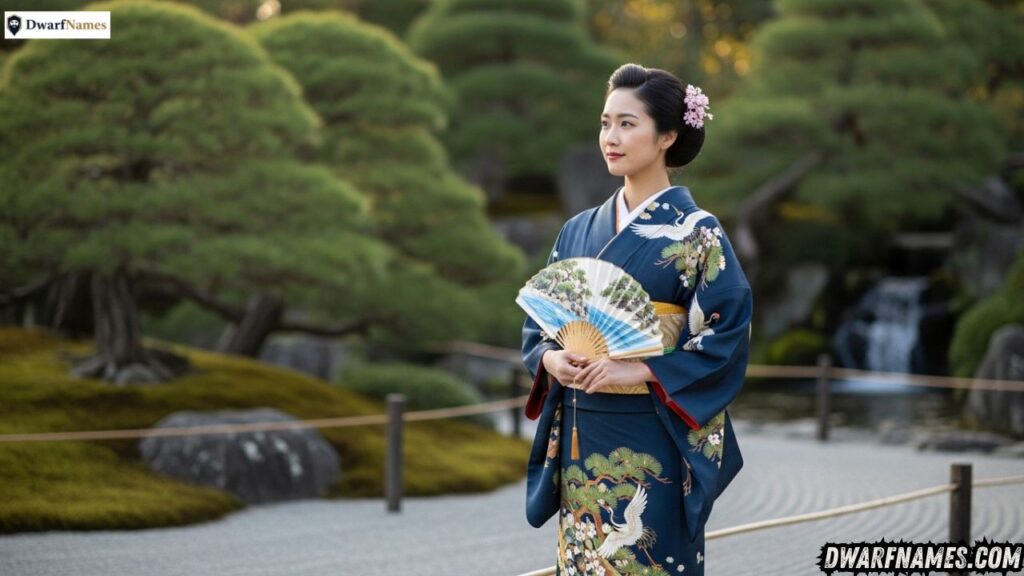
Delicate yet strong, these surnames carry elegance and poetic imagery that suits heroines, scholars, healers, and queens alike.
- Hanabusa – Flower cluster
- Ueno – Above the blessed field
- Akiyama – Autumn mountain
- Shiraishi – White stone
- Minamoto – Origin of water (legendary noble house)
- Asahi – Morning sun
- Harukawa – Spring river
- Miyoshi – Three good things
- Tsukamoto – Base of the moon
- Kagawa – Fragrant river
- Natsumi – Summer beauty
- Hoshino – Field of stars
- Shibata – Brushwood rice paddy
- Tsuruta – Crane rice paddy
- Momoi – Peach well
- Kinoshita – Below the tree
- Yanagida – Willow rice paddy
- Shiratori – White bird
- Fujimori – Wisteria forest
- Makihara – Pasture plain
- Totsuka – Ten hills
- Kubo – Hollow place, deep hollow
- Asano – Morning field
- Sakuraba – Cherry blossom place
- Murase – Village rapids
Cool and Unique Japanese Last Names
These surnames have an edge, a striking quality that makes them memorable on first hearing. They belong to characters who leave an impression.
- Kazuya – Peaceful night, calm celebration
- Kurogane – Black steel, forged iron
- Raiden – Thunder and lightning
- Hayate – Swift wind, cutting breeze
- Kazan – Volcano, fire mountain
- Ryugasaki – Dragon cape
- Kurohane – Black feather
- Tsukishiro – Moon castle
- Kagemi – Shadow beauty
- Shinkuro – New black, reborn darkness
- Fujin – Wind god
- Kamikaze – Divine wind
- Yorozu – Ten thousand things
- Musashi – Warrior of the plains
- Arashi – Storm, tempest
- Genbu – Black tortoise
- Byakko – White tiger
- Seiryu – Azure dragon
- Suzaku – Vermillion bird
- Onryu – Vengeful dragon
- Tengu – Heaven dog, sky demon
- Kaguya – Radiant night
- Rasetsu – Demon warrior
- Muramasa – Village justice (legendary cursed sword maker)
- Kokuryu – Black dragon
Warrior and Samurai Japanese Last Names
For characters who carry the weight of battle, these names resonate with the spirit of the samurai age. They echo through history in tales of loyalty, conflict, and honor.
- Miyamoto – Base of the shrine (Miyamoto Musashi, greatest swordsman)
- Maeda – Front rice paddy (Maeda clan, great daimyo)
- Sanada – Real rice paddy (Sanada Yukimura, legendary warrior)
- Honda – Original rice paddy (Honda Tadakatsu, demonic spear)
- Ii – Good, noble (Ii Naomasa, red devil general)
- Fukushima – Lucky island (Fukushima Masanori, fierce warrior)
- Kato – Increasing valor
- Kuroda – Black rice paddy (Kuroda Kanbei, master strategist)
- Naoe – Straight bay (Naoe Kanetsugu, warrior poet)
- Shingen – Hearts of truth (Takeda Shingen title)
- Kenshin – Sword heart (Uesugi Kenshin title)
- Kamiizumi – Upper spring well (sword school founder)
- Yagyu – Dark willow (Yagyu sword masters)
- Tsukahara – Crane plain (legendary sword school)
- Arima – Wild mountain horse
- Goto – Rear guard, eastern vanguard
- Tachibana – Orange tree (ancient warrior clan)
- Minamoto – Source, origin (warrior noble house)
- Taira – Flat, peaceful (rival warrior house)
- Fujiwara – Wisteria field (most powerful court clan)
Royal and Noble Japanese Last Names
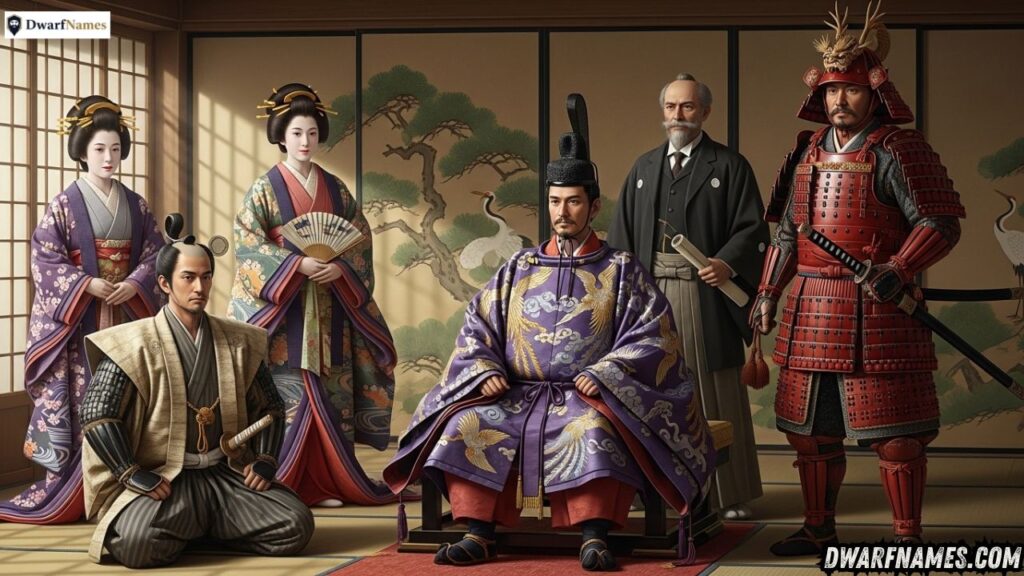
These surnames belong to dynasties, courtiers, and bloodlines that shaped the fate of nations. They carry authority in every syllable.
- Konoe – Before the house (highest court noble family)
- Kujo – Nine temples (Fujiwara branch, court nobles)
- Nijo – Second avenue (imperial noble line)
- Ichijo – First avenue, supreme path
- Saionji – West garden temple
- Tokugawa – Virtue river (shogunate dynasty, 250 years of rule)
- Ashikaga – Reed stride (shogunate before Tokugawa)
- Kamakura – Fortified cliff
- Minamoto – Sacred source, divine origin
- Taira – Great plains, serenity
- Fujiwara – Eternal wisteria, court flower
- Ki – Tree, ancient clan
- Tachibana – Wild orange, divine fruit
- Abe – Ancient peace
- Nakatomi – Middle companion (Shinto ritual clan)
- Otomo – Great companion (ancient court guard)
- Mononobe – Weapon makers, royal armourers
- Soga – Ancient valley
- Kose – Ancient voice
- Kataoka – Shoulder hill, fortress crest
Traditional and Classic Japanese Last Names
These names feel timeless, rooted in the everyday dignity of ordinary Japanese life across many centuries.
- Nishida – West rice paddy
- Ueda – Upper rice paddy
- Fujii – Wisteria well
- Matsuda – Pine tree rice paddy
- Okada – Hillside rice paddy
- Noda – Field of the plains
- Harada – Original rice paddy
- Takahashi – High bridge
- Ishida – Stone rice paddy
- Maruyama – Round mountain
- Shimada – Island rice paddy
- Fuji – Wisteria, everlasting
- Wada – Peaceful rice paddy
- Nakano – Middle plains
- Nomura – Plains village
- Narita – Already rice paddy
- Higuchi – Sun entrance
- Tsuda – Harbor rice paddy
- Suwa – Straight bay
- Yukimura – Snow village
- Kamiya – God house, shrine family
- Otani – Great valley
- Sone – Steep ridge
- Tsuchiya – Earth house
- Kuwahara – Mulberry plain
Japanese Names Inspired by Other Cultures
Japan’s history of contact with China, Korea, Portugal, and the Netherlands left traces in its naming culture. Some Japanese surnames absorbed foreign sounds and meanings, transforming them into something distinctly Japanese.
The influence of Chinese culture runs deepest. Many kanji used in Japanese surnames are borrowed directly from classical Chinese, carrying meanings that overlap with names from Chinese dynasties. Just as Roman god names shaped naming conventions across medieval Europe, Chinese classical culture reshaped East Asian naming traditions for over a millennium.
- Takashima – High island (Chinese kanji reading influence)
- Kanda – Sacred rice paddy (Korean influence in some regions)
- Nanba – Southern wave (Portuguese contact era name)
- Dejima – Protruding island (Dutch contact point)
- Shinra – New Rome (name inspired by Chinese dynastic naming)
- Toranosuke – Tiger helper (Chinese zodiac influence)
- Ryoma – Dragon horse (Chinese cosmological influence)
- Genkai – Limit of darkness (Buddhist Chinese influence)
- Amaterasu – Heaven shining (Shinto, parallel to solar deity traditions)
- Kami – God, spirit (ancient animist tradition)
- Yorimichi – Trust in the path (Chinese philosophical influence)
- Hanzo – Half three (numerological naming from China)
- Koremitsu – Ancient light (Tang dynasty naming echo)
- Tamaoki – Jewel tree (jade tradition from Chinese culture)
- Kenzaburo – Health third son (Chinese generational naming)
Just as Korean names carry deep Confucian and ancestral significance, many Japanese surnames blend native Yamato language with continental scholarly traditions. The intersection is rich territory for worldbuilders imagining cultures at the crossroads of civilizations.
Japanese Naming Traditions and Lore
In the ancient system, names were believed to hold power. To know a person’s true name was, in some traditions, to hold influence over them. This echoes similar beliefs found in Celtic god names and other animist traditions worldwide.
Japanese surnames traditionally come before given names. The family name holds the primary social identity. When a woman married, she typically took her husband’s surname, merging her identity into his clan’s lineage. In recent decades, debate over this tradition has intensified in Japan’s parliament.
Clan names in feudal Japan were fiercely guarded. To be stripped of your surname was to be stripped of your social existence. This is why the phrase “to have a name” meant something profound: it meant you belonged somewhere, to someone, to a history.
Warrior families often chose names that combined natural imagery with martial virtue. A name like Takeda, meaning “bamboo rice paddy,” combined the humble work of farming with the toughness of bamboo, which bends but does not break. Much like how farm names in other traditions encoded the dignity of agricultural life, Japanese surnames linked noble status back to the earth.
Japanese Last Names
- Sato
- Suzuki
- Takahashi
- Tanaka
- Watanabe
- Ito
- Yamamoto
- Nakamura
- Kobayashi
- Kato
- Yoshida
- Yamada
- Sasaki
- Yamaguchi
- Matsumoto
- Inoue
- Kimura
- Hayashi
- Shimizu
- Yamazaki
Japanese Surnames
- Mori
- Ikeda
- Abe
- Hashimoto
- Ishikawa
- Nakajima
- Maeda
- Fujita
- Ogawa
- Goto
- Okada
- Hasegawa
- Murakami
- Kondo
- Ishii
- Saito
- Sakamoto
- Endo
- Fujii
- Aoki
Japanese Last Name
- Nishimura
- Fukuda
- Ota
- Miura
- Takeuchi
- Kaneko
- Nakano
- Harada
- Tamura
- Ueda
- Hirano
- Kinoshita
- Kikuchi
- Matsuda
- Sugiyama
- Shibata
- Sakurai
- Honda
- Takagi
- Furukawa
Japanese Last Names for Girls

- Hanazawa
- Sakuraba
- Mizuno
- Aizawa
- Fujimori
- Hoshikawa
- Midorikawa
- Umegawa
- Kiyokawa
- Yukimori
- Hanamori
- Mizuhara
- Natsuyama
- Yuzukawa
- Wakabayashi
- Takamori
- Shirakawa
- Moriyama
- Kurokawa
- Aoyama
Japanese Family Names
- Minamoto
- Taira
- Fujiwara
- Tachibana
- Ashikaga
- Tokugawa
- Hosokawa
- Shimazu
- Date
- Uesugi
- Takeda
- Morioka
- Chiba
- Ogasawara
- Imagawa
- Kitabatake
- Satake
- Nanbu
- Mogami
- Akamatsu
Japanese Clan Names and Compound Surnames
These compound names read like battle cries and ancient seals. They belong to clans of warriors, mages, wanderers, and lords. Each one carries its own mythology.
- Ironpetal (Tessho) – Clan of the unyielding blossom
- Stormcrest (Arashimine) – Clan of the tempest peak
- Shadowbrook (Kagebayashi) – Clan of the shaded stream
- Stonefang (Iwakiba) – Clan of the rock jaw
- Emberglow (Monohi) – Clan of fading firelight
- Mistwalker (Kirigake) – Clan of those who travel through fog
- Nightheron (Yosagi) – Clan of the nocturnal hunter
- Coldsteel (Kantetsu) – Clan of the frozen blade
- Ashenleaf (Haikoba) – Clan of the burned grove
- Silvertide (Ginchō) – Clan of the silver moon tide
- Dustfire (Jinbo) – Clan of the desert flame
- Thornridge (Ibara) – Clan of the barbed heights
- Wrathwater (Ikari) – Clan of the furious river
- Thunderstone (Raigan) – Clan of the storm rock
- Duskmantle (Tasogare) – Clan of the twilight cape
- Ironbloom (Tetsuhana) – Clan of the forged flower
- Voidwalker (Kūkage) – Clan that walks the empty shadow
- Emberveil (Kayui) – Clan of the smoldering mist
- Crownless (Mukannmuri) – The fallen noble clan
- Galescar (Kazakizu) – Clan marked by the wind
- Moonpiercer (Tsukizashi) – Clan of the lunar blade
- Starweaver (Hoshibori) – Clan that weaves fate through stars
- Coldmantle (Kanmanto) – Clan of the winter cape
- Redstone (Akaishi) – Clan of the crimson rock
- Wolftide (Ōkami) – Clan of the great ocean wolf
- Ashenblade (Haiken) – Clan of the scorched sword
- Nightbloom (Yohana) – Clan of the flower that blooms in darkness
- Ironveil (Tetsukasumi) – Clan hidden behind forged mist
- Stormborn (Arashiko) – Clan born in the tempest
- Embermane (Hinagami) – Clan of the living flame
Conclusion
Names are the first mythology of any world. In Japanese surname tradition, a single word can contain a mountain, a river, a dynasty, and a dream. These are not just labels for people. They are compressed worlds, handed down through generations like sacred objects.
Whether you are crafting the next great fantasy novel, designing a role-playing game with depth and authenticity, or simply searching for a name that feels true, the 500 Japanese last names gathered here offer a universe of possibility. Let the warrior carry a name of iron and stone. Let the healer carry a name of still water and forest shade. Let the villain carry a name that sounds beautiful and conceals something dark.
The right name does not just complete your character. It begins them. Go forth and name your world with intention, with beauty, and with the ancient power that the Japanese people have always known lives inside a surname well chosen.
Frequently Asked Questions
What is the most common Japanese last name?
Sato is the most common Japanese surname, meaning “helpful village.” It is estimated that over two million people in Japan carry this ancient and widespread family name.
Why do Japanese last names often reference nature?
Most Japanese surnames were created during the Meiji era when families chose names based on surrounding landscapes, producing mountain, river, and forest surnames that reflect their ancestral lands.
Can I use Japanese last names for fantasy characters?
Yes, Japanese surnames work beautifully for fantasy characters. Their layered kanji meanings, natural imagery, and warrior clan history make them ideal for immersive worldbuilding and storytelling.
Are Japanese surnames used before or after the first name?
In Japanese tradition, the surname always comes first. The family name precedes the given name, reflecting the cultural value placed on group identity over individual identity.
What Japanese last names mean strength or power?
Names like Takeda (bamboo warrior), Kurogane (black steel), Musashi (plains warrior), and Shimazu (island harbor master) all carry connotations of strength, power, and martial tradition.
Do Japanese clan names still exist today?
Yes, many ancient clan names like Fujiwara, Minamoto, and Taira still exist as family surnames today, though the clans themselves no longer hold political power in modern Japan.
Where can I find more fantasy name inspiration beyond Japanese surnames?
For fantasy worldbuilding, exploring traditions like Welsh names and Irish names can complement Japanese surnames with equally rich mythological and ancestral naming traditions.